Canadian ‘Stimulus’ Targets Carbon Capture & Nuclear

canadian-prime-minister-stephen-harper

Canada’s Conservative government unveiled a budget yesterday with an energy balance distinctly different from that contemplated by President Obama in his economic stimulus package. “Green Causes Left Out of Budget” is how the Toronto-based National Post headlined its coverage of the Canadian budget proposed yesterday. Toronto Star columnist Chantal Hebert writes that environmentalists may be the only “constituency, friendly or hostile to the Conservatives, that will not get a piece of the multibillion-dollar stimulus package.”

Whereas Obama’s $819-billion stimulus package proposes to give renewables a big boost, Prime Minister Stephen Harper’s C$33-billion (US$27-billion) ‘Economic Action Plan’ would leave unchanged Canada’s EcoEnergy support program for renewable energy. Canadian Wind Energy Association president Robert Hornung predicts the program may run out of cash before the end of the coming fiscal year, blunting the industry’s ability to draw investment amidst a superhot U.S. market:

“Our ability to compete with the United States for investment in wind energy projects and manufacturing opportunities will decline as a result of this budget. At a time when the United States has made measures to support renewable energy deployment a key component of its plans to stimulate the US economy, Canada is moving in the opposite direction.”

Continue reading “Canadian ‘Stimulus’ Targets Carbon Capture & Nuclear”

Electric Vehicles Can Cut Power Plant Pollution

Last week we saw that doing right by the environment is more complicated than simply downsizing the carbon footprint. Shifting to soot-free power sources will reduce mortality in cities, we noted, while increased use of variable wind power could jack up emissions of smog-forming NOx from the ‘peaking power’ plants that ramp up and down to balance electrical supply and demand.

Now power grid modelers at the National Renewable Energy Laboratory add another twist to this story with a report that electric vehicles (EVs) plugged into the grid can reduce NOx emissions and possibly more. Their report “Emissions Impacts and Benefits of Plug-In Hybrid Electric Vehicles and Vehicle-to-Grid Services” appears in the January 22 issue of the journal Environmental Science & Technology.

Continue reading “Electric Vehicles Can Cut Power Plant Pollution”

Pushing Geoengineering Out of the Closet

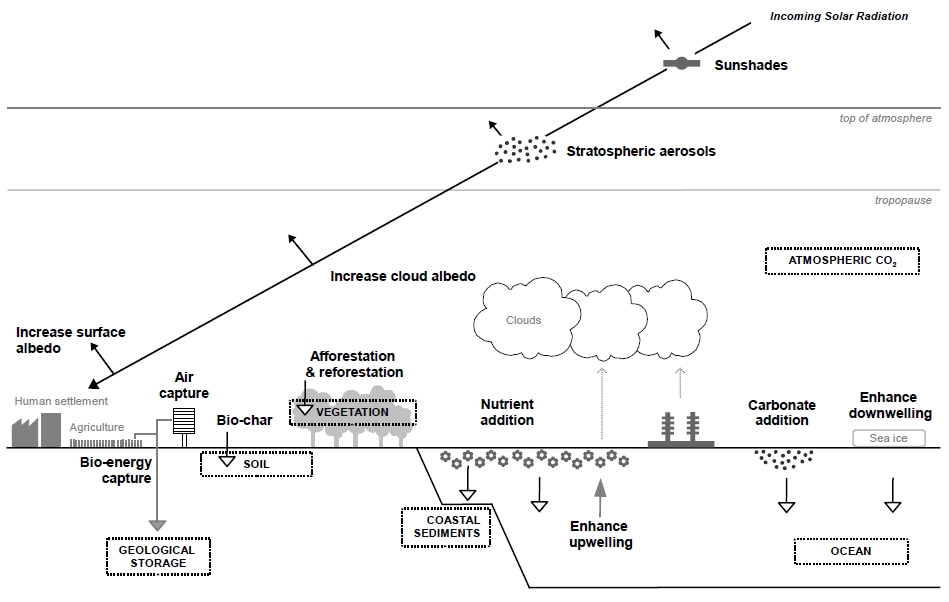
geoengineering-options-diagram-source-east-anglia-universityWhen Time Magazine included geoengineering in its “What’s Next for 2008” report it wrote that, “a few scientists are beginning to quietly raise the possibility of cooling the planet’s fever directly…as an option of last resort.” Today scientists at the University of East Anglia (UEA) are definitively smashing the hush surrounding geoengineering, publishing the first comprehensive assessment of the climate cooling potential of the various schemes being contemplated to re-engineer Earth.

“The realisation that existing efforts to mitigate the effects of human-induced climate change are proving wholly ineffectual has fuelled a resurgence of interest in geo-engineering,” explains UEA Environmental Sciences professor Tim Lenton, who wrote the report with UEA colleague Naomi Vaughan. Their report in today’s issue of the journal Atmospheric Chemistry and Physics Discussions shows that the benefits of some schemes have been exaggerated in the past by “significant” errors in calculations, but the best will likely play a constributing role in blunting climate change:

“We found that some geoengineering options could usefully complement mitigation, and together they could cool the climate, but geoengineering alone cannot solve the climate problem.”

Continue reading “Pushing Geoengineering Out of the Closet”

Big Footprints Next to Carbon’s

nejm-logoThe U.S. carbon footprint looms large as Washington prepares to finally begin, in earnest, a shift away from fossil fuels under a new President promising international action to, “roll back the specter of a warming planet,” as Agence France Presse highlighted in its reporting of Obama’s inaugural address. Debate is already raging, for example, around whether President Obama will allow California and other states to ratchet up the fuel efficiency improvements automakers must make in the years to come.

But research published yesterday in the New England Journal of Medicine provides a needed reminder that burning less fossil fuels can also directly reduce mortality from air pollution, as reported yesterday by CNN’s health desk. (Carbon-Nation readers will recall that the network’s sci/tech/environment desk is currently unavailable, having been eliminated by CNN last month.)

Continue reading “Big Footprints Next to Carbon’s”

Major Automakers Spurred by California’s Higher Expectations

Honda execs John Mendel and Yasunari Seki relaunch the Insight hybrid in DetroitMajor automakers such as Honda and Chrysler are realizing that it’s time to throw away the old game plan and chart a new one around the sale of smaller, more fuel-efficient vehicles. Ironically, some of the most direct evidence of this changed thinking lies buried at the end of an otherwise apologistic report on the U.S. auto industry’s troubles in the L.A. Times earlier this week.

The story reports on a likely forthcoming waiver from President Obama’s EPA effectively allowing states to demand better fuel economy than the federal CAFE standard. After declaring this a “nightmare scenario for automakers,” the article delivers desperate quotes from General Motors and the Alliance of Automobile Manufacturers — the trade group that fought (unsuccessfully) to block California’s standards in court. A GM spokesperson sets the tone, saying that subjecting a depressed industry to these tough standards is like asking a cancer patient to, “finish chemo and then go run the Boston Marathon.”

Here’s an alternative bedside analogy that looks to a deeper cancer: Setting lower standards than the European Union and China are already phasing in is reminiscent of the fatalistic approach to cancer treatment in which doctors hid from their patients the full extent of their sickness.

Continue reading “Major Automakers Spurred by California’s Higher Expectations”

Will Obama Get EPA Off the Road?

President Obama’s first move for clean tech could simply be getting the federal government out of the way in one area where the states are already poised to move aggressively: fuel economy. Candidate Obama promised to do as much on the campaign trail and yesterday Lisa Jackson, his nominee for EPA administrator, provided some hope that he will follow through in office.

Jackson, formerly New Jersey’s top environmental regulator, pledged in a Senate confirmation hearing yesterday that she would “immediately revisit” whether to allow states to set CO2 emissions limits on automobiles.

The CO2 tailpipe standards at issue were set by California in 2004 and subsequently adopted by 18 other states, which are more stringent than the tightened Corporate Average Fuel Economy (CAFE) standards approved by Congress in December 2007. Federal courts rejected auto industry challenges against the tougher state standards, but the Bush EPA rode to the rescue by denying California (and by extension its partner states) a federal waiver needed to implement the rules.

Jackson, if confirmed by the Senate, will thus have the power to immediately take an obstructionist EPA off the road. This could have a significant impact on technology development, given that minimal innovation is required to meet the tightened CAFE standards.

Jackson’s pledge to reconsider the state emissions waiver is an “early challenge for automakers” as Obama takes office next week, according to business journal Automotive News:

Automakers and their allies oppose state-by-state regulation of greenhouse gases. They say such rules are an indirect attempt to regulate fuel economy, which is a federal responsibility. They also say state rules would add costs and create market chaos, especially for dealers near borders with states that don’t have their own rules.

Natural Resources Defense Council vehicles policy director Roland Hwang suggested recently in a provocative report that automakers could solve such problems itself: “The obvious solution to all of the automaker concerns — including their desire for a uniform national standard — is to adopt California’s [greenhouse gas] standards nationwide.”

Hwang analyzed fuel economy projections in business plans that GM and Ford Motor submitted to Congress last month during their pursuit of a federal loan package. (His analysis excludes Chrysler, whose business plan was short on fuel economy details.) He concludes that GM and Ford could comply with the  California standards with little to no effort:

All three companies state that they will at least comply with future federal fuel economy (“CAFE”) standards. This analysis demonstrates that GM and Ford are now positioned also to comply with the more stringent California greenhouse gas standards if they were extended to apply nationwide. (my emphasis)

Postscript: Jackson’s home state of New Jersey just joined the list of states implementing California’s Zero Emissions Vehicle (ZEV) program, according to the Daily Record of Parsippany, NJ. The ZEV program was declared dead along with the battery-electric vehicle by the award-winning 2006 documentary Who Killed the Electric Car?. In fact, the program helped drive hybrid vehicles onto car lots across the country and will likely accelerate future adoption of plug-in hybrids and battery-electrics according to my ZEV report in IEEE Spectrum magazine.

add to del.icio.us : Add to Blinkslist : add to furl : Digg it : add to ma.gnolia : Stumble It! : add to simpy : seed the vine : : : TailRank

This post was created for the Technology Review guest blog: Insights, opinions and analysis of the latest in emerging technologies

Complication and Climate Communication

In response to CNN’s termination of its science/tech/environment unit and continued questioning of anthropogenic climate change, personal friend Peter Offenhartz wrote me to comment that while CNN’s move is “impossible to understand,” the continuing controversy over climate change is less perplexing.

In his email, Offenhartz suggests that part of the problem lies with the climatology community, which has not excelled at simplifying their models’ main results so that ordinary people can understand them. “The evidence is not so hard to understand as most people seem to think,” he writes. Offenhartz, a physical chemist, makes his case by offering the informal lecture on climate change that he’s been sharing socially in recent weeks. His explanation highlights the idea that rising CO2 matters most where water vapor concentrations are low: (emphasis Offenhartz) Continue reading “Complication and Climate Communication”