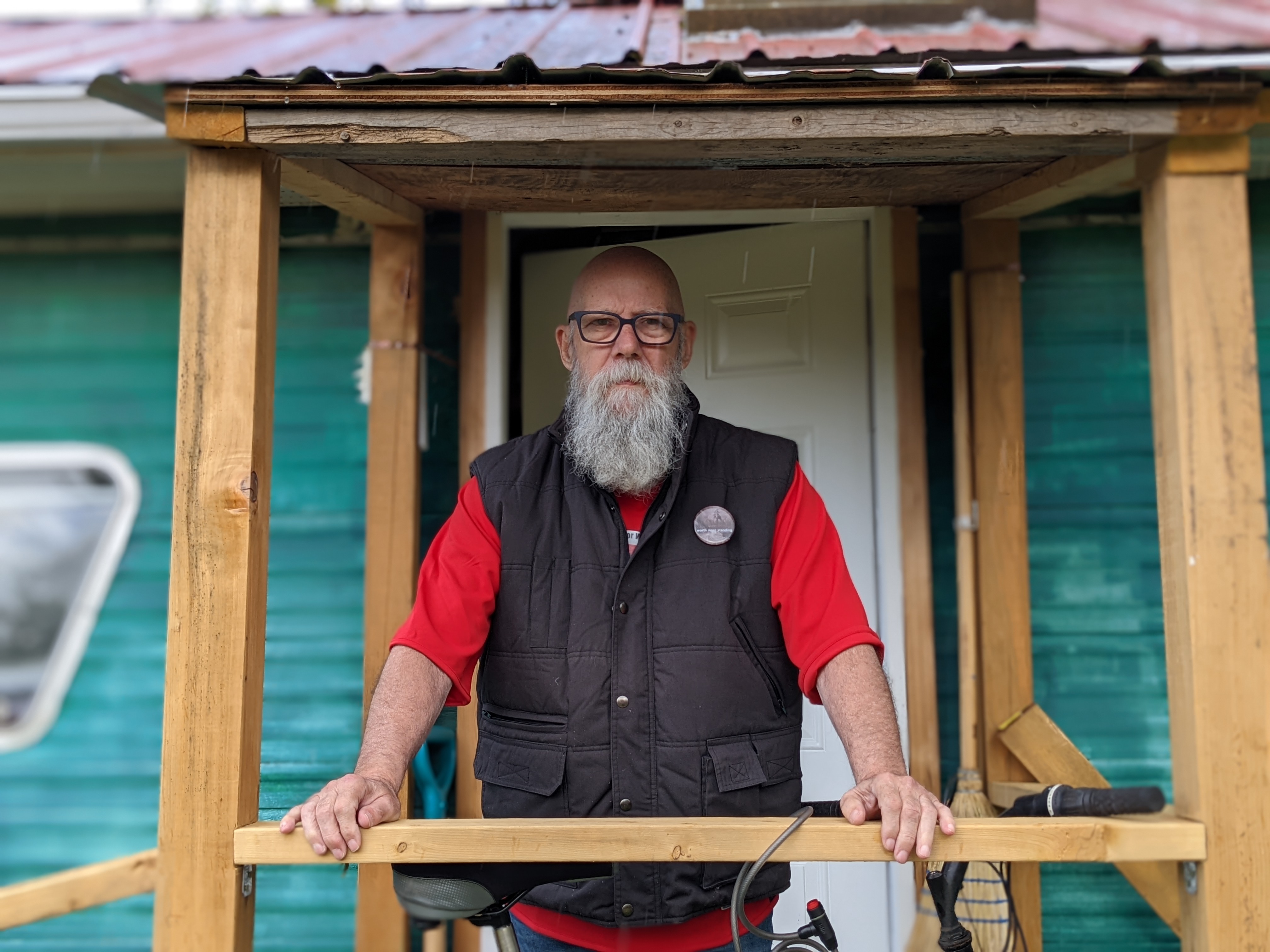
Extinction Rebellion activist Howard Breen, on Day 27 of his hunger strike, under house arrest at his back-lot cabin in Nanaimo, B.C. Photo credit: Peter Fairley
Climate protest via self-sacrifice is on the rise globally. Extinction Rebellion activists in the UK, for instance, have started to deliberately seek imprisonment. Hunger strikes are seemingly everywhere. And then there’s the ultimate sacrifice, self-immolation. 50-year old Colorado activist Wynn Bruce burned alive on the steps of the U.S. Supreme Court on Earth Day last month.
I reported on this abnormal new normal from the inside for The Tyee, visiting veteran British Columbia activist and hunger striker Howard Breen.
What drives Breen and his comrades-in-nonviolence? Can their highly-polarizing sacrificial protests accelerate climate protection, or will they be written-off as misguided and/or mentally ill? Read the story @TheTyee.
Energy is central to the geopolitics of Russia’s war on Ukraine. Putin thought Europe would let him seize Ukraine because the continent depends so heavily on Russian gas, petroleum and coal. The US is helping turn back Russian aggression not just by pumping weapons into Ukraine, but also by bolstering Europe’s energy supplies and thus facilitating European solidarity.
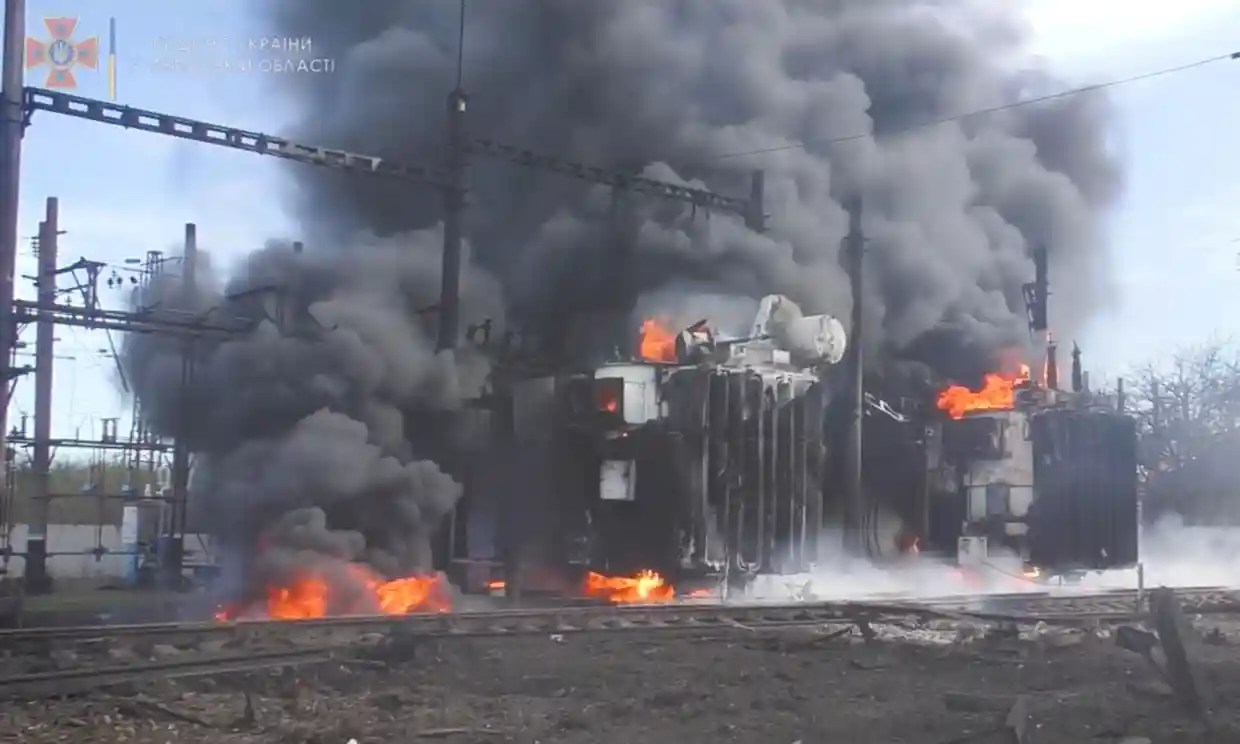
A substation in Ukraine shelled by Russia. Photo credit: State Emergency Service Of Ukraine.
But there’s also an #EnergyFront within Ukraine, which I’ve been covering for @IEEESpectrum. One flashpoint has been Ukraine’s power grid which was, until the war began, tied to the giant UPS/IPS synchronous AC power zone controlled from Moscow. My report, How Russia Sent Ukraine Racing Into the “Energy Eurozone”, chronicles bold moves in the war’s first weeks that isolated Ukraine’s power system and then plugged it into Europe’s.
Ukraine’s power grid operator made the first move hours before Russian tanks and missiles crossed borders in February. The transmission operators’ European counterparts made the next “heroic” move a few weeks later, stabilizing Ukraine’s power supply even as its attackers destroyed lines, substations and power generators.
Another flashpoint is the battle for control of Ukraine’s nuclear power sector, including the four operating plants that supply over half of the country’s electricity. When Russia invaded, Ukraine remained heavily dependent on Russian suppliers of nuclear fuel, waste handling, and parts. Patriots feared sabotage of nuclear power plants and and their defences, either to facilitate the plants’ seizure by Russian forces or to cause a nuclear incident.
Their fears prove justified when the Russian army attacked and captured Ukraine’s Zaporizhzhya nuclear power plant—Europe’s largest.
My report, Ukraine Scrubbing Nuclear Agencies of Russian Influence, revealed an internal struggle for control of Ukrainian national nuclear power generating company Energoatom whereby several top executives fled the country and a vice president was detained by state security police.
In August 2020 over 18 months of reporting paid off with my investigative feature Who Killed The Supergrid – an InvestigateWest production co-published with The Atlantic. Today that work and its immediate impact was recognized with an investigative journalism award from Covering Climate Now. That consortium, created in 2019 by the Columbia Journalism Review, The Nation, The Guardian and WNYC, has since grown into a who’s who of international media, and I’m honoured that they picked my work from more than 600 nominated entries.
— Peter Fairley / Decarbonizing Cascadia (@pfairley) October 6, 2021
This meticulous story revealed the Trump administration’s deliberate effort to bury a federally funded study that provided evidence that a connected super grid would accelerate the growth of wind and solar energy. The story made the abstraction of the nation’s power grid interesting, and Fairley’s explosive disclosures also led to regulatory change.
Individual panelists added commentary during the video awards celebration (see below). Giles Trendle, Managing editor for Al Jazeera English, called my story, “another great example of holding power to account.”
I have thanked many of the talented people who contributed to this success in the Twitter thread at right. But a few bear repeating:
My friend, longtime SEJ colleague, and editor Robert McClure, co-founder of InvestigateWest, jumped at the opportunity to take on my project and helped me take it all the way. I’m grateful that ‘just good enough’ isn’t in Robert’s DNA.
The team at The Atlantic, including Ellen Cushing and Faith Hill, further improved the prose and managed a very thorough fact check.
FYI the awards video hosted by ‘America’s weatherman’ Al Roker and NBC Live NOW anchor Savannah Sellers showcases all of the 2021 award program’s winning entries from around the world. It’s inspiring and informative. Definitely worth watching, and sharing…
I live in Cascadia, a land of hydropower, mossy forests and clearcuts, increasing human diversity and megafires. We think, on the whole, that we’re green, and our leaders think we’re leading the fight against climate change. Alas despite big promises over a decade ago and countless initiatives since, fossil fuel use and greenhouse gas emissions keep growing across Washington, Oregon and British Columbia.
This year I’m drilling down on what it will take to turn Cascadia’s climate picture around — for my region to get real about moving beyond carbon energy. In January my reporting for Seattle-based nonprofit journalism studio InvestigateWest launched a year-long collaborative project exploring Cascadia’s capacity to slash carbon emissions over the coming decades.
Getting to Zero: Decarbonizing Cascadia profiles the people, policies and firms that can transform the region’s economy and restore its scorched and beetle-infested forests. It’s an ambitious project, and nearly unique in its cross-border frame.
To deliver on the ambition we recruited a team of nonprofit journalism superstars, including Grist.org, The Tyee, Seattle-based Crosscut, and Jefferson Public Radio — the NPR affiliate for southwest Oregon and northwest California. The Associated Press wire carries our series to news outlets across the United States. And we’re already a LONGFORM selection.
Pat Bradley / springshoeanimation.com. Full credits at 1:30
In August my exposé in The Atlantic detailed the Trump administration takedown of a clean energy study. Since then I have been working hard to document how deep the political interference goes at the U.S. Department of Energy. The answer is DEEP.
My story for InvestigateWest and Grist shows that political interference is a pervasive practice targeting research funded by the DOE’s efficiency and renewables office. In all, Trump appointees have blocked reports for more than 40 clean energy studies, according to emails and documents I obtained as well as interviews with more than a dozen current and former employees at the Department of Energy and its national labs.
“There are dozens of reports languishing right now that can’t be published,” said Stephen Capanna, a former director of strategic analysis for the Energy Department’s Office of Energy Efficiency and Renewable Energy — the office that Simmons runs — who quit in frustration in April 2019. “This is a systemic issue.”
Bottling up and slow-walking studies violates the Energy Department’s scientific integrity policy and is already harming efforts to fight climate change, according to energy and policy experts, because Energy Department reports drive investment decisions. Entrepreneurs worry that the agency’s practices under the current White House will ultimately hurt growth prospects for U.S.-developed technology.
The meddling is also fuelling an energy science brain drain. Not only because research is held up. But because scientists have no idea why their work is disappearing. They, and the research they’re waiting to publish, are simply left dangling. “There’s no feedback,” said one national lab researcher. “It just goes into a black hole.”
Response to my August 20, 2020 investigation for The Atlantic and InvestigateWest has been moving, humbling and, at times, overwhelming. We took a deep dive into censorship of clean energy research by Trump officials at the U.S. Department of Energy, and it struck a chord. Especially our inside story of the impact on federal researchers doing their best science. The suppression of the National Renewable Energy Laboratory’s grid modernization study is a dark tale, but the positive feedback provides a much-needed boost to this journalist during these dark times for the press.
The ripples are still moving, but already include …
Interventions by the U.S. House of Representatives: House Science Committee chairwoman Eddie Bernice Johnson sent a letter to the Secretary of Energy demanding answers about NREL’s missing study and the department’s violations of its scientific integrity policy. Two days later the House passed an energy bill with a last minute amendment ordering the Interconnections Seam Study’s release.
Plus a tweetstorm on Twitter. Tweeters include a U.S. Senator, a Cousteau, and globally-recognized researchers such as climate scientist Ken Caldeira, former World Bank energy analysis chief Morgan Bazilian, and US-Canadian applied physics superstar David Keith.
Twitter also delivered severallimericks by #energytwitter experts, and a #FreeSeams movement led by Joseph Majkut, the Princeton-trained climatologist who directs climate policy for the Niskanen Center, a Washington, DC-based thinktank.
The best feedback of all are the messages from federal scientists at the national labs and at DOE’s Office of Energy Efficiency and Renewable Energy, who have suffered in silence under the Trump administration’s anti-science regime and finally feel heard.
Oh, and word from insiders that the Department of Energy is moving to release the Seams study.
Stayed tuned: Followup investigation in preparation. And #FreeSeams!
On August 14, 2018, Joshua Novacheck, a 30-year-old research engineer for the U.S. National Renewable Energy Laboratory, was presenting the most important study of his nascent career. He couldn’t have known it yet, but things were about to go very wrong.
At a gathering of experts and policy makers in Lawrence, Kansas, Novacheck was sharing the results of the Interconnections Seam Study, better known as Seams. The Seams study demonstrated that stronger connections between the U.S. power system’s massive eastern and western power grids would accelerate the growth of wind and solar energy—hugely reducing American reliance on coal, the fuel contributing the most to climate change, and saving consumers billions. It was an elegant solution to a complicated problem.
Democrats in Congress have recently cited NREL’s work to argue for billions in grid upgrades and sweeping policy changes. But a study like Seams was politically dangerous territory for a federally funded lab while coal-industry advocates—and climate-change deniers—reign in the White House. The Trump administration has a long history of protecting coal companies, and unfortunately for Novacheck, a representative was sitting in the audience…
This investigative feature, a co-production for The Atlantic and Seattle-based nonprofit journalism studio InvestigateWest, has been over 18 months in the making. I had the story at the outset, but I needed documents obtained via the Freedom of Information Act to back-up — and protect — my sources.


 Peter Fairley