Clean Coal’s Mountainous Upstream Blindspot

Gasification-based IGCC power plant technology offers a powerful means of cleaning up local air pollution from coal-fired power and, via carbon capture and storage, its carbon footprint. Carbon-Nation has argued in past that it should be legally mandated for new power plants burning coal because (1) air pollution laws require use of the best emissions controls available, (2) carbon capture and storage will be economically viable under emerging carbon caps and taxes, and (3) adding new carbon emissions from coal is unjustifiable given the critical need to stabilize atmospheric levels of CO2. 

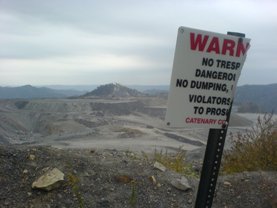
But let’s be clear on one thing: IGCC and carbon capture can substantially clean up the coal-fired power plant, but they can’t deliver “clean” coal. That’s because extracting coal to feed the power plants is, in itself, a dirty business — at least as it is currently practised. Last week I witnessed this firsthand at two West Virginia mines where mountains are literally dismantled to reveal their hidden coal seams, then piled back to a rough approximation of their original contours or left flat for development. I visited the mines as part of the Society of Environmental Journalists’ annual conference, held this year in the heart of coal country in Roanoke, Virginia. 

Mountaintop removal mining, as this practice is called, accounts for about a third of Appalachian coal production but contributes a considerably larger share of Appalachian coal burned in power plants (conventional deep mines yield more metallurgical coal used in steel mills). They are, without question, environmentally and culturally destructive. Thousands of cubic meters of rock, sand, and soil dumped into valleys bury ephemeral stream beds; wildlife are displaced; sludge impoundments from coal-cleaning operations threaten groundwater and communities; and residents of the mountains suffer internal devestation as the lands that define their existence are blasted into oblivion. For a sense of scale check out this 5MB panorama of the mine pictured above by National Geographic executive editor Dennis Dimmick.  

Can the coal industry do better? Yes. For example, reclamation experts from Virginia Tech told the tour that mountaintop mines are adopting a new reforestation approach that could restore the mountains’ ecology within two generations. That’s huge improvement over current practices where grasses and shrubs take over, leaving the land in what Virginia Tech forestry professor James Berger called a state of “arrested succession.”

Will the industry ever make coal mining socially and environmentally sustainable? Appalachian activists who have fought ‘Big Coal’ for decades doubt it. For one thing, the coal companies enjoy undivided support from state legislators and governors in coal states. That’s why West Virginia author and political activist Denise Giardina told the SEJ conference attendees that she was “rooting for global warming” to stop coal. “I think it will force us to change,” said Giardina, who made it clear that IGCC power plants sequestering CO2 weren’t the kind of change she had in mind. Quite the opposite in fact: “If we ever have clean coal,” said Giardina, “you can kiss the mountains goodbye.”

I’m going to need more time to reflect on what I saw and heard last week. The scale of carbon reductions required and developing nations’ right to develop may yet justify the ongoing use of coal. But, at the very least, it is more clearer to me than ever that cleaning up our energy systems must start with energy efficiency and less extractive forms of renewable energy. We are all, as willing users of coal-supplied power grids, contributors to Appalachia’s plight everytime we turn on the juice. 

Storied author, poet and social critic Wendell Berry put that message to the SEJ conference in the bluntest of terms: “It’s awfully hard to remember when you push that button that you are authorizing mountaintop removal.” 

For more on mountaintop removal mining check out this week’s article by the Associated Press which I believe was inspired by the SEJ mountaintop mining tour.

add to del.icio.us : Add to Blinkslist : add to furl : Digg it : add to ma.gnolia : Stumble It! : add to simpy : seed the vine : : : TailRank

This post was created for Energywise, IEEE Spectrum’s blog on green power, cars and climate

Peak Lithium Counterpoint from Gas 2.0

My presentation of Le Monde’s Peak Lithium story prompted some sage commentary from critics of the notion that lithium could ever run dry (so to speak). Rather than leaving the counter-argument buried in the comments, here’s a thoughtful elaboration argued from first principles by EV software developer Karen Pease.

The post appears on Gas 2.0, a blog dedicated to alternative fueling options that looks worthy of much deeper exploration.

One quick followup on the “drive less” front: Beijing has enacted agressive car restrictions. In essence the city is extending restrictions brought into play this summer in a desperate bid to clear the air for the Olympic games.

CN’s editor is feeling thoroughly vindicated for the optimism imparted in that coverage. Change is Always possible.

add to del.icio.us : Add to Blinkslist : add to furl : Digg it : add to ma.gnolia : Stumble It! : add to simpy : seed the vine : : :

Peak Lithium: EVs’ Dirty Little Secret?

Electric vehicles web-journal EV World has done the English-speaking world a favor by translating an excellent Peak Lithium story written last week by Le Monde journalist Hervé Kempf. What is Peak Lithium you ask? The notion that a wholesale shift to EVs powered by lithium batteries in response to peaking petroleum production could just as quickly exhaust the global supply of lithium metal.

Kempf credits a May 2008 study by consultancy Meridian International Research — The Trouble with Lithium 2 — as the source of growing concern over peak lithium; the study concluded that reasonable increases in lithium production over the next decade will generate enough of the light, energetic metal to produce batteries for only 8 million batteries of the sort that GM plans to use in its Chevy Volt plug-in hybrid.

But he does his own homework, providing an accessible introduction to the geological distribution of lithium and its likely magnitude. I say ‘likely’ because Kempf shows that industrial secrecy makes it difficult to assess the probability of a peak lithium scenario prematurely squelching the electrification of the automobile.

As George Pichon, CEO of French metals trader Marsmétal puts it in Kempf’s piece, the world of a lithium metal is “un monde fermé.”

Alas, it’s just a little less closed today thanks to Le Monde and EV World.

add to del.icio.us : Add to Blinkslist : add to furl : Digg it : add to ma.gnolia : Stumble It! : add to simpy : seed the vine : : : TailRank

This post was created for Tech Talk – Insights into tomorrow’s technology from the editors of IEEE Spectrum.

The EuroParliament’s Schwarzenegger Clause and CCS

Carbon sequestration — the notion that carbon dioxide from coal-fired power stations and other major greenhouse gas emitters can be captured and stored underground — is taking a lot of hits from environmental activists bent on banning coal outright. For a taste, check out this recent post on the Gristmill green blog by Joseph Romm, a most articulate carbon capture critic. Political leaders, in contrast, appear far more supportive, and it’s not just American presidential candidates wooing coal-country voters. Last week European parliamentarians voted to finance largescale sequestration demo projects with a generous €10-billion fund and, better still, approved what they called a ‘Schwarzenegger Clause’ to mandate carbon capture for new generating stations from 2015. Like an existing requirement approved by California’s governor the clause sets a 500 gram CO2 per kilowatt-hour emissions limit that coal-fired plants can beat only with carbon capture.

The U.K.’s Environment Agency had already recommended a ban new coal-fired power plants that don’t use carbon capture and storage (CCS) the week before.

Part of the European motivation, as French and British leaders have made clear, is that CCS is more than a key to meeting agressive climate change action goals. They are also a critical means of keeping coal in the mix and thus limiting Europe’s dependence on imported oil and gas from Russia and the Middle East.

In the U.S., meanwhile, Al Gore is calling for civil disobediance to force adoption of the same CCS mandate. In fact, there are already steps in this direction even in North America beyond Schwarzenegger’s innovations:A panel appointed by Arkansas’ governor recommended last month the state approve no new coal plants until CCS is ready; the Canadian government floated a plan this spring to require CCS at new bitumen-to-oil plants in Alberta’s tarsands from 2012; and last fall British Columbia decreed a no-new CO2 from coal policy that stalled two proposed coal-fired plants (one may go forward as a biomass plant to burn trees killed by a warming-enabled infestation of beetles).

A wildcard to watch: weakening political resolve in the face of the global finance crisis. According to this report from Agence France Press yesterday, a few European leaders are wavering on greenhouse gas emissions as energy-intensive industries face tough times ahead.

add to del.icio.us : Add to Blinkslist : add to furl : Digg it : add to ma.gnolia : Stumble It! : add to simpy : seed the vine : : :

Return of the Solar Power Tower

Last week Spectrum Online ran my profile of Andasol 1, a solar thermal power plant that’s set to startup in Andalucia with the largest installation built expressly for storing renewable energy: a set of molten salt storage tanks that will hold enough heat energy to run its 50 MW steam turbine for 7.5 hours after dark. This week brought decisive evidence that another solar thermal design that makes even better use of energy storage — a so-called ‘power tower’ whereby sunlight is focused on a central tower — will also have its moment in the Andalucian sun.

The project, dubbed Gemasolar, will employ sun-tracking mirrors covering an area equal to 40 soccer fields to focus light at the top of a roughly 120-meter-high tower. There the sunlight will heat a solar receiver full of molten salt. In contrast, Andasol 1 (like most of the solar thermal plants under construction in the U.S., Spain, North Africa and the Gulf) uses thousands of square meters of trough-shaped mirrors to focus light on a synthetic oil; energy is stored via heat exchangers that transfer the synthetic oil’s heat to a molten salt.

One advantage of the power tower is thus obvious: heating salt directly eliminates the need for heat exchangers, reducing installation and operating costs. Another lies in the fortuitous thermodynamics of heating molten salts, whose maximum safe temperature of 565 C is about 165 C higher than the synthetic oil’s.

Sandia National Lab researchers verified these power tower advantages in the second half of the 90s, but also suffered through a series of operational difficulties. Five years ago the European Commission provided funding for the Gemasolar project (then known as the Solar Tres) to demonstrate that the difficulties could be overcome, but the project foundered on legal issues and changes in Spain’s renewable energy law. But engineering continued and this March the project sprung back to life when its lead proponent, Spanish engineering firm Sener, clinched a solar thermal joint venture with Abu Dabi’s alternative energy program.

With Abu Dabi’s deep pockets Gemasolar’s financing just might survive the current financial crisis. Siemens confirmed that the tower was moving forward this week by disclosing that it would supply the steam turbine to convert the tower’s solar-generated heat into up to 19 MW of electricity for the Spanish grid. 

For further details on Gemasolar, see this frank telling of its origins, design and goals on Sener’s website. For details on a competing power tower design that directly produces steam, see this white paper from Spains’ Abengoa Solar.

add to del.icio.us : Add to Blinkslist : add to furl : Digg it : add to ma.gnolia : Stumble It! : add to simpy : seed the vine : : : TailRank

This post was created for Tech Talk – Insights into tomorrow’s technology from the editors of IEEE Spectrum.

Déjà? Are Hybrids Already Passé?

Plugs are definitely vogue at this week’s Mondial de l’Automobile in Paris. So where does the hybrid vehicle fit into the picture? It may not, according to Renault. The French carmaker says that electric vehicles, not hybrids, are needed to deliver the emissions reductions that governments and customers demand.

Renault says that it is engineering a pair of battery-powered electric vehicles (EVs), to be produced starting in 2011. As I report for MIT Technology Review today, Renault claims these EVs will be cheaper to build, cost markedly less to power, and produce far less carbon dioxide. Today they unveiled a partnership with utility géant Electricité de France to “establish electric cars as a viable and
attractive transport solution for consumers.”

And Renault is not the only major automaker planning to produce commuter-oriented EVs. Mitsubishi Motors and Daimler both announced plans in Paris last week to accelerate commercialization of small EVs — Mitsubishi with its i-MiEV minicar and Daimler with a battery version of its popular Smart Fortwo. Volkswagen’s promo materials in Paris confirmed it would join the EV club, producing a tiny commuter EV called the Up! in 2010 with a top speed of 130 kilometers/hour and roughly 100 kms of range. 

Ok you say. EV’s are à la mode. But what of the hybrid option? The question is partly semantic. Hybrid technology is everywhere if you count the mild hybrids, which employ a small but potent electric battery  to save gas by rebooting the combustion engine on a green light instead of idling through the red; some can also recuperate energy during breaking by recharging their battery. This technology is going mainstream: Renault competitor PSA Peugeot Citroën said it alone will install 1 million stop-start systems by 2011. VW spokesperson Martin Hube said his company viewed stop-start as just an evolution of internal combustion drive. “You can call it a mild hybrid but it’s just a smart technique,” says Hube. “That’s nothing new.” 

No automaker questions whether full hybrids like the Prius or GM’s plug-in Chevy Volt that can drive on either electricity or gasoline are something new. But while several showed full hybrid concept cars in Paris, fewer talked up plans to build one. Perhaps they’ve made the same calculation as Renault: it’s not worth the trouble to cram high-energy motors, batteries and an engine into a vehicle when one can go straight to the full EV instead.

add to del.icio.us : Add to Blinkslist : add to furl : Digg it : add to ma.gnolia : Stumble It! : add to simpy : seed the vine : : : TailRank

This post was created for Tech Talk – Insights into tomorrow’s technology from the editors of IEEE Spectrum.

Paris Mondial de l’Automobile Flaunts the Plug

Five years ago Toyota relaunched its Prius with a Saatchi & Saatchi ad blitz with the EV-bashing tagline “and you never have to plug it in.” Toyota’s corporate marketing manager said the idea was to show the Prius was, “not an idea that’s ahead of its time.” 

What a difference a few years can make. At this year’s Paris Mondial de l’Automobile, which opened to the press yesterday, plug-in hybrids and full-battery EVs are everywhere — and their plugs are displayed conspicuously. 

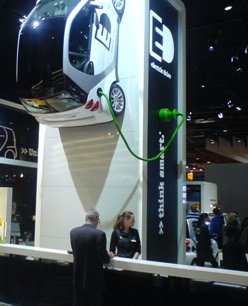
Smart, the Daimler/Swatch joint venture, towered a dangling plug over their floorspace to highlight its development of an EV model of the tiny trendy Smart Car due out in 2010. GM executives gamely held the cord of the Chevy Volt plug-in hybrid for photographers. And check out the plug on Ligier Automobiles’ EV city car!

Frank Weber, GM’s Global Vehicle Line Executive for the Volt, explained the shift to me in dollars and cents, or rather euros and centimes. “If you say that the charge costs less than a euro per day, it’s that simple,” says Weber. “Plugging in means saving, being able to drive and don’t watch the signs at the gas station. This is what the plug means. It’s now looked at as an opportunity and like, well ok at night you have to plug it in but you would do this anytime because the moment you plug it in you know that you save.”

add to del.icio.us : Add to Blinkslist : add to furl : Digg it : add to ma.gnolia : Stumble It! : add to simpy : seed the vine : : : TailRank

This post was created for Tech Talk – Insights into tomorrow’s technology from the editors of IEEE Spectrum.