C-N Weighs in on FutureGen Confusion

Power industry webzine EnergyBiz Insider published the following commentary today from C-N’s editor. Call it one more attempt to clear away some of the dust kicked up by DOE’s efforts to restructure the FutureGen project:  

I’m glad you took up the Department of Energy’s reversal on the FutureGen clean coal project because there is considerable confusion surrounding its likely demise. The biggest misunderstanding concerns FutureGen’s place in the context of commercializing IGCC and carbon capture technology.

The Department of Energy rejected FutureGen in favor of investing the same funds to equip commercial coal-fired power plants – each of which would be larger than FutureGen – with the equipment to capture their greenhouse gas emissions. With over 40 IGCC projects in various states of development and technology for capturing CO2 at conventional coal plants improving rapidly, DOE will have no shortage of targets to choose from. And while the individual DOE projects may look smaller, the plants involved and the scale of the carbon capture are likely to be several times larger.

DOE now recognizes what gasification technology providers have been screaming for years: FutureGen set out to develop next-generation technology rather than applying commercially-ready technology, thereby miscasting carbon capture itself as a sort of technological moonshot. The best evidence of this remains Dakota Gasification, a 1970s era synthetic fuels plant that has been capturing its CO2 and selling it to oil producers across the border in Saskatchewan since the late 1990s …

… DOE’s rejection of FutureGen suggests that even Washington has realized that gasification and carbon capture are ready for action. While I applaud their reformulation of FutureGen, we’ll know they’re truly serious about seizing the opportunity inherent in existing technology when they institute the carbon caps or taxes required to make carbon capture pay.

See The Clean Coal Paradox for more.

add to del.icio.us : Add to Blinkslist : add to furl : Digg it : add to ma.gnolia : Stumble It! : add to simpy : seed the vine : : : TailRank

The Other Solar Power

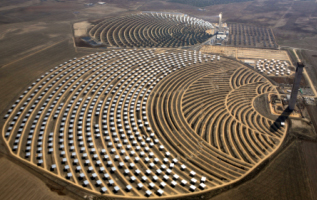
Solar thermal power cuts a fascinating contrast with solar photovoltaics and wind turbines — today’s leading renewable energy technologies — besting one on price and the other on quality. Little surprise then that it is being selected for power plants equal in output to large wind farms and ten-times the size of the largest photovoltaic installations.

Whereas photovoltaics employ semiconductors to directly convert sunlight into electricity, solar thermal power stations convert sunlight into heat to generate steam and drive a turbine. This roundabout is, ironically, a huge money-saver. The Abengoa thermal solar power towers in Sevillemirrors, pipes, pumps and steam turbines that form a solar thermal plant cost less than half than an equivalently powerful array of photovoltaics.
Solar thermal cannot similarly challenge wind turbines on cost (at least not at present). But solar thermal plants can store some of the energy they capture and, as a result, produce a much steadier and more reliable supply of electricity than the famously variable wind turbine.

So why then did we hear so much about solar photovoltaics over the past decade and sol little of solar thermal? Because the latter is inherently utility-scale technology, whereas photovoltaic panels provide value one rooftop at a time. Fred Morse, a solar thermal pioneer and currently senior advisor to renewable energy developer Abengoa Solar, likens it to a bakery operating through the depression. “If you had a bakery and you sold cookies or big wedding cakes, during hard times you could sell a lot of cookies,” says Morse. “PV has little niche markets and it could grow and grow and as the price came down it expanded those markets to where it is today.”

These days, thanks to state and (albeit on-again-off-again) federal incentives and record fuel prices, solar power is back to wedding cakes.

For more, check out “Solar without the Panels”

add to del.icio.us : Add to Blinkslist : add to furl : Digg it : add to ma.gnolia : Stumble It! : add to simpy : seed the vine : : :

California Counts the Ways to Decarbonate

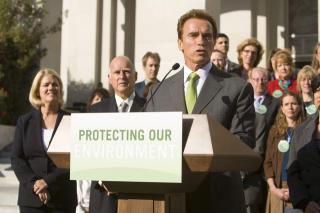
Governor Schwarzenegger Takes on the FedsTrying to track California’s developments in climate change policy is a full-time job these days. Carbon-Nation has followed the state’s efforts to drive the electrification of the automobile, but this is but a scratch at the surface. California’s initiatives also include: incentives for renewable energy, taxes on high-carbon fuels, tough vehicle fuel economy standards (in the absence of real leadership from Washington), and, in partnership with other western states and British Columbia, a regional cap-and-trade system that should ratchet down industrial emissions of greenhouse gases.

This broad frontal attack on climate complacency is helping to change the politics of climate change across the U.S. and Canada. It is also driving innovation. Today, California’s Air Resources Board reviews an innovative report from its Global Warming Economic and Technology Advancement Advisory Committee that lays out no less than 55 opportunities to cut greenhouse gas emissions. The proposals span the realms of finance, transportation, industry, commerce, residential energy use, electricity and natural gas, agriculture, forestry and water policy.

Let no one say that its too late to stop climate change.

add to del.icio.us : Add to Blinkslist : add to furl : Digg it : add to ma.gnolia : Stumble It! : add to simpy : seed the vine : : : TailRank

Scaling Energy to Dizzying Heights and Quaking Depths

The demonization of carbon capture recently moved into new territory as opponents — who hope to kill coal-fired power by squelching carbon capture — worry over the seismic effects of massive underground CO2 injection. This got me to thinking that it’s time to, yet again, consider the virtues of energy conservation.

Fact is, there are risks inherent in every approach to energizing our future (not least sticking with the status quo). The risks look especially daunting if one imagines single-handedly fixing climate change by immediately scaling up any one of the various low-carbon energy technologies available. Take wind power. Install enough wind turbines and they will measurably alter regional airflow patterns and climate (Keith et al, PNAS 2004):

Large-scale use of wind power can alter local and global climate by extracting kinetic energy and altering turbulent transport in the atmospheric boundary layer. We report climate-model simulations that address the possible climatic impacts of wind power at regional to global scales… We find that very large amounts of wind power can produce nonnegligible climatic change at continental scales.

Covering half the Earth with solar panels would undoubtedly deliver its own evils, starting with a sharp increase in power costs that would set back the developing world’s aspirations for economic improvement.

What’s a planet to do? On the generation side I believe we should allow all low-carbon solutions to flourish. We can do this by putting a price on CO2 through taxes or emissions cap-and-trade systems that make it economically punishing to pollute. A price on CO2 would drive coal burning power plants, for example, to invest in pricey carbon capture equipment, increasing the cost of coal-fired electricity — a development that every renewable energy advocate would cheer. (Or one could simply ban new CO2 emissions from coal-fired power plants, as British Columbia did last year.)

At the same time we must take account of the scale of our energy use. If we can now envision installing enough turbines to alter local weather patterns, or injecting enough CO2 underground to stimulate earthquakes, surely we must recognize that innovative energy supply will not rebalance our relationship with the Earth. We must also learn to live and live well with considerably less energy.  

add to del.icio.us : Add to Blinkslist : add to furl : Digg it : add to ma.gnolia : Stumble It! : add to simpy : seed the vine : : : TailRank

Does Fusion Have a Future?

The 2004 report “Burning Plasma: Bringing a Star to Earth,” from the U.S. National Research Council, sold Washington on the International Thermonuclear Experimental Reactor (ITER), a massive R&D project that proponents predict will be the breakthrough project for fusion energy. In its fiscal 2008 budget, however, Congress drove the United States’ role in ITER right into the ground, slashing US $160 million promised for this year to $10.7 million. That has some wondering if fusion research, considered since the 1960s one of the great long shots for a sustainable and relatively clean energy supply, has run out of time.

What makes fusion a long shot? Like most fusion experiments to date, ITER proposes to use formidable electric currents and magnetic fields to induce fusion in isotopes of hydrogen (deuterium and tritium) and to contain the resulting burning plasma-akin to a tiny star and exceeding 100 million ˚C. Existing fusion reactors have produced heat equivalent to just a few megawatts of power–less than the energy required to induce the reaction–and for just fractions of a second. ITER should put out ten times as much power as it consumes, but still for just a matter of minutes.

And even that level of performance will require a 27-meter-high magnetic confinement chamber that will take a decade to build and cost an estimated $2.76 billion. Including design, administration, and 20 years of operation, the project’s total expenses will be nearly $15 billion.

For more on fusion’s troubled poster child, see my story at Spectrum Online.

add to del.icio.us : Add to Blinkslist : add to furl : Digg it : add to ma.gnolia : Stumble It! : add to simpy : seed the vine : : : TailRank

Probing St. Valentine’s Bubbles

Champagnes Laherte FrèresCarbon-Nation couldn’t pass up the teach-able moment inherent in Valentine’s Day. Only New Year’s competes with February 14th’s love affair with champagne, and champagne would be unthinkable without carbon dioxide.

Check out my latest connect-the-dots photo montage for MSN Green, “The Troubles in the Bubbles”, to see how champagne is both contributing to – and at the whim of – a changing environment.

add to del.icio.us : Add to Blinkslist : add to furl : Digg it : add to ma.gnolia : Stumble It! : add to simpy : seed the vine : : : TailRank

Tech Talk on Plug-in Hybrids

IEEE Spectrum Tech TalkGoing forward, some of Carbon-Nation’s posts will now be copublished via IEEE Spectrum’s Tech Talk blog, beginning with this report on California plug-in mania: “Plug-in hybrids win big in ZEV tweaks” (full text follows)

Plug-in mania has an influential new fan: the California Air Resources Board, which looks set to elevate plug-ins several notches in its zero-emissions vehicle (ZEV) mandate.

The ZEV directive requires car manufacturers to market ultraclean and emissions-free vehicles (or buy credits earned by others making such vehicles). The California Air Resources Board unleashed intense lobbying this winter among battery EV start-ups, major automakers, hydrogen fuel-cell developers, and coalitions promoting plug‑in hybrids when it promised to tweak the level of credits earned by various technologies. From the Air Resources Board staff proposal released late last week, plug-ins appear to be the big winners.

Presently the ZEV credit ratios favor fuel cells and offer relatively little help for plug-ins. The staff proposal would change this by enabling manufacturers to meet most of their ZEV requirements through 2014 with plug-in hybrids and hydrogen combustion vehicles. While not pure ZEVs like battery EVs and fuel cell vehicles, the California regulators bet that manufacture of plug-ins will yield components and infrastructure that will hasten the day when the pure EVs go mainstream.

“The goal continues to be to accelerate the development of pure ZEVs,” says Air Resources Board member Daniel Sperling, director of the University of California, Davis, Institute of Transportation Studies. Sperling says promoting plug-in hybrids is the “only realistic way” to push car makers forward in light of the continued high cost of batteries and fuel cells.

Sperling and his fellow Air Resources Board members will take up the staff proposal after a public hearing in Sacramento scheduled for March 27-28.

Meanwhile, Arizona regulators seem to be feeling considerably more bullish about the viability of pure electrics. The Arizona Republic reports that Airzona’s Department of Environmental Quality has drafted rules mandating that 11 percent of all cars sold in the state must be ZEVs from the 2011 model year. In 2018 the mandate would jump to 16 percent.

This post was created for Tech Talk – Insights into tomorrow’s technology from the editors of IEEE Spectrum.

add to del.icio.us : Add to Blinkslist : add to furl : Digg it : add to ma.gnolia : Stumble It! : add to simpy : seed the vine : : : TailRank