Re-embracing the Grid

eagle-island-2007-145.jpgOne month ago (a thoroughly inexcusable gap for a webjournal) I began my annual migration to an island-bound off-grid retreat, promising to make up for my absence by bringing Carbon-Nation fresh insights on low-energy living.

First realization: Energy efficiency is a tough sell. People want energy. Fellow islanders, suddenly attuned to energy like the rest of North America, had trouble reconciling the fact that I write about energy and live in the most primitive house on the island. Yet energy conservation is the largest and cleanest opportunity we have to radically reduce our use of energy, far better than switching to new forms of power generation which inevitably bring their own risks and environmental impacts. The challenge is exciting people (including my editors).

Second insight: Our energy use on the island has expanded more than I had realized. Like our neighbors we have a propane stove and fridge, but we are the last holdouts without on-demand electricity (others use solar and gasoline generators while we rely on batteries and kerosene) and we still use an outhouse and a rain-fed cistern connected to a hand pump for plumbing (others have solar-pumped water systems and there are even a few toilets). Nevertheless, over the past decade we’ve added a chain saw and a small boat, bringing gasoline into our energy mix and thus plugging in a little tighter to a fossil fuel distribution ‘grid’ stretching from here to Iraq.

Mea culpa: I did plug in to a friend’s solar system once or twice to recharge a pocket PC and cell phone and, yes, to check my email. In 2003 I was ensconced in my island paradise in August, missing both the largest blackout in history and calls from CNN looking for on-air commentary on the state of the grid and the technological options for modernizing it. I didn’t want to miss the boat again. 

Three: Upon departing, I described the rain-fed cistern and hand pump as our cottage’s most advanced technological feature. I had overlooked the kerosene lamps, whiUncle Dave burning fuelch burn amazingly clean thanks to their glass chimneys. The contrast with what the off-grid villagers I visited in Bolivia’s Cordillera Real for “Lighting Up the Andes” is stark. Many used a kerosene-filled tin can with a wick stuck into the top producing a thick stream of soot.

A reminder: Huge efficiency and health gains await if we can banish such primitive lighting and open-burning stoves from the developing world.

Which brings me to Jerry’s comments during my absence: Jerry asked why North Americans surpass everyone else in energy consumed per capita, and what strategies we can employ to turn this around. Observing that Ford, Daimler-Chrysler and GM sell far more efficienct vehicles in Europe, the higher use of ductless AC in Asia (what is that?), and Europe’s tankless water heaters, Jerry says he is “beginning to believe that the technology required to significantly reduce our per-capita consumption is proven, established, even old.” How true. The glass-chimneyed kerosene lamp is but one more example.

Stay tuned for a proper response to the “what to do” portion of Jerry’s comment. Or start writing!

add to del.icio.us : Add to Blinkslist : add to furl : Digg it : add to ma.gnolia : Stumble It! : add to simpy : seed the vine : : : TailRank

Going Off-Grid

Eagle Island, METhis weekend I begin my annual migration to an off-grid cottage whose most advanced technological feature is a rain-fed cistern connected to a hand pump. I hope to resist the urge to use the Internet (technically feasible but not easy), thus returning to Carbon-Nation with fresh insights from both the alternative manner of existence and the uninterrupted stretches of deep-thinking it delivers. Go ahead and chime in with deep thoughts of your own about our use of energy and options for rethinking it.
Solar power records smashing like pumpkins

Wow. What a time for solar energy. On top of recent gains in plastic and thin-film photovoltaics the University of Delaware now reports the world’s most efficient solar cell at 42.8% — if the finding is confirmed it will boost high-end PV output an incredible 2.1% over the previous record set by Boeing-subsidiary SpectroLab last December (see my presentation of their approach at MIT Technology Review: “Ultra-efficient Photovoltaics”).

The University of Delaware advance is notable for (a) the incredible consortium assembled to bring together the multiple PV cells employed in the record-breaking cell, (b) the role of government funding — in this case its dollars from DARPA that were yanked out of the hands of another set of researchers developing plastic solar cells, and (c) the comeback it represents for Allen Barnett, the University of Delaware scientist leading the effort.

Barnett founded what was once the most successful solar U.S. solar producer, AstroPower, which made its mark producing photovoltaics from recycled silicon wafers. The firm took a blow when the tech bubble burst and semiconductor manufacturing slowed, causing a shortage of recycled wafers, and was then destroyed by an accounting scandal. GE picked up AstroPower’s assets in bankruptcy proceedings in 2004 — adding one more piece in the energy giant’s sweep into renewable energy (see “The Greening of GE” for more on that story).

add to del.icio.us : Add to Blinkslist : add to furl : Digg it : add to ma.gnolia : Stumble It! : add to simpy : seed the vine : : : TailRank

Solar Redux: Thin Film’s Time in the Sun

Power-plant scale installations of solar panels from photovoltaics developer First Solar provides a nice follow-up to a story I wrote for IEEE Spectrum five years ago, when BP’s solar subsidiary cast a pall over solar energy by terminating its investment in the same technology. The followup on First Solar’s perserverance and success ran this morning on the MIT Technology Review website (see “Thin Film’s Time in the Sun”).

Worth noting that this story affirms the observation we made last week that photovoltaics technology is advancing across the board thanks to sustained investment. In First Solar’s case the sustenance came in the form of a $250 million cash infusion from Walmart founder John Walton.

add to del.icio.us : Add to Blinkslist : add to furl : Digg it : add to ma.gnolia : Stumble It! : add to simpy : seed the vine : : : TailRank

China’s Renegade Provinces

Beijing blocked two reports recently — one of its own, another by the World Bank — detailing the cost of rampant environmental degredation gripping the nation. The LA Times analysis of the development, “China cancels environmental report: An assessment of ‘green GDP’ would have calculated the cost of pollution to its rapidly growing economy”, insightfully captures the context.

While decisions like these issue from Beijing, one must look to the provinces for understanding. Chinese central government has a strong set of environmental policies but they are no match for provincial and municipal officials — the firemen feeding China’s economic train without brakes, running roughshod over well-meaning officials from the capitol.

Even illegally constructed coal-fired power plants shuttered under direct order of top leaders of the Communist Party of China officials spring back to life within days when the spotlight has faded.

Beijing can help China tackle new economic opportunities through its financial largesse, but it appears powerless to reign in that which it has unleashed.

add to del.icio.us : Add to Blinkslist : add to furl : Digg it : add to ma.gnolia : Stumble It! : add to simpy : seed the vine : : : TailRank

Let the Electrons Blow

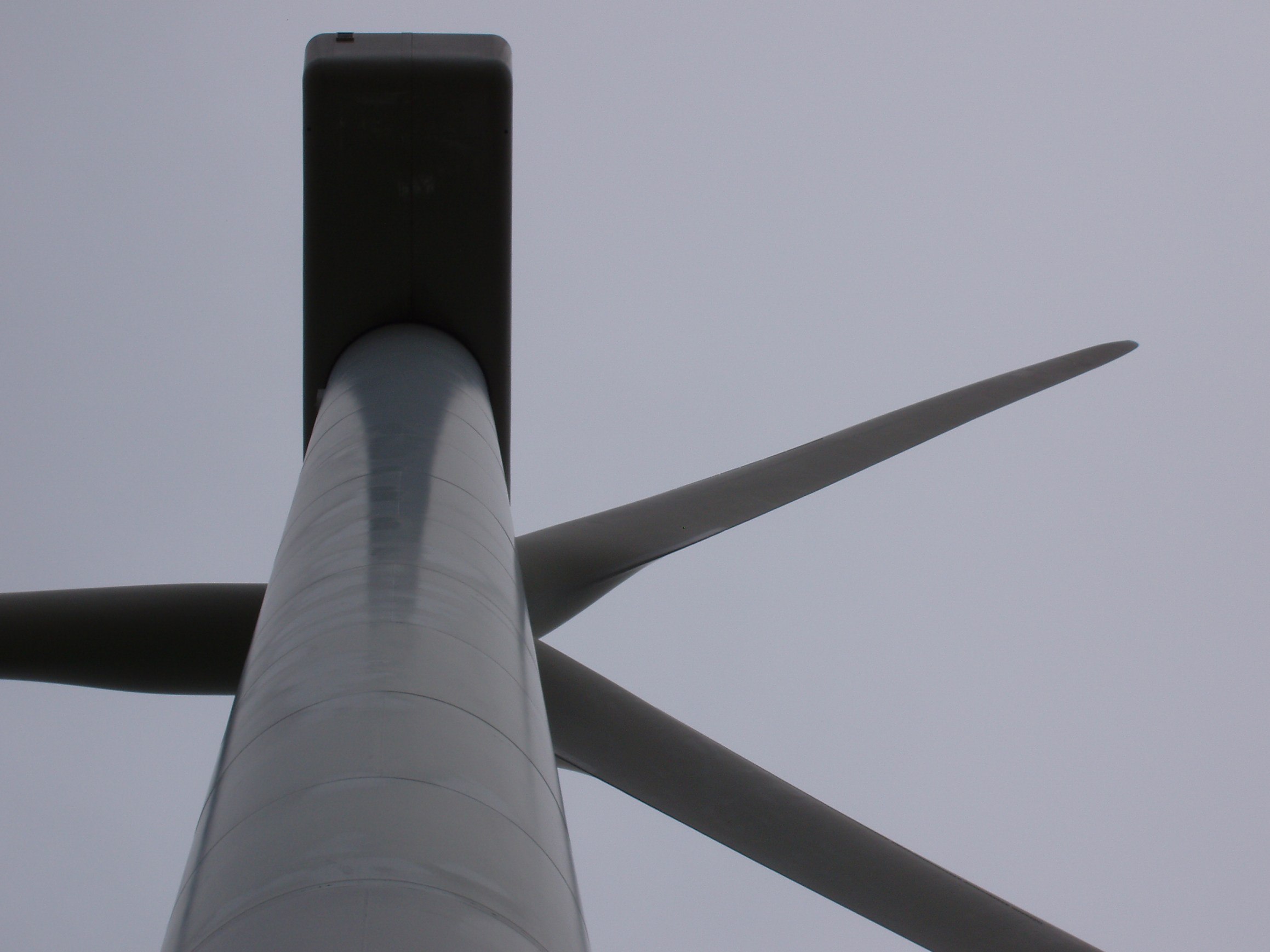
Up close and personal with a Pennsylvania wind turbineFor several years now the American Wind Energy Association has been telling anyone who’d listen that access to power transmission lines was quickly emerging as the greatest impediment to continued expansion of wind farms — renewable energy’s biggest success story of the decade. This puts wind power in a very uncomfortable place given the cost and unpopularity of high-voltage power lines, which multiply similar issues faced by the wind farms themselves.

Case in point is recent opposition to new power lines under construction in southern California to bring wind power out of the Tehachapi Mountains. Southern California Edison and California regulators say the 500kv lines are needed to meet the state’s agressive renewable portfolio standard, which mandates that the utility meet 20% of electricity demand with renewable sources by 2010.

But according to today’s LA Times a few dozen cabin owners in the Angeles National Forest, to be bisected by the lines, pose an unacceptable fire risk to their cabins. This otherwise fine piece of reporting neglects to ask one important question: Should these people be living in a national forest, where fire is a natural component of the ecosystem?

One piece of good news from California: the state is not only expanding grid capacity for renewable energy today, but also creating new approaches to grid financing that will help address the cost burden of building new power lines. Under current market rules set by the Federal Energy Regulatory Commission (FERC) in D.C., windfarm developers must pay up front for the cost of new transmission capacity built to bring their electricity to market.

However, FERC recently approved a California proposal enabling utilities to pay the upfront cost of building new transmission lines and then recover that investment from the line’s users as they feed in their power. Folks at CalISO, the independent system operator which controls California’s grid, tell me the new financing scheme has kickstarted other wind projects and a geothermal project elsewhere in the state that were heretofore stymied by the transmission cost-penalty.

add to del.icio.us : Add to Blinkslist : add to furl : Digg it : add to ma.gnolia : Stumble It! : add to simpy : seed the vine : : : TailRank

Coal Synfuel’s Green Edge for China

Synthetic fuels derived from coal are taking a beating these days, but when it comes to energy solutions one must be careful not to oversimplify, even in the case of coal. Case in point: what looks like an evil in the context of North America’s energy system may offer important advantages to the developing world.

In North America coal synfuels face two powerful adversaries. First there is the ethanol lobby, which sees synthetic gasoline and diesel fuel produced via coal gasification as a competitor for federal tax breaks. Environmentalists and energy analysts offer a more virtuous beef: the energy-intensity of the coal-to-liquids processes. Coal synfuels leave an even bigger carbon footprint than refined petroleum fuels — even if the CO2 from the synfuels plants is captured and stored underground. Today’s Grist makes that case in “Coal bashing: good, and good for you”, including a new study from Carnegie Mellon on the climate advantage of subsidizing plug-in hybrid vehicles rather than synfuels.

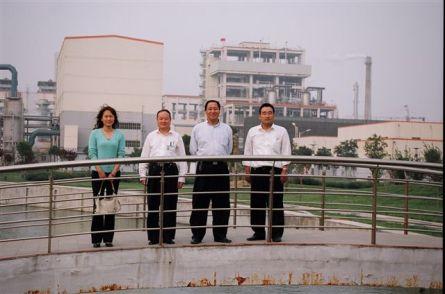
In China, however, coal synfuels offer an attractive route to cleaner air. Methanol produced from coal, for example, can be converted into clean-burning dimethyl-ether or DME which is similar to propane. DME supplied in portable tanks supplants indoor in-china-these-synfuels-pioneers-are-environmentalists.jpgburning of coal, wood, or dung which the WHO estimates is second only to poor sanitation as a cause of premature mortality in the developing world.

Coal-derived methanol also offers environmental benefits as a motorfuel. Blended into gasoline (something that my reporting confirms is already happening with Beijing’s tacit approval) can cut local air pollution in Chinese cities by at least a fifth according to research from Princeton’s Environment Institute and Beijing’s Tsinghua University.

How to solve the potential increase in CO2 emissions? Capturing and sequestering the CO2 is one option. Another complimentary solution promoted by the Princeton group is to feed both coal and renewable biomass into the synthetic fuel plants.

The takeaway message for me is that we should be careful not to take energy solutions off the table too hastily. The climate problem is too big for that. I say let a thousand flowers bloom, even those that grow on coal.

add to del.icio.us : Add to Blinkslist : add to furl : Digg it : add to ma.gnolia : Stumble It! : add to simpy : seed the vine : : :