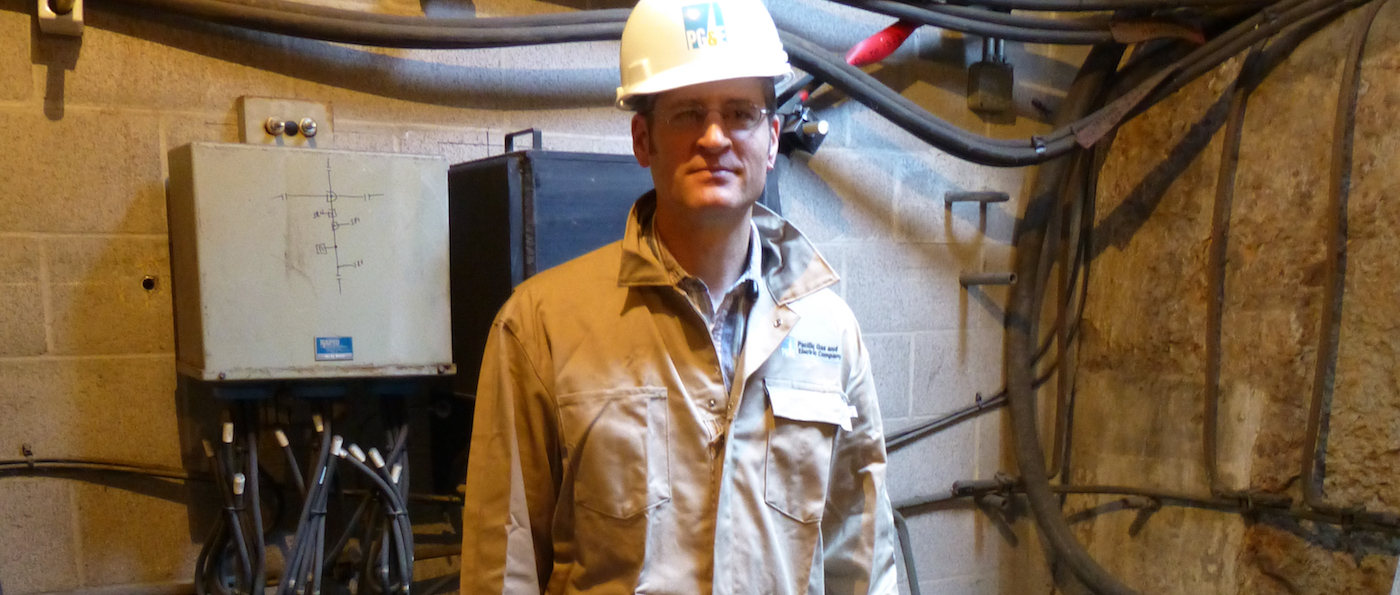
Fire the Grid

People around the world answered a call today to “fire the grid” this morning at 11:11am Greenwich Mean Time (7:11am EST). Unfortunately they’re not firing the grid that concerns me — the power grid — but rather the ‘earth grid’. Seems a near-death experience followed by other-worldly “light beings” inspired the organizer to call for a global spiritual embrace of the planet.  

Too bad. I for one thought that they were planning to lay-off electricity for a global hour, much as TV TurnOff Week frees our minds each April. Turning off the grid could be equally instructive.Pacific Northwest National Lab

The hour without power would be an opportunity to appreciate the grid, which has been called the greatest machine ever built and yet is all too often taken for granted. We should pay it heed, because the power grid needs to be modernized if it’s to shoulder increasing loads of clean-but-intermittent renewable energy.

At present investment is low. Universities have eliminated much of their research and teaching related to high-voltage power transmission. The power industry, meanwhile, spends just 0.3 percent of revenues on R&D, one of the lowest rates for any industrial sector. As one power expert lamented during an interview, “We’re beat out easily by the pet food manufacturers.”

Turning off the grid would also serve as a moment to reflect on our growing dependence on the various devices we plug into the power grid — some that we could easily get by without and others that may aggravate the stress and disconnectedness of modern life.

Science writer Phillip Schewe captured that last point succinctly in his wonderfully written precis on modern power systems: The Grid. Describing New Yorkers’ experiences of the August 14, 2003 blackout — the largest power system failure in history — Schewe writes that “after complaining about spoiled food or lost computer files” many also expressed a “sort of joy” at the conversations they enjoyed and the moments they spent with their children: “Provided it wasn’t too inconvenient, the absence of electricity was welcome. At least for a night.”

In The Grid Schewe toys with making the blackout a monthly affair, then rejects it as impractical. But one hour a year might not be so bad…

add to del.icio.us : Add to Blinkslist : add to furl : Digg it : add to ma.gnolia : Stumble It! : add to simpy : seed the vine : : : TailRank

CN Factoid #2: Why EPA Is Not Mandating Cleaner Coal

Last week I passed on a recent U.S. Department of Energy study calculating just how cheap it should be to zero-out emissions of CO2 from coal-fired power plants (CN Factoid #1: Cleaning Up Coal is Cheap). Now it’s time, as promised, to follow up with why the Bush Administration is not forcing use of Integrated Gasification Combined Cycle or ‘IGCC’ power plants, which excel at capturing CO2.

The short answer is that the Bush Administration has opposed the regulation of greenhouse gas emissions, including CO2 from coal. That ideological impediment is on the way out thanks to the U.S. Supreme Court ruling in April that “The harms associated with climate change are serious and well recognized” and that the EPA must therefore consider regulating CO2.

The longer answer is that the Bush EPA has followed neither the spirit or the letter of the Clean Air Act. EPA should be mandating IGCC technology for new coal-fired power plants, irrespective of its position on CO2, because IGCC plants also excel at capturing more conventional pollutants such as smog-forming NOx, sulfur and especially mercury. As the Clean Air Act stipulates that new power plants must be built using the best pollution control technology available, new coal plants dirtier than IGCCs should thus be technology-non-grata.

But when officials in Illinois, Montana and New Mexico began requiring consideration of IGCC technology when issuing air permits for new power plants, EPA issued a policy blocking such consideration. That prompted the Clean Air Task Force, a Boston-based environmental consulting firm, to sue EPA on procedural grounds. In a settlement reached last year EPA dropped the anti-IGCC policy, but the agency is still a ways from becoming an agent for positive change.

add to del.icio.us : Add to Blinkslist : add to furl : Digg it : add to ma.gnolia : Stumble It! : add to simpy : seed the vine : : : TailRank

Payoff from Sustained Solar Power R&D

Something good is happening in the world of photovoltaics: renewed investment in R&D is increasing the efficiency with which solar cells convert sunlight into electricity. See, for example, two reports I recently posted to the MIT Technology Review website:

Today’s on the latest in plastic solar cells: “Record Efficiency for Plastic Solar Cells”. And last month’s on the high-output crystal cells employed mostly in satellites: “Ultra-efficient Photovoltaics”.

That such performance gains are occurring in cells employing such radically different technologies suggests a systemic development. Alan Heeger, the 2000 Nobel Prize winner behind today’s advance in plastic power, told me his greatest hope is that the U.S. Department of Energy funding flowing once again to solar R&D will endure.

Consistent support is something the U.S. solar research community has never had. Support for PV jumped amid the 1970s energy crises, crashed with the energy price slide under Reagan, came back under Clinton and then fell again when Bush arrived. Plastic photovoltaics suffered similar short-term thinking in 2005 when DARPA (the Pentagon’s Advanced Research Projects Agency) quietly shelved a $40 million R&D program in plastic and other forms of “organic” solar after just one year of research.

“My hope is that interest on the part of the funding agencies and more generally on the part of the people in this country is sustained,” says Heeger. Only that consistency, he told me, will deliver the improvements required to make solar a big part of the solution.

add to del.icio.us : Add to Blinkslist : add to furl : Digg it : add to ma.gnolia : Stumble It! : add to simpy : seed the vine : : : TailRank

CN Factoid #1: Cleaning Up Coal is Cheap

What do I mean when I say that we are scared to death of controlling CO2?

Consider the continued construction of conventional coal-fired power plants, which spew 2-3 times as much CO2 skyward per kilowatt-hour of electricity produced than a natural gas fired generator. Despite that, coal remains popular with utilities because the cost of cleaner-burning gas has gone through the roof.GE's new image for coal

But we should be having our cake and eating it too, because the added cost of capturing and burying the CO2 from a coal-fired power plant is negligible relative to the benefit.

According to the latest numbers from the U.S. Department of Energy’s National Energy Technology Lab, building and running the equipment needed to capture CO2 from a coal-fired generator would add about 2.2 cents per kilowatt-hour of electricity delivered (increasing the cost of coal power from a new plant from 4.98 cents/kWh to 7.2 cents/kWh). That includes: the cost of building and operating Integrated Gasification Combined Cycle (or IGCC) power plants, which excel at capturing CO2; transporting CO2 to a site where it can be sequestered deep underground; and monitoring the buried CO2 for 100 years

For context, consider that the average price of electricity in the U.S. was 10.04 cents/kWh in the U.S. according to the latest federal stats, and in many places like California and New England average power costs exceed 14 cents/kWh. That means coal plants with carbon capture would still cost half what many American routinely pay for electricity.

Some major utilities such as AEP say they are ready to embrace IGCC technology and carbon capture, but they won’t make the switch until the public demands the extra investment.

For details on the DOE study, download the March 2007 presentation by NETL’s Jared Ciferno: Carbon Capture – Comparison of Cost & Performance for Gasification and Combustion-Based Plants. For more on the potential of coal gasification, check out my recent feature story for MIT Technology Review magazine — “China’s Energy Future” — on gasification’s extensive and growing use in China.

Up next: Why the Clean Air Act, which stipulates that utilities must use the best pollution control technology available, is not delivering when it comes to new coal plants. (Or for the policy wonks out there: IGCC’s struggle to get BACT)

add to del.icio.us : Add to Blinkslist : add to furl : Digg it : add to ma.gnolia : Stumble It! : add to simpy : seed the vine : : : TailRank

Getting Past the Fear

We are suddenly petrified by carbon dioxide. Not because the risk of climate change is overblown, but because our technological mastery over this simple gas has been vastly undersold. By applying this technological mastery, readily-available carbon-neutral energy sources and efficient vehicles we can stop treating Earth’s atmosphere like a garbage dump, just as cities in the industrial world (and increasingly beyond) no longer flush refuse into rivers and bays. That is the message of Carbon-Nation, a blog to blow off the haze of claims and counter-claims obscuring climate change solutions, charting the technological paths available today to co2-capture at esbjerg in-denmark-small.jpgre-energize our economies.

Starting with carbon capture. Why do so many still view the capture of CO2 from power plants as science fiction, or at best impractical? CO2 leavens our bread, bubbles our soda, animates the pistons powering our combustion engines, and even dry cleans our best ensembles. We know how to handle this stuff. In fact, CO2 is rapidly becoming the key to domestic oil production: Since the 1970s U.S. oil producers have pumped millions of tons of CO2 into their rapidly maturing oil wells to free up the liquid gold trapped within (collecting handsome tax breaks in the process).

They’ll use hundreds of millions of tons more in the decades to come. In other words storing carbon underground is already standard practice in the oilpatch — and profitable to boot. See, for example, my story “Carbon Dioxide for Sale” in MIT’s Technology Review on Dakota Gasification, which buries more CO2 pollution in oilfields in a year than a hundred thousand cars release in their operational lifetime.

If the technology to capture and store CO2 is viable today, why does CO2’s growing concentration in Earth’s atmosphere leave us feeling so powerless? Why do we let utilities build new carbon-spewing coal plants and automakers build unreformed combustion engines? Because the anti-climate PR campaigns financed by oil companies, automakers, coal producers and utilities told us that reforming our energy systems would bankrupt the economy.

Carbon-Nation will seek to deliver the knowledge available to master that fear and to implement solutions that will give us cleaner, higher-performing energy system.

add to del.icio.us : Add to Blinkslist : add to furl : Digg it : add to ma.gnolia : Stumble It! : add to simpy : seed the vine : : : TailRank