Can U.S. Grids Handle 100% Renewables?

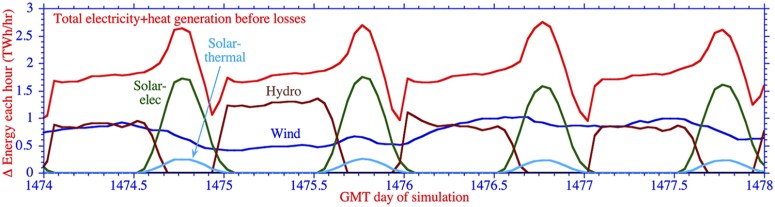
Four Days in 2055: Dynamic heat and power supply on the mid-century wind, water and sunlight-fuelled U.S. grid simulated by Stanford’s Mark Jacobson

A battle royale between competing visions for the future of energy blew open today on the pages of a venerable science journal. The conflict pits 21 climate and power system experts against Stanford University civil and environmental engineer Mark Jacobson and his vision of a world fuelled 100 percent by renewable solar, wind, and hydroelectric energy. The criticism of his “wind, water and sun” solution and an unapologetic rebuttal from Jacobson and three Stanford colleagues appear today in the Proceedings of the National Academy of Sciences. In fact, while both sides claim to be objectively weighing the energy options, the arguments and backgrounds of the protagonists belie well-informed affinities for various energy sources (and informed biases against others). As sociologists of science would say, their choice of data and their reading of it reflects hunches, values, and priorities.

Continue reading “Can U.S. Grids Handle 100% Renewables?”

Commentary: Photo Ops with Miners No Substitute for Climate Policy

President Donald Trump surrounded himself with coal miners at the EPA yesterday as he signed an executive order calling for a clean sweep of federal policies hindering development of fossil fuel production in the United States. The order instructs EPA to kill Obama’s Clean Power Plan and thus, according to Trump’s rhetoric, revive coal-fired power generation and the miners who fuel it. The electric power sector, however, responded with polite dismissal. What separates President Trump and some of his top officials from power engineers and utilities? The latter operate in a world governed by science and other measurable forces. Unlike President Trump, scientists, engineers, and executives suffer reputational and financial losses when they invent new forms of logic that are unsupported by evidence. And a world of fallacies underlies the President and his administration’s rejection of climate action. Continue reading “Commentary: Photo Ops with Miners No Substitute for Climate Policy”

Trump Budget Dumps Climate Science, Innovation

Al Gore didn’t really claim to invent the Internet in 1999, but he did champion a NASA mission that installed a deep space webcam pointed at Earth in 2015. And yesterday President Trump put a bullseye on that mission. Trump’s 2018 budget blueprint asks Congress to defund the Earth-facing instruments on the Deep Space Climate Observatory (DSCOVR). Selectively deep-sixing well-functioning instruments on a satellite 1.5 million kilometers from Earth is one of the stranger entries in President Trump’s first pass at a budget request. But it fits a pattern: Throughout the document programs aimed at comprehending or addressing climate change take deep cuts, even where there is no obvious fiscal justification. Continue reading “Trump Budget Dumps Climate Science, Innovation”

The Self-Driving Car’s Bicycle Problem

Robotic cars are great at tracking other cars, and they’re getting better at noticing pedestrians, squirrels, and birds. The main challenge, though, is posed by the lightest, quietest, swerviest vehicles on the road. “Bicycles are probably the most difficult detection problem that autonomous vehicle systems face,” says UC Berkeley research engineer Steven Shladover. Nuno Vasconcelos, a visual computing expert at the University of California, San Diego, says bikes pose a complex detection problem because they are relatively small, fast and heterogenous. “A car is basically a big block of stuff. A bicycle has much less mass and also there can be more variation in appearance — there are more shapes and colors and people hang stuff on them.” Bikes are also being left behind by the machine learning techniques that enable detection systems to train themselves by studying thousands of images in which known objects are labeled. Most of the training, to date, has employed images featuring cars, with far fewer bikes. Continue reading “The Self-Driving Car’s Bicycle Problem”

Carbon Tax Split on the Northern Border

The victory of climate change-denying Republican candidate Donald Trump was one of two big setbacks for U.S. climate policy earlier this month. The other was the resounding defeat of Washington State’s Initiative 732, which sought to prove that using fees on carbon emissions to cut existing taxes could provide bipartisan appeal for what economists consider to be the most efficient mechanism to cut greenhouse gas emissions: carbon taxes. Washington State rejected the carbon tax by 59 percent to 41. In sharp contrast, just across the world’s longest border, carbon taxes are attracting politically diverse support. Four-fifths of Canadians will live in provinces with such taxes in 2017, and in 2018 all Canadians could be paying a carbon tax. Read on at MIT Technology Review… 

Continue reading “Carbon Tax Split on the Northern Border”

Bark Versus Bite on Trump and Clean Energy

President-elect Donald Trump is a self-declared climate-change denier who, on the campaign trail, criticized solar power as “very, very expensive” and said wind power was bad for the environment because it was “killing all the eagles.” He also vowed to eliminate federal action on climate change, including the Clean Power Plan, President Obama’s emissions reduction program for the power sector. Trump’s rhetoric has had renewable-energy stocks gyrating since the election. But the impact on renewable-energy businesses could be far less drastic than many worst-case scenarios. “At the end of the day what Trump says and what is actually implemented are two completely different things,” says Yuan-Sheng Yu, an energy analyst with Lux Research. Read on at MIT Technology Review

Can Reprogrammed Renewables Stabilize Grids?

As renewable power displaces more coal, gas, and nuclear generation, electricity grids are losing the conventional power plants whose rotating masses have traditionally helped smooth over glitches in grid voltage and frequency. One solution is to keep old generators spinning in sync with the grid, even as the steam and gas turbines that once drove them are mothballed. Another emerging option will get a hearing next week at the 15th International Workshop on Large-Scale Integration of Wind Power in Vienna: creating “synthetic inertia” by reprogramming wind and solar equipment to emulate the behavior of their fossil-fired predecessors.

Continue reading “Can Reprogrammed Renewables Stabilize Grids?”