Democratizing geothermal energy

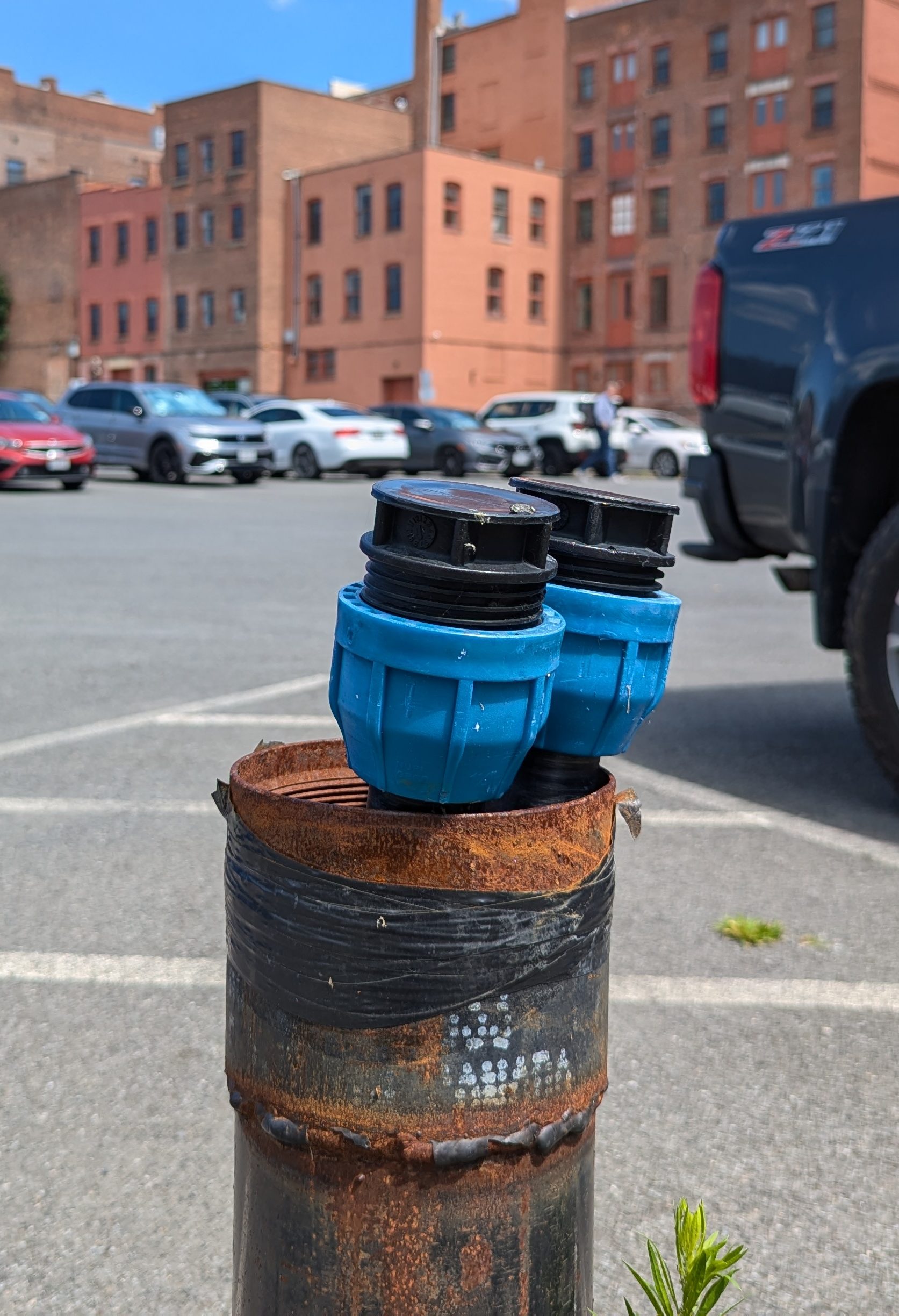
Pilot borehole for geothermal network in Troy NY
A geothermal test loop behind the arts center in Troy, NY

Tapping the ground is the most efficient means of heating and cooling buildings, but requires boreholes that are prohibitively expensive for most homeowners and businesses to drill on their own. Geothermal ‘networks’ change that equation. Just as power and gas utilities spread the costs of building power plants and transmission lines and gas pipes, they can make geothermal accessible to all by spreading out the costs of drilling hundreds of feet into the ground.

My Nature magazine feature on geothermal networks shows how this largely overlooked solution for moving cities off gas heating is spreading in Europe and North America, and why its performance and politics may accelerate electrification. I also show how this promising climate solution is undermined by a dearth of knowledge exchange between practitioners on either side of the Atlantic.

This is effectively part 4 in an ongoing series of ‘getting off gas’ stories supported by the Fund for Environmental Journalism. On-the-ground insights from New York’s Hudson Valley that enriched the Nature feature wouldn’t have been possible without that grant from the Society of Environmental Journalists.
UNDARK: Do High-rises Built from Wood Guarantee Climate Benefits?

Dual debuts in this critical investigation of cross-laminated timber — multi-ton panels built from lumber that are the hottest material in “sustainable” building. It’s my debut work for Seattle-based nonprofit reporting outfit InvestigateWest as well as my first article in MIT-based science magazine Undark, which co-published the finished product

Spoiler alert: CLT producers promote their building material as a climate solution because their giant wood panels can replace energy-intensive concrete and steel construction. My investigation reveals that the carbon accounting behind their claim is oversimplified, and too many journalists give short shrift to concerns from sustainable materials experts.

Take one study of CLT’s carbon footprint that VOX’s high-profile sustainability writer David Roberts called a “soup-to-nuts lifecycle analysis.” My look under the hood revealed a huge pile of nuts that’s left out: nearly all of the carbon flows into and out of forests harvested to supply CLT manufacturing plants with lumber. One of my expert sources calls that a “gaping hole” in the industry’s standard carbon-counting methodology. 

It’s a particularly egregious gap for CLT assembled from lumber from British Columbia, where timber firms remove far more carbon every year than BC’s fire and infestation-ravaged forests can regrow. 

Read it via InvestigateWest or Undark
Article republished by Grist and by NW nonprofit news outlet Crosscut

Seattle’s Bullitt Center Shines

The designers of Seattle’s Bullitt Center have overachieved. The designers set out to demonstrate that a six-story office building could generate all of the energy it needs, but after one year of operation, it is sending a sizable energy surplus to the local power grid, according to data released by its developer, the Bullitt Foundation. Consumption is simply far lower than what its architects and engineers projected for the 52,000-square-foot building. Instead of using 16kBtu per square foot—half the energy-use intensity (EUI) of Seattle’s best-performing office building—consumption during its first year was just 10kBtu/sf …read on at Architectural Record

Vertical Farming Grows Up

Community-gardening advocates have sold urban farming as a sustainable local alternative to industrial-scale farming and as an educational platform for healthier living. And municipalities are buying in, adopting urban ag to transform vacant lots into productive civic assets. In the last two or three years, however, entrepreneurial urban farmers have opened a new frontier with a different look and operating model than most community gardens. Their terrain is above the ground, not in it. Working with help from engineers, architects, and city halls, they have sown rooftops and the interiors of buildings worldwide. “There’s a lot of activity right now, and there is huge potential to do more of it,” says Gregory Kiss, principal at Brooklyn-based architecture firm Kiss + Cathcart. Continue reading “Vertical Farming Grows Up”

Listening to Building Occupants

The stats on occupant comfort are disappointing, and green buildings are no exception. Consider, for example, heating and cooling performance. Thermal-comfort standard standards stipulate that such systems should satisfy at least four out of five occupants. “Very few buildings actually perform that well,” according to John Goins with the Center for the Built Environment (CBE) at UC Berkeley. Out of the 609 buildings in CBE’s database, only 13 percent meet ASHRAE’s performance threshold; among those that are LEED-certified, 20 percent make the grade. There is increasing recognition that all that discomfort may be translating into a lot of wasted energy. Goins estimates that the average office building wastes 4 percent of its energy just by cooling and heating more than occupants want. The indirect impact could be even bigger when one considers how disgruntled occupants—who in most buildings lack an effective channel for requesting change—fight back against the machine. They may block air vents or plug in space heaters to combat excessive air-conditioning…

Excerpted from the May/June edition of GreenSource Magazine. Read the story at GreenSource.

Building-in a Force of Nature

Turbine House: Design by Michael Pelken & Thong Dang
Turbine House: Michael Pelken & Thong Dang’s residence with horizontal-axis wind turbine

As design teams work toward harnessing air flows around buildings, they are producing some intriguing structures. But just how viable is wind power as a source of on-site renewable energy?
By Peter Fairley

Wind power is the fastest-growing source of megawatts thanks to the jumbo-jet-sized turbines sprouting en masse worldwide. But it also has a significant presence in the city, where gusts regularly send umbrellas to landfills. Rather than considering it a nuisance, architects increasingly view urban wind as a renewable resource for on-building power generation.

Building-integrated wind power (BIWP)—wind turbines mounted on or incorporated within an occupied structure—may lack wind farms’ economies of scale. But like the leading source of on-building renewables—photovoltaics (PVs)—wind turbines offer some advantages in architectural applications. No roads get cut through wilderness to erect towers, and they deliver electricity without power lines and transmission losses. Wind turbines are also attractive to designers and clients looking to express a commitment to sustainability.

Such benefits provide potential for dramatic growth, says mechanical engineer Roger Frechette, principal in the Washington, D.C., office of Interface Engineering. “If there’s data showing that BIWP works and testimony that it’s a good thing to do, there will be an explosion,” he predicts…

Published in the April 2013 issue of Architectural Record Magazine. Read the whole story.