 Local concerns about the safety of carbon sequestration are blocking European power giant Vattenfall’s plan to close the loop on greenhouse gas emissions from its coal-fired carbon capture and storage (CCS) pilot plant in Schwarze Pumpe, Germany. The ‘oxyfuel’ plant has been burning coal in pure oxygen since starting up last fall, making its CO2 exhaust easy to capture. But burial of the CO2, set to begin this spring, is now on hold according to the U.K.’s Guardian newspaper. Staffan Gortz, Vattenfall’s CCS spokesperson, told the paper that, “people are very, very skeptical.” Continue reading “Schwarze Pumpe Hits a Bump”
Category: Climate Science & Politics
Winged Creatures Should Fear CO2, Not Wind Turbines
 Benjamin Sovacool agrees that wind turbines kill birds and bats, but this University of Singapore public policy professor makes a convincing case that this fact desperately needs context. Reviewing avian mortality from power generation in the June issue of Energy Policy, Sovacool shows that — gigawatt-hour for gigawatt-hour — it is fossil-fired power by a longshot that will ground winged creatures.
Sovacool’s analysis estimates avian deaths throughout the fuel cycle for coal, oil and natural-gas fired power generation:
- Coal mining = 0.02 deaths per gigawatt-hour (GWh). For example, habitat destruction by mountaintop removal coal mining in Appalachia has killed approximately 191,722 Cerulean Warblers.
- Plant operations = 0.07 bird deaths/GWh. Electrocution at one well-observed power plant in Spain killed 467 birds over two years.
- Acid rain = 0.05 deaths/GWh. Cornell’s Laboratory of Ornithology estimated in 2002 that acid rain reduced the U.S. wood thrush population by 2–5%.
- Mercury emissions = 0.06 deaths/GWh. Impacts include hampered reproduction and survival, observed in everything from albatross and woodstorks to bald eagles. Continue reading “Winged Creatures Should Fear CO2, Not Wind Turbines”
Europe Shortlists Capture Projects for Stimulus
European leaders shortlisted a dozen proposals to demonstrate large-scale carbon capture and storage at coal-fired power plants last month as eligible to share €900 million of the EU’s €5-billion stimulus funding package. The goal is to bring down the cost of carbon-neutral coal power — which the European Commission expects to continue to exceed the cost of conventional coal power in 2020 — and to gain more experience with underground storage of CO2.
Seven propose to capture CO2 post-combustion from the exhaust of conventional coal-fired power plants, a relatively inefficient process that nonetheless costs less up front — an attractive feature given today’s financial mess. Three are Integrated Combined Cycle Gasification or IGCC power plants that would pull CO2 out of coal-derived gases prior to combustion, akin to the U.S. FutureGen project that Bush killed and Obama may be reviving. Two more would concentrate their CO2 exhaust by burning coal in purified oxygen — the oxyfuel approach that Sweden’s Vattenfall is testing at a pilot plant in Germany.
Continue reading “Europe Shortlists Capture Projects for Stimulus”
Giving FutureGen a Second Chance
FutureGen — the carbon-neutral coal power project initiated and then killed under the Bush Administration — looks increasingly likely to be resuscitated under President Obama after proponents met with Energy Secretary Steven Chu this week. There is now good reason to take a fresh look at this proposed coal gasification power plant which integrates carbon capture and storage (CCS) from the ground up.
Those words don’t come easy for this longtime FutureGen critic. But the context has changed since FutureGen was conceived in 2003, and even since Bush Energy Secretary Samuel Bodman killed it in January of 2008. While Energywise recently noted ongoing concern over FutureGen’s cost, here are five arguments that could justify heavy federal financing:
- Project scope: In its early years FutureGen was viewed as a PR exercise because it framed carbon-neutral coal as a research project, positioning the use of commercially-ready Integrated Gasification Combined Cycle power plants as a moon-shot. Chu has indicated that the project would be streamlined. My sources say one element likely to go will be plans to generate fuel-cell grade hydrogen.
- Financing: The most fundamental block to commercialization of IGCC technology was Bush’s refusal to put a price on carbon emissions, which thwarted even utilities such as AEP that wanted to build cleaner coal plants. Carbon pricing may arrive under Obama–if he can push it through Congress–but the financial collapse has now slashed utilities’ appetite to pore capital into big projects.
Chu Entertains FutureGen Alliance
 Potential Energy has learned that Energy Secretary Steven Chu met with representatives of the FutureGen Alliance today, reinforcing positive signals from Chu two weeks ago that the troubled project could be revived. The public-private partnership to prove the integration of carbon capture and storage and coal gasification technology was killed by the Bush Administration in January 2008 using what Congressional investigators have shown to be specious accounting.
In an email to TechReview today, Department of Energy press secretary Stephanie Mueller confirms that Chu and the Alliance had a “good discussion” and that the Secretary Chu “believes that the FutureGen proposal has real merit”:
Secretary Chu believes that investment in carbon capture and storage research and development is critical to meeting our energy and climate change challenges. Unfortunately, the prior Administration simply walked away from FutureGen after years of work … In the coming weeks, the Department will be working with the Alliance and members of Congress to strengthen the proposal and try to reach agreement on a path forward.
Climate Denial Crock of the Week
Opponents of the theory of anthropogenic climate change are hard at work via Internet forums making a last stand against the present societal momentum to address our impact on global climate and, specifically, to reduce the carbon footprint of our energy systems. Midland, MI-based multimedia producer, cartoonist, and alternative energy enthusiast Peter Sinclair is returning fire, nugget-for-nugget, with his new YouTube-distributed video series, Climate Denial Crock of the Week.
Each episode of Crock answers one of the climate denial “hobby-horse arguments” with five minutes of science-based, semi-professionally produced video. The Vikings star in this week’s episode, Medieval Warming?, which explodes the notion that Earth was warmer in the Middle Ages:
Pushing Geoengineering Out of the Closet
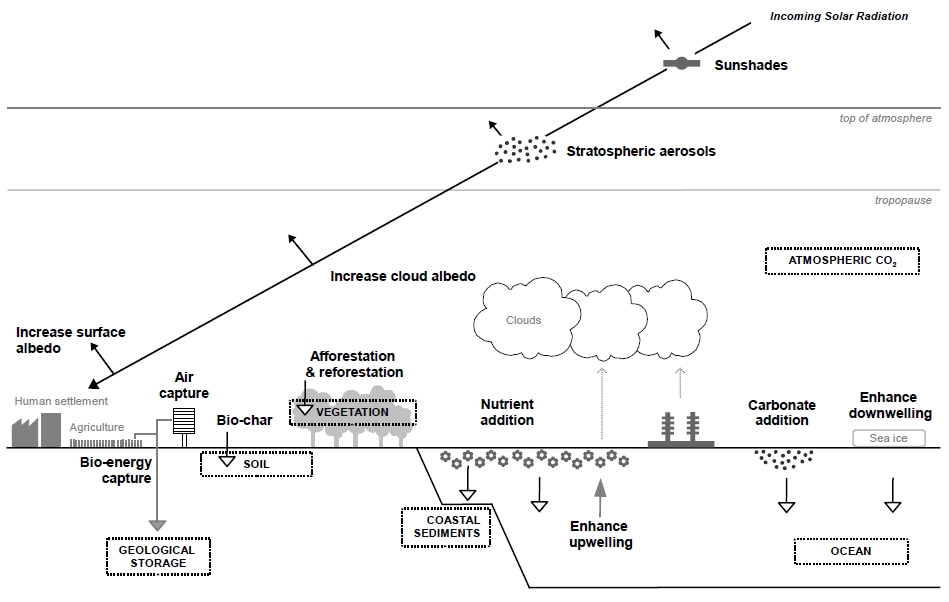 When Time Magazine included geoengineering in its “What’s Next for 2008” report it wrote that, “a few scientists are beginning to quietly raise the possibility of cooling the planet’s fever directly…as an option of last resort.” Today scientists at the University of East Anglia (UEA) are definitively smashing the hush surrounding geoengineering, publishing the first comprehensive assessment of the climate cooling potential of the various schemes being contemplated to re-engineer Earth.
“The realisation that existing efforts to mitigate the effects of human-induced climate change are proving wholly ineffectual has fuelled a resurgence of interest in geo-engineering,” explains UEA Environmental Sciences professor Tim Lenton, who wrote the report with UEA colleague Naomi Vaughan. Their report in today’s issue of the journal Atmospheric Chemistry and Physics Discussions shows that the benefits of some schemes have been exaggerated in the past by “significant” errors in calculations, but the best will likely play a constributing role in blunting climate change:
“We found that some geoengineering options could usefully complement mitigation, and together they could cool the climate, but geoengineering alone cannot solve the climate problem.”
 Peter Fairley