The EuroParliament’s Schwarzenegger Clause and CCS

Carbon sequestration — the notion that carbon dioxide from coal-fired power stations and other major greenhouse gas emitters can be captured and stored underground — is taking a lot of hits from environmental activists bent on banning coal outright. For a taste, check out this recent post on the Gristmill green blog by Joseph Romm, a most articulate carbon capture critic. Political leaders, in contrast, appear far more supportive, and it’s not just American presidential candidates wooing coal-country voters. Last week European parliamentarians voted to finance largescale sequestration demo projects with a generous €10-billion fund and, better still, approved what they called a ‘Schwarzenegger Clause’ to mandate carbon capture for new generating stations from 2015. Like an existing requirement approved by California’s governor the clause sets a 500 gram CO2 per kilowatt-hour emissions limit that coal-fired plants can beat only with carbon capture.

The U.K.’s Environment Agency had already recommended a ban new coal-fired power plants that don’t use carbon capture and storage (CCS) the week before.

Part of the European motivation, as French and British leaders have made clear, is that CCS is more than a key to meeting agressive climate change action goals. They are also a critical means of keeping coal in the mix and thus limiting Europe’s dependence on imported oil and gas from Russia and the Middle East.

In the U.S., meanwhile, Al Gore is calling for civil disobediance to force adoption of the same CCS mandate. In fact, there are already steps in this direction even in North America beyond Schwarzenegger’s innovations:A panel appointed by Arkansas’ governor recommended last month the state approve no new coal plants until CCS is ready; the Canadian government floated a plan this spring to require CCS at new bitumen-to-oil plants in Alberta’s tarsands from 2012; and last fall British Columbia decreed a no-new CO2 from coal policy that stalled two proposed coal-fired plants (one may go forward as a biomass plant to burn trees killed by a warming-enabled infestation of beetles).

A wildcard to watch: weakening political resolve in the face of the global finance crisis. According to this report from Agence France Press yesterday, a few European leaders are wavering on greenhouse gas emissions as energy-intensive industries face tough times ahead.

add to del.icio.us : Add to Blinkslist : add to furl : Digg it : add to ma.gnolia : Stumble It! : add to simpy : seed the vine : : :

CO2’s Bottom Line Just Keeps On Rising

Climate change skeptics obsess about the immense uncertainties that plague climate modeling. It’s not, however, all a matter of mysterious physics and chemistry. Human behavior — in this case our boundless capacity to ignore grave danger — poses the greatest challenge. No order of scientific progress nailing down the links that regulate Earth’s climate will enable certain projections of climate change over the next century because it is human behavior that controls the most powerful element: emissions of greenhouse gases such as CO2 and methane.

Today scientists with the international Global Carbon Project are releasing an updated accounting of CO2 emissions, and they far exceed the best guesses of human behavior by the Intergovernmental Panel on Climate Change (IPCC). “Emissions in 2007 were at the high end of’ those used for climate projections in the last [IPCC] report,” says Global Carbon Project participant Corinne Le Quéré, an environmental chemist at the University of East Anglia.

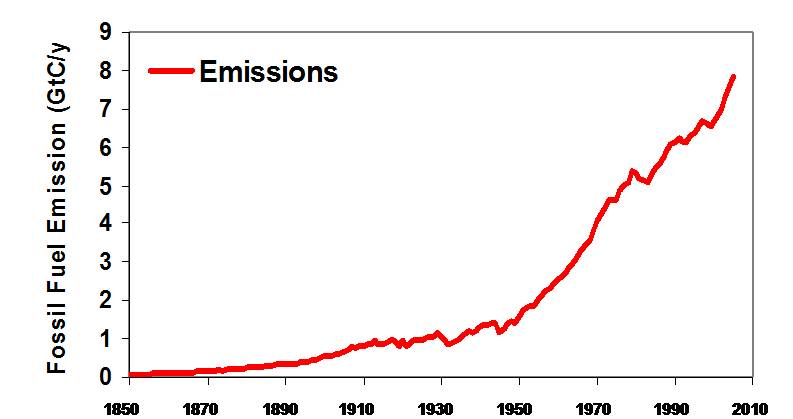
Emissions from burning fossil fuels and cement manufacturing — the largest sources of anthropogenic CO2 — continue to increase rapidly (see graph above); in 2007 they were now 38% higher than in 1990. In total, emissions drove up the atmospheric concentration of CO2 by 2.2 parts per million last year, compared with 1.8 ppm in 2006. At the end of 2007 CO2 was at 383 ppm — the highest concentration during the last 650,000 years and probably during the last 20 million years according to the Global Carbon Project. 

At the same time the oceans, which in past acted as a buffer to absorb excess CO2, are saturating. Le Quéré, who coauthored a report last year in Science that the Antarctic Ocean had already saturated, calls it a dangerous combination: “If this trend continues and the natural sinks weaken, we are on track towards the highest projections of climate change.”

add to del.icio.us : Add to Blinkslist : add to furl : Digg it : add to ma.gnolia : Stumble It! : add to simpy : seed the vine : : : TailRank

U.S. Law Swinging for Carbon Controls

Just over one year ago Carbon-Nation pondered the continued construction of conventional coal-fired power plants in the U.S. despite the availability of cleaner gasification-based technology. In Why EPA is not Mandating Cleaner Coal I laid out the legal case for EPA to mandate the use of Integrated Gasification Combined Cycle technology — something the Bush Administration has refused to do:

As the Clean Air Act stipulates that new power plants must be built using the best pollution control technology available, new coal plants dirtier than IGCCs should thus be technology-non-grata.

At the time I posited that the then-recent U.S. Supreme Court decision declaring carbon dioxide a pollutant under U.S. law might help to turn the tide. That appears to be happening. Late last month a judge in Georgia overturned a permit for a planned coal-fired power plant, linking the Supreme Court ruling and the existing Clean Air Act requirement for best available technology.

Here’s how the Pew Center on Global Climate Change, a Washington-based think tank, presented the decision in “Georgia Court Rejects Proposed Coal-Fired Plant Over GHG Emissions Concerns” :

On June 30, 2008, Judge Moore of Georgia’s Fulton County Superior Court revoked a permit for construction of a proposed 1200-megawatt coal-fired power plant in the state. Ruling in favor of the plaintiffs, Judge Moore found that the permit filed by Longleaf Energy and approved by the Georgia Environmental Protection Division failed to consider the best available pollution control technology (BACT) to mitigate harm caused by the proposed plant’s estimated annual emissions of 8-9 million tons of CO2. The defense had argued that a BACT analysis was unnecessary because CO2 is not a pollutant subject to regulation under the Clean Air Act (CAA). In rejecting the defense’s argument, Judge Moore cited the U.S. Supreme Court’s April, 2007 decision in Massachusetts v. EPA, in which the Court found that CO2 does qualify as a harmful pollutant that the United States Environmental Protection Agency must consider regulating under the CAA.

The company behind the project, Longleaf Energy Associates, plans to appeal.

add to del.icio.us : Add to Blinkslist : add to furl : Digg it : add to ma.gnolia : Stumble It! : add to simpy : seed the vine : : :

Garbage to Gas Addendum

An important paragraph fell out of my waste gasification coverage this week during the editing process:

Bryden [PlascoEnergy’s CEO] says the core functions of their 100-m.t./day demo plant are performing to expectations. Nevertheless, he acknowledges that its also had its share of teething pains. The feed system has proved susceptible to jamming, regularly interrupting test runs. And they discovered that after such unanticipated interruptions oxygen entering the system ignited particulates and burned the baghouse filters designed to capture that soot before it exits the plant. Adding a valve stopped the filter fires, and Bryden says PlascoEnergy will install a new waste feeder in August.

These are the kinds of glitches one expects with new technology. But they’re also an important reminder that this is new technology and, as such, there’s no guarantee it will work as advertised.

Caveat emptor.

add to del.icio.us : Add to Blinkslist : add to furl : Digg it : add to ma.gnolia : Stumble It! : add to simpy : seed the vine : : :

Garbage to Gas

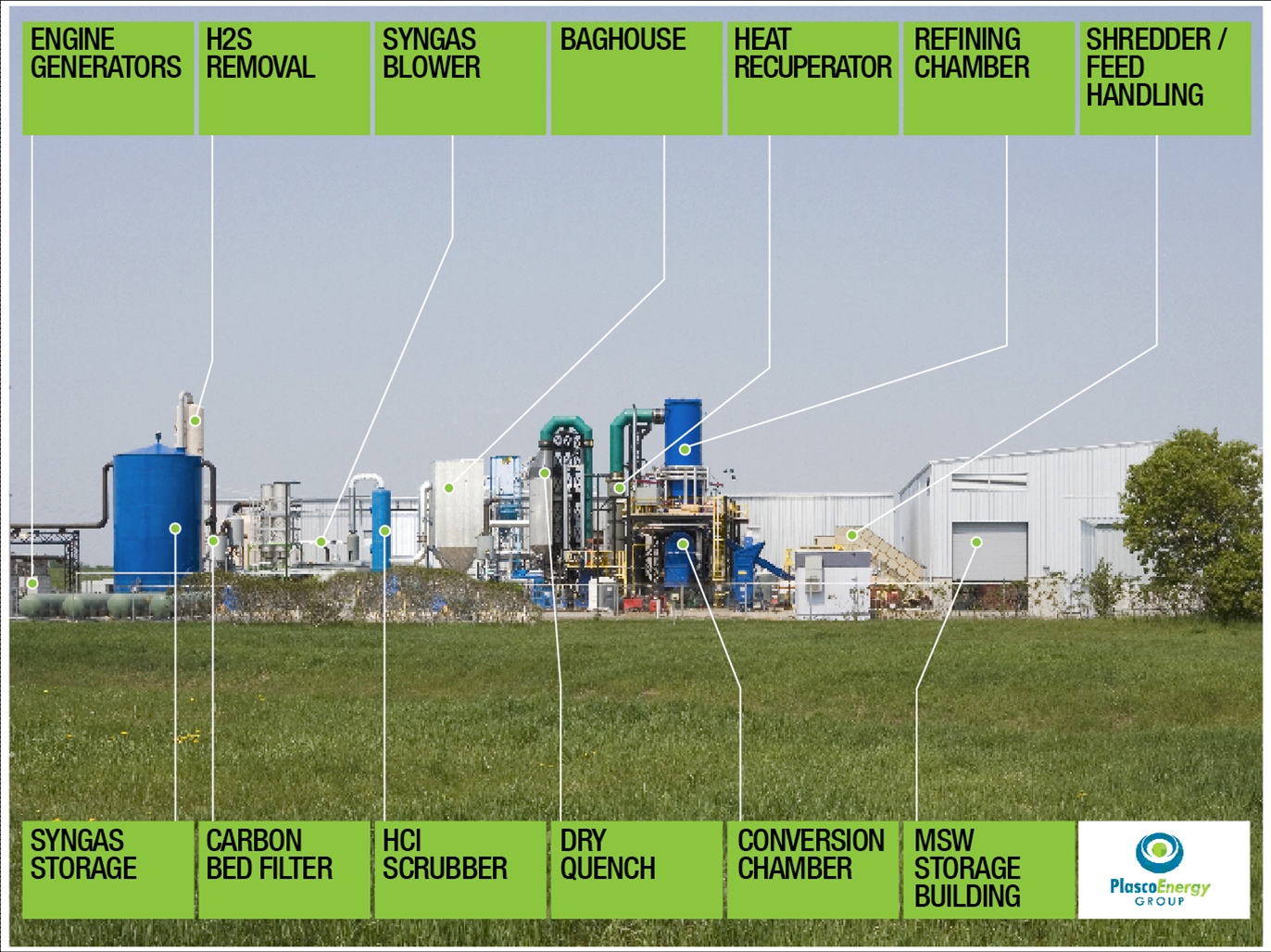
PlascoEnergy\'s Waste Gasfication ProcessRising costs of energy and other commodities have silenced erstwhile critics of municipal collection of plastic, paper and glass for recycling. Critics of converting trash into energy may be the next to go, if developments in Ottawa are any guide. Last week Ottawa’s city council unanimously approved a proposal by local technology developer PlascoEnergy to build an innovative 400-m.t./day waste-to-energy facility within city limits. If built, it would be the first such plant in North America in over a decade.

PlascoEnergy CEO Rod Bryden says the plant’s technology is key to public acceptance. “There wasn’t a single person who attended the council meeting to object. There’s no chance that would happen with a landfill or an incinerator,” says Bryden.

Rather than simply tossing trash into a giant furnace, PlascoEnergy’s design employs superhot electric plasma torches to first gasify municipal waste. Gasification eases the subsequent removal of contaminants such as mercury and produces a clean-burning ‘synthesis gas’ amenable to combustion in high-efficiency engine generators; net power exports to the grid will be about 21 megawatts. At the same time the plant will cut the equivalent of 2.1 m.t. of CO2 for every tonne of waste, thanks largely to avoided methane emissions from Ottawa’s landfill.

More gasification-based waste treatment is on the way, and not just to generate electricity. In April General Motors-based cellulosic ethanol firm Coskata, which plans to make ethanol from syngas, announced plans to integrate its first demonstration plant with an existing waste gasification pilot plant in Pennsylvania.

For more on the trash gas trend, see “Garbage In, Megawatts Out” on MIT’s TechnologyReview.com.

add to del.icio.us : Add to Blinkslist : add to furl : Digg it : add to ma.gnolia : Stumble It! : add to simpy : seed the vine : : : TailRank

Dark Clouds Over Clean Diesels

GM-Opal\'s turbo-diesel Agila © GM CorpDiesels are returning to auto showrooms nationwide. Major automakers will offer them from this fall for the 2009 model year, equipped with vastly improved emissions control devices that make them a lot cleaner than the diesel image. But their main attraction — fuel economy — is rapidly fading. The cost of diesel is rising more rapidly than gasoline, while there is increasing skepticism about their impact on climate change.

I explore the environmental implications of diesel in “Dark Clouds Over Clean Diesels”, a web-exclusive news piece on Spectrum.com. The short take: diesels still emit more soot than gasoline-fueled vehicles and the bad news on soot just keeps getting worse. Estimates of mortality from breathing fine particles is still rising, and there are top climate scientists who believe that soot is also a serious contributor to global warming. It could be second only to CO2, even outpacing methane.

Interestingly, while the U.S. and Canada prepares for a new generation of diesel cars and light trucks, European car buyers are moving in the opposite direction. A German automotive research center recently forecast a sharp decline in diesel’s share of the European car market over the coming decades, thanks to the cost of adding tailpipe controls and tough competition from gasoline-powered engine technology. From a current market share of 53% (compared to 3% in the U.S.), the study predicts diesels to drop to 38% of Europe’s car market in 2015 and to 30% in 2020.

add to del.icio.us : Add to Blinkslist : add to furl : Digg it : add to ma.gnolia : Stumble It! : add to simpy : seed the vine : : : TailRank

The Other Solar Power

Solar thermal power cuts a fascinating contrast with solar photovoltaics and wind turbines — today’s leading renewable energy technologies — besting one on price and the other on quality. Little surprise then that it is being selected for power plants equal in output to large wind farms and ten-times the size of the largest photovoltaic installations.

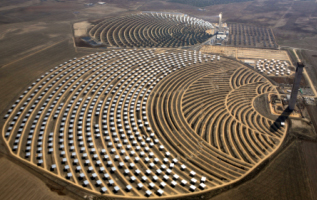
Whereas photovoltaics employ semiconductors to directly convert sunlight into electricity, solar thermal power stations convert sunlight into heat to generate steam and drive a turbine. This roundabout is, ironically, a huge money-saver. The Abengoa thermal solar power towers in Sevillemirrors, pipes, pumps and steam turbines that form a solar thermal plant cost less than half than an equivalently powerful array of photovoltaics.

Solar thermal cannot similarly challenge wind turbines on cost (at least not at present). But solar thermal plants can store some of the energy they capture and, as a result, produce a much steadier and more reliable supply of electricity than the famously variable wind turbine.

So why then did we hear so much about solar photovoltaics over the past decade and sol little of solar thermal? Because the latter is inherently utility-scale technology, whereas photovoltaic panels provide value one rooftop at a time. Fred Morse, a solar thermal pioneer and currently senior advisor to renewable energy developer Abengoa Solar, likens it to a bakery operating through the depression. “If you had a bakery and you sold cookies or big wedding cakes, during hard times you could sell a lot of cookies,” says Morse. “PV has little niche markets and it could grow and grow and as the price came down it expanded those markets to where it is today.”

These days, thanks to state and (albeit on-again-off-again) federal incentives and record fuel prices, solar power is back to wedding cakes.

For more, check out “Solar without the Panels”

add to del.icio.us : Add to Blinkslist : add to furl : Digg it : add to ma.gnolia : Stumble It! : add to simpy : seed the vine : : :