Physicists Talk Tough on Efficiency and The War

I recall well a meeting of journalists at the Kennedy School of Government in 2003 where I was regarded as a wingnut + conspiracy theorist for seeing a linkage between U.S. intransigence on greenhouse gas controls and the War in Iraq. Never have I felt as alienated as an American intellectual. These days I reflect instead on how far the national conversation has come in the years since. I happened upon the latest sign of hope quite unexpectedly in a report on energy efficiency issued earlier this month by the American Physical Society: “Energy = Future. Think efficiency.” 

I’d been feeling guilty about letting the APS report pass by without a mention. Energy efficiency is a tough story for journalists — making do with less energy simply lacks the sex appeal of faster cars or new power generating technologies such as high-tech techniques for pollution-free coal power or the latest in photovoltaics. And yet, as the APS rightly points out, the U.S. is in a better position than most countries to meet its need for clean, domestic energy by squeezing a bigger bang out of every joule of energy consumed.

What will be useful about the APS report is its explicit connection between the technologies available to boost efficiency in the key sectors of transportation and buildings, and the shortcomings in science & technology policy that thwart their ready adoption or rapid adoption.

But what I really appreciated was the no-nonsense manner in which the analysis unfolds. The relatively frank prose of the executive summary (considering the genre) sets the stage for what follows:

“Nowhere is the standard of living more rooted in energy than in the United States, and, with its defense forces deployed in the most distant regions around the world, nowhere is the security of a nation more dependent on energy…Yet only in times of extreme turbulence — the OPEC (the Organization of Petroleum Exporting Countries) oil embargo in 1973, the overthrow of the shah of Iran in 1979 and the Persian Gulf War in 1991 — when public frustration became politically intolerable did American officials devote serious attention to energy policy. Although some of the policy initiatives yielded significant benefits, others were left on the drafting board as the nation reverted to a business-as-usual energy routine once the turbulence passed and public dissatisfaction dissipated.”

How refreshing. Now, let’s get to work.

add to del.icio.us : Add to Blinkslist : add to furl : Digg it : add to ma.gnolia : Stumble It! : add to simpy : seed the vine : : : TailRank

This post was created for Tech Talk – Insights into tomorrow’s technology from the editors of IEEE Spectrum.

Electric Supergrids Gaining Traction

Greenpeace%20Belgium%20North%20Sea%20Grid%20Map.jpgIncomplete and constrained transmission grids pose a serious impediment to the use of renewable energy sources such as wind power. Proposals launched over the past week show that support for more lines is going mainstream.
Last week none other than Greenpeace called for an underwater power grid criss-crossing the North Sea to accelerate the installation of dozens of new offshore wind farms. In “A North Sea Electricity Grid [R]Evolution”, Greenpeace Belgium and Brussels-based environmental consulting firm 3E map out an offshore network composed of 6,200 kilometers of undersea lines. According to their models, this grid extension could add 68 gigawatts of wind power capacity by 2020 — enough to meet 13% of net power demand of seven North Sea countries.

Yesterday the Washington, D.C.-based Council on Competitiveness, an alliance of corporate CEOs, university presidents and labor leaders, lent its support to grid expansion, urging the next U.S. president to create a “national transmission superhighway.” The proposal is part of a broader “100-Day Energy Action Plan”. The Council would empower the Federal Energy Regulatory Commission to determine when and where expanded transmission capacity is needed, overriding state authorities. “As with the interstate highway system and the information superhighway, our leaders must knit together the current patchwork of regulations and oversight into a seamlessly connected electrical power highway,” states the plan.

Proposals that need to be debated.

add to del.icio.us : Add to Blinkslist : add to furl : Digg it : add to ma.gnolia : Stumble It! : add to simpy : seed the vine : : : TailRank

This post was created for Tech Talk – Insights into tomorrow’s technology from the editors of IEEE Spectrum.

Drilling the Media on Drilling

Food for thought on the power of repetition and omission from the Center for Economic and Policy Research, a Washington-based thinktank. Their report, Oil Drilling in Environmentally Sensitive Areas: The Role of the Media, asserts that major TV news outlets are selling Americans on John McCain’s new-found affinity for expanded domestic oil and gas drilling as a response to rising energy prices.

The study shows that most news coverage of proposed drilling for oil in environmentally sensitive zones in the U.S. ignores relevant data from the U.S. Department of Energy’s Energy Information Agency showing that such drilling would have no impact on the price of oil. It then asserts that this omission has contributed to increasingly widespread public support for expanded drilling.

Kudos to CNN, which stands out as the only broadcast outlet that presented the federal data this media critic thought most relevant.

add to del.icio.us : Add to Blinkslist : add to furl : Digg it : add to ma.gnolia : Stumble It! : add to simpy : seed the vine : : : TailRank

China ‘Gets It’ On Green Jobs

Threatened American jobs and higher gas prices were the points of attack that deep-sixed the latest effort to put a price on U.S. greenhouse gas emissions — a cap-and-trade bill that died in the Senate on Friday. This defensive posture, seeking to preserve energy-intensive transportation and industries, is short-sighted in light of the transition to alternative forms of energy underway worldwide.

China gets it. Not only is it racing to implement renewable energy (ie setting a nationwide renewable portfolio standard for utilities, installing enough wind power in just the last two years to edge out wind-energy pioneer Denmark for fifth place in the Global Wind Energy Council’s annual capacity rankings, and building a photovoltaics export business essentially overnight). China designs these initiatives to favor the development of domestic industries.

In a recent article for Spectrum magazine I show how China’s dramatic installation of wind power parks is occuring despite rock-bottom pricing — a situation that analysts say favors local players. See China Doubles Wind Watts in Spectrum’s May 2008 issue.

Note that while John McCain and Barack Obama both claim to get it on both green jobs and climate change, neither bothered to show up for Friday’s vote.

add to del.icio.us : Add to Blinkslist : add to furl : Digg it : add to ma.gnolia : Stumble It! : add to simpy : seed the vine : : : TailRank

Quote of the Day from Globe 2008

“When analysts tell you that the only thing that will bring down the price of oil is a recession, you know you’re in trouble.” Gal Luft, Executive Director, Institute for the Analysis of Global Security, delivered that quote of the day here in Vancouver during a panel discussion on future automotive markets at the biennial Globe trade fair and conference — a premier event on the business / environment nexus.

Luft’s policy solution to break oil’s virtual strangle-hold on transportation fuels markets worldwide? Mandating production of flex-fuel vehicles (that can burn a range of alcohol/gasoline blends) and plug-in hybrids (that can charge overnight on comparatively diversified electric power systems). “Flex-fuel should be a standard feature in every automobile,” says Luft, “just like the rear-view mirror, seat belts and air bags.”

Mea cupla of the day goes to Walter McManus, former director of forecasting for automotive market analysts J.D. Powers & Associates. During the same Globe session McManus, now at the University of Michigan’s Transportation Research Institute, admitted personal culpability in Detroit’s decision to sit out the first round of hybrid vehicle development–handing the market to Toyota. He says that Detroit, himself included, considered fuel economy to be simply a question of cost and thus discounted the weight consumers placed on it as “irrational.” He now advises market researchers to pass consumer demands up to senior management even when those demands don’t jive with the researchers’ preconceived notions!

I vividly remember McManus selling me preconceived notions just a few years ago when I was exposing Toyota’s dominance of hybrid technology for MIT Technology Review. (We didn’t quote him in the resulting story, “Hybrids’ Rising Sun”, which ran as TechReview’s April 2004 cover.) I look forward to getting back to my files and digging out my own McManus quotes. For now, here’s a representative quote from a 2004 L.A. Times story: “We don’t see hybrids, per se, ever being more than a niche vehicle.”

add to del.icio.us : Add to Blinkslist : add to furl : Digg it : add to ma.gnolia : Stumble It! : add to simpy : seed the vine : : : TailRank

C-N Weighs in on FutureGen Confusion

Power industry webzine EnergyBiz Insider published the following commentary today from C-N’s editor. Call it one more attempt to clear away some of the dust kicked up by DOE’s efforts to restructure the FutureGen project:  

I’m glad you took up the Department of Energy’s reversal on the FutureGen clean coal project because there is considerable confusion surrounding its likely demise. The biggest misunderstanding concerns FutureGen’s place in the context of commercializing IGCC and carbon capture technology.

The Department of Energy rejected FutureGen in favor of investing the same funds to equip commercial coal-fired power plants – each of which would be larger than FutureGen – with the equipment to capture their greenhouse gas emissions. With over 40 IGCC projects in various states of development and technology for capturing CO2 at conventional coal plants improving rapidly, DOE will have no shortage of targets to choose from. And while the individual DOE projects may look smaller, the plants involved and the scale of the carbon capture are likely to be several times larger.

DOE now recognizes what gasification technology providers have been screaming for years: FutureGen set out to develop next-generation technology rather than applying commercially-ready technology, thereby miscasting carbon capture itself as a sort of technological moonshot. The best evidence of this remains Dakota Gasification, a 1970s era synthetic fuels plant that has been capturing its CO2 and selling it to oil producers across the border in Saskatchewan since the late 1990s …

… DOE’s rejection of FutureGen suggests that even Washington has realized that gasification and carbon capture are ready for action. While I applaud their reformulation of FutureGen, we’ll know they’re truly serious about seizing the opportunity inherent in existing technology when they institute the carbon caps or taxes required to make carbon capture pay.

See The Clean Coal Paradox for more.

add to del.icio.us : Add to Blinkslist : add to furl : Digg it : add to ma.gnolia : Stumble It! : add to simpy : seed the vine : : : TailRank

California Counts the Ways to Decarbonate

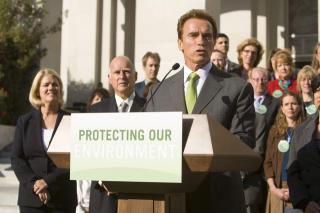
Governor Schwarzenegger Takes on the FedsTrying to track California’s developments in climate change policy is a full-time job these days. Carbon-Nation has followed the state’s efforts to drive the electrification of the automobile, but this is but a scratch at the surface. California’s initiatives also include: incentives for renewable energy, taxes on high-carbon fuels, tough vehicle fuel economy standards (in the absence of real leadership from Washington), and, in partnership with other western states and British Columbia, a regional cap-and-trade system that should ratchet down industrial emissions of greenhouse gases.

This broad frontal attack on climate complacency is helping to change the politics of climate change across the U.S. and Canada. It is also driving innovation. Today, California’s Air Resources Board reviews an innovative report from its Global Warming Economic and Technology Advancement Advisory Committee that lays out no less than 55 opportunities to cut greenhouse gas emissions. The proposals span the realms of finance, transportation, industry, commerce, residential energy use, electricity and natural gas, agriculture, forestry and water policy.

Let no one say that its too late to stop climate change.

add to del.icio.us : Add to Blinkslist : add to furl : Digg it : add to ma.gnolia : Stumble It! : add to simpy : seed the vine : : : TailRank