
Democratizing geothermal energy

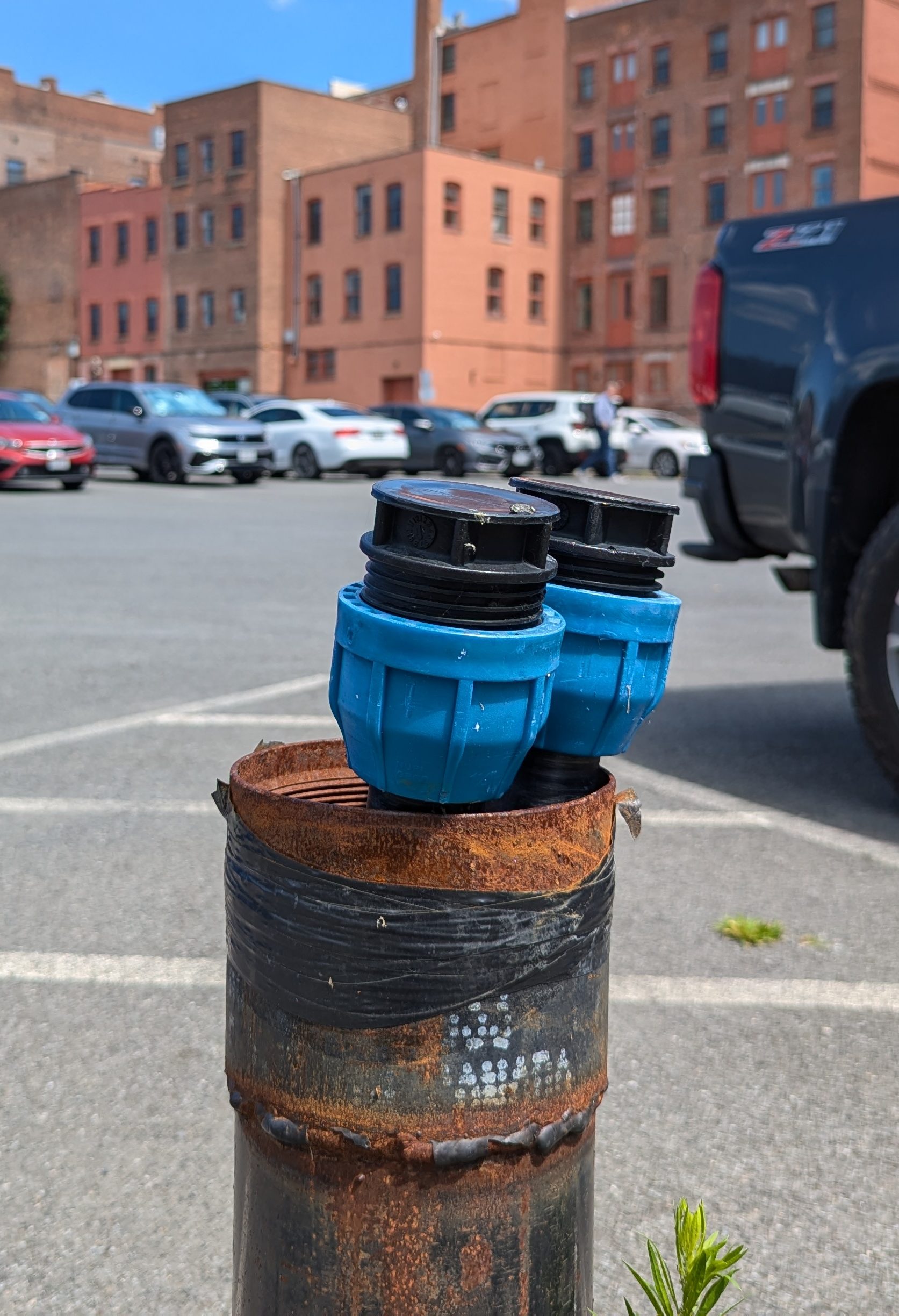
Pilot borehole for geothermal network in Troy NY
A geothermal test loop behind the arts center in Troy, NY

Tapping the ground is the most efficient means of heating and cooling buildings, but requires boreholes that are prohibitively expensive for most homeowners and businesses to drill on their own. Geothermal ‘networks’ change that equation. Just as power and gas utilities spread the costs of building power plants and transmission lines and gas pipes, they can make geothermal accessible to all by spreading out the costs of drilling hundreds of feet into the ground.

My Nature magazine feature on geothermal networks shows how this largely overlooked solution for moving cities off gas heating is spreading in Europe and North America, and why its performance and politics may accelerate electrification. I also show how this promising climate solution is undermined by a dearth of knowledge exchange between practitioners on either side of the Atlantic.

This is effectively part 4 in an ongoing series of ‘getting off gas’ stories supported by the Fund for Environmental Journalism. On-the-ground insights from New York’s Hudson Valley that enriched the Nature feature wouldn’t have been possible without that grant from the Society of Environmental Journalists.
Energizing Taiwan’s ‘Silicon Shield’

National Gold Feature Article, 2025 Azbee Awards

One incredibly wealthy firm, the Taiwan Semiconductor Manufacturing Company, dominates the global microchip market. To Taiwan, it’s much more than an economic engine. TSMC’s advanced microchips are to this century what petroleum was to the last, and that geopolitical asset gives embattled Taiwan what security experts call the ‘Silicon Shield’: The US won’t let TSMC’s chip fabrication plants fall to China, and Beijing won’t risk the economic devastation of a fab-destroying invasion.

Or so the logic goes.

The challenge is keeping this geopolitical forcefield powered up.

TSMC’s power consumption is nearly doubling every 5 yrs as it taps extreme-UV beams to etch silicon. And power quality matters as much as quantity. TSMC needs cleaner energy than Taiwan’s mostly coal and LNG-fired power plants supply. As buyers like Apple & Google seek to wring carbon out of their supply chains, Taiwan risks losing TSMC to greener pastures.

My latest feature, reported from Taiwan, captures a massive push to green the country’s energy with solar arrays and offshore wind plants. In a densely-populated land slightly larger than Maryland, that renewables push is inevitably ruffling feathers.

Read the full story @IEEE Spectrum

SPECTRUM: Energy-Gobbling Cryptocurrency Redux

A little over a year ago I took apart the cryptographic arms race that makes Bitcoin such a massive energy hog. For their January 2019 issue IEEE Spectrum asked me to follow up by profiling Ethereum, Bitcoin’s younger cryptocurrency cousin, which used roughly as much electricity as Iceland for most of 2018. The resulting feature explores the implications of Ethereum’s heavy energy footprint and the Ethereum community’s ambition to prove out a better way to secure global transactions. 

I was pleasantly surprised by the candour of Vitalik Buterin, the Russian-Canadian computer scientist who invented Ethereum when he was just 18. “Criminal” and “a huge waste of resources” are how he described the power-hungry ‘Proof of Work’ distributed security scheme that underpins most cryptocurrencies — including Bitcoin and Ethereum. Even in raw economic terms, Buterin ventured that his brainchild’s economic contributions “look unfavourable” next to the “millions of dollars being burned” to sustain Ethereum.

By the end of this year Buterin and his fellow travellers expect to be implementing an alternative security scheme (‘Proof of Stake’). Ultimately, vows Buterin, they will slash Ethereum energy use by over 99 percent.

A Solid-State Fridge in Your Pocket

Can you imagine an electric cooler compact enough to fit in your pocket and flexible enough to wear? If not, think again because engineers at the University of California at Los Angeles and SRI International have one working: A 5-millimeter-thick device that is the world’s first solid-state cooler combining practicality, energy efficiency, and high performance. Solid-state cooling has become a highly-competitive field in recent years, as researchers race to develop alternatives to refrigerators and air conditioners that gobble energy and release potent greenhouse gases. In 2014 General Electric heralded a “breakthrough” using materials that heat and cool when moved near and away from magnets, enthusing that its “magnetocaloric” system could be “inside your fridge by the end of the decade.” The comparatively simple working device from UCLA and SRI, reported in today’s issue of the journal Sciencemay give GE the chills.

Continue reading “A Solid-State Fridge in Your Pocket”

Beetles, Cacti, Killer Plants Inspire Efficiency

https://youtu.be/GKGME0N_vNE

What do you get when you mix a desert beetle, a pitcher plant, and a cactus? Pick the right parts and you get an extremely slippery surface with an uncanny capacity to condense and collect water, according to research reported today in the journal Nature. The advance could be a big deal for the energy world because, when it comes to energy efficiency, condensation lies somewhere between a necessary evil and a major drag. Nuclear, coal, and thermal solar power plants, for example, require large heat exchangers to condense the steam exiting from their turbines so that they can raise a new round of hotter steam. For other devices, such as wind turbines and refrigerator coils, condensation is the first step towards energy-sapping ice formation. Continue reading “Beetles, Cacti, Killer Plants Inspire Efficiency”