This month’s issue of IEEE Spectrum spotlights methane emissions overlooked by the U.S. EPA’s official inventory, and the satellite-based detector launching next year to map this “missing methane.” Last week the White House acknowledged EPA’s missing methane problem, and laid out a strategy to combat it. While promising to improve EPA’s inventory, including more use of top-down methane measurement, the White House also promised federal investment in ground-based methane sensing to plug leaky natural gas systems thought to be the source of much of the missing methane. Action can’t come soon enough according to the Intergovernmental Panel on Climate Change (IPCC), which on Monday unveiled its latest climate assessment. The IPCC said “widespread and consequential” impacts are already visible and world leaders have only a few years to change course to avoid catastrophic warning. Methane is a major contributor according to the scientific body, which deems methane to be up to 44 percent more potent as a warming agent than previously recognized. Continue reading “Sniffing Gas: White House Taps ARPA-E to Boost Methane Detection”
Category: Fossil Fuels & Carbon Capture
Satellites and Simulations Track Missing Methane
In the April 2014 issue of IEEE Spectrum:
Methane emissions from oil and gas extraction, herding livestock, and other human activities in the United States are likely 25 to 75 percent higher than the U.S. Environmental Protection Agency currently recognizes, according to ameta-analysis of methane emissions research published recently in Science. While experts in remote sensing debate the merits of this and other recent challenges to the EPA’s numbers, definitive answers are already on order via a high-precision Earth observation satellite to be launched next year.
The intensifying methane emissions debate has profound implications for climate and energy policy. Natural gas consumption is rising, and methane’s global warming impact is more than 30 times as much as that of carbon dioxide, molecule for molecule, and second only to carbon dioxide’s in today’s net climate impact …
click to read on
Counting the Sins of Chinese SynGas
Heavy water use, threats of tainted groundwater, and artificial earthquakes are but a sampling of the environmental side effects that have tarnished North America’s recent boom in natural gas production via hydraulic fracturing or fracking. No surprise then that in European countries such as the U.K. that are looking to frack for cheap domestic gas, the environmental protesters often arrive ahead of the drill rigs.
But countries seeking fresh gas supplies could do far worse than fracking. So say Duke University researchers who, in today’s issue of the research journal Nature Climate Change, shine a jaundiced spotlight on China’s plans to synthesize natural gas from coal. Nine synthetic gas plants recently approved by Beijing would increase the annual demand for water in the country’s arid northern regions by over 180 million metric tons, the Duke team concluded, while emissions of carbon dioxide would entirely wipe out the climate-cooling impact of China’s massive wind and solar power installations. Continue reading “Counting the Sins of Chinese SynGas”
Ohio State Gets a Bead on Cleaner Coal
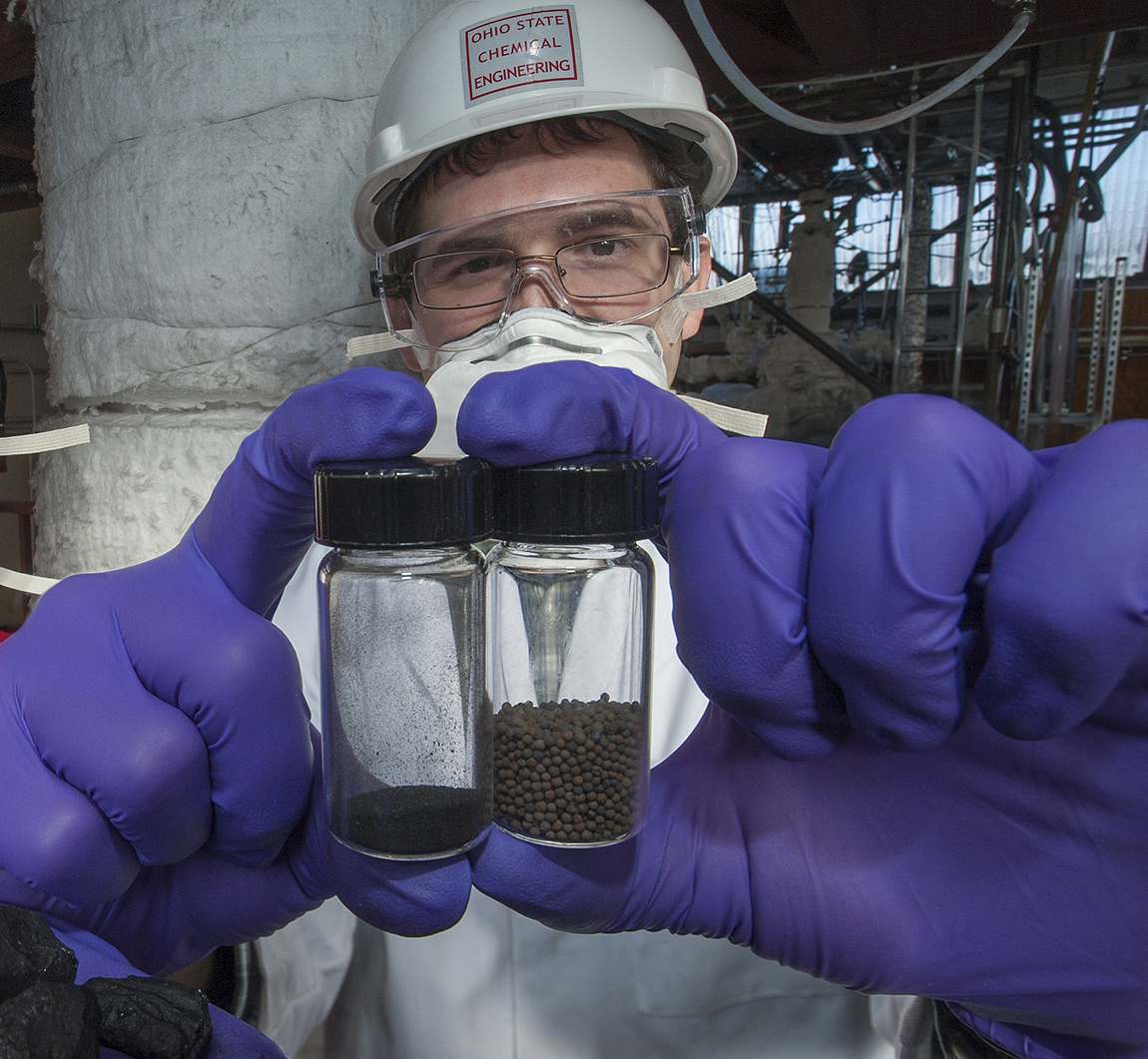 Ohio State University claims to have reached a milestone towards proving a radical new take on oxyfuel power generation that could push down the cost of zeroing out coal’s large and growing carbon footprint. Project director Liang-Shih Fan, director of OSU’s Clean Coal Research Laboratory, revealed recently that their reactor had operated for 203 continuous hours last fall and captured 99 percent of the resulting CO2.
Their run is the longest to date for a “chemical looping” reactor consuming coal, according to the U.S. Department of Energy, and in Fan’s view it means the technology is ready for testing at pilot scale.
OSU’s chemical looping reactor (the centerpiece for a $7.1 million ARPA-E project that began in 2010) is so named because it circulates its components in a continuous loop in a manner that controls the interaction of pulverized coal and oxygen to prevent ignition of the coal. “We carefully control the chemical reaction so that the coal never burns—it is consumed chemically, and the carbon dioxide is entirely contained inside the reactor,” says Fan. Continue reading “Ohio State Gets a Bead on Cleaner Coal”
The Debate: Fracking and the Future of Energy
 The Arctic is melting faster than predicted. Is now the time to shut down the low-carbon nuclear power plants in France — the 20th Century’s staunchest proponent of nuclear energy? Is natural gas produced via hydraulic fracturing or ‘fracking’ a gift that is buying time for a transition to renewable energy or a curse that reinforces fossil fuel dependence? Will carbon belching heavyweights such as the U.S. and China ever get serious about cleaning up their energy systems?
Such questions are top order in France, whose President kicked off a Grand Débat on energy this month Continue reading “The Debate: Fracking and the Future of Energy”
How Canada Should Return Obama’s Oil Pipeline Punt
 Late last week President Barack Obama deferred consideration of the Keystone XL oil pipeline, designed to ship Alberta petroleum to the Gulf Coast, until after next year’s U.S. elections. Obama’s move immediately sparked vows in Canada to redirect crude exports to Asian markets less angst-ridden by the environmental impacts associated with tapping Alberta’s tough, tarry petroleum. A smarter strategy would be to reduce those impacts, starting with the black mark that brought Keystone XL to national attention: oil sands crude’s bloated carbon footprint. Continue reading “How Canada Should Return Obama’s Oil Pipeline Punt”
Is Gas Fracking Inducing Earthquakes?

Fracking for natural gas, whereby gas-trapping rock formations are blasted open with high-pressure water and chemicals, has prompted serious concerns over the safety of groundwater supplies. But another risk is gaining profile: the potential for inducing nerve-rattling microseismicity or, potentially, unleashing a quake of truly destructive magnitude. Like the magnitude-5.6 quake that rocked Oklahoma last weekend.
As I documented for Spectrum magazine this spring, human activity can and does induce earthquakes. Continue reading “Is Gas Fracking Inducing Earthquakes?”
 Peter Fairley