
Déjà? Are Hybrids Already Passé?

Plugs are definitely vogue at this week’s Mondial de l’Automobile in Paris. So where does the hybrid vehicle fit into the picture? It may not, according to Renault. The French carmaker says that electric vehicles, not hybrids, are needed to deliver the emissions reductions that governments and customers demand.

Renault says that it is engineering a pair of battery-powered electric vehicles (EVs), to be produced starting in 2011. As I report for MIT Technology Review today, Renault claims these EVs will be cheaper to build, cost markedly less to power, and produce far less carbon dioxide. Today they unveiled a partnership with utility géant Electricité de France to “establish electric cars as a viable and
attractive transport solution for consumers.”

And Renault is not the only major automaker planning to produce commuter-oriented EVs. Mitsubishi Motors and Daimler both announced plans in Paris last week to accelerate commercialization of small EVs — Mitsubishi with its i-MiEV minicar and Daimler with a battery version of its popular Smart Fortwo. Volkswagen’s promo materials in Paris confirmed it would join the EV club, producing a tiny commuter EV called the Up! in 2010 with a top speed of 130 kilometers/hour and roughly 100 kms of range. 

Ok you say. EV’s are à la mode. But what of the hybrid option? The question is partly semantic. Hybrid technology is everywhere if you count the mild hybrids, which employ a small but potent electric battery  to save gas by rebooting the combustion engine on a green light instead of idling through the red; some can also recuperate energy during breaking by recharging their battery. This technology is going mainstream: Renault competitor PSA Peugeot Citroën said it alone will install 1 million stop-start systems by 2011. VW spokesperson Martin Hube said his company viewed stop-start as just an evolution of internal combustion drive. “You can call it a mild hybrid but it’s just a smart technique,” says Hube. “That’s nothing new.” 

No automaker questions whether full hybrids like the Prius or GM’s plug-in Chevy Volt that can drive on either electricity or gasoline are something new. But while several showed full hybrid concept cars in Paris, fewer talked up plans to build one. Perhaps they’ve made the same calculation as Renault: it’s not worth the trouble to cram high-energy motors, batteries and an engine into a vehicle when one can go straight to the full EV instead.

add to del.icio.us : Add to Blinkslist : add to furl : Digg it : add to ma.gnolia : Stumble It! : add to simpy : seed the vine : : : TailRank

This post was created for Tech Talk – Insights into tomorrow’s technology from the editors of IEEE Spectrum.

Paris Mondial de l’Automobile Flaunts the Plug

Five years ago Toyota relaunched its Prius with a Saatchi & Saatchi ad blitz with the EV-bashing tagline “and you never have to plug it in.” Toyota’s corporate marketing manager said the idea was to show the Prius was, “not an idea that’s ahead of its time.” 

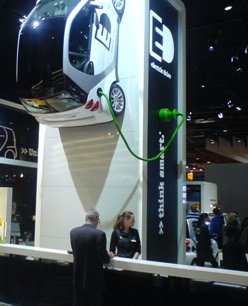
What a difference a few years can make. At this year’s Paris Mondial de l’Automobile, which opened to the press yesterday, plug-in hybrids and full-battery EVs are everywhere — and their plugs are displayed conspicuously. 

Smart, the Daimler/Swatch joint venture, towered a dangling plug over their floorspace to highlight its development of an EV model of the tiny trendy Smart Car due out in 2010. GM executives gamely held the cord of the Chevy Volt plug-in hybrid for photographers. And check out the plug on Ligier Automobiles’ EV city car!

Frank Weber, GM’s Global Vehicle Line Executive for the Volt, explained the shift to me in dollars and cents, or rather euros and centimes. “If you say that the charge costs less than a euro per day, it’s that simple,” says Weber. “Plugging in means saving, being able to drive and don’t watch the signs at the gas station. This is what the plug means. It’s now looked at as an opportunity and like, well ok at night you have to plug it in but you would do this anytime because the moment you plug it in you know that you save.”

add to del.icio.us : Add to Blinkslist : add to furl : Digg it : add to ma.gnolia : Stumble It! : add to simpy : seed the vine : : : TailRank

This post was created for Tech Talk – Insights into tomorrow’s technology from the editors of IEEE Spectrum.
Hub Motors: When EVs Smash Open Auto Design

Chrysler leapt back into relevance this week announcing no less than four EVs in development — at least one of which it promises to sell in 2010. Most intriguing for this fan of EV technology is its claim to be experimenting with permanent magnet in-wheel motors for an plug-in hybrid version of the Jeep Wrangler. That step would be an exciting leap in auto design where the electric drivetrain frees the automobile from its heavy and design-constraining mechanical transmission and driveshafts.

For a sense of the hub motor’s potential design impact, consider the experimental Reconnaissance Surveillance Targeting Vehicle that General Dynamics built for the U.S. Marine Corps. The “Shadow” is “a four-ton armored truck that has the payload of a Humvee and yet is svelte enough to deploy from a tactical aircraft.” The Shadow used a series hybrid design in which the engine serves only to keep the lithium battery charged in extended range use–much like GM’s vaunted Chevy Volt.

Unlike the Volt it transmits power to the wheels via power cables, rather than using its stored electricity to drive a central motor and mechanically distributing it to the wheels. The result is unprecedented traction thanks to the direct control of each wheel by its hub motor and the wheels’ freedom to range up and down almost half a meter.

Then there’s the Shadow’s metamorphosis when it rolls out of a V-22 vertical take-off tactical plane. Sizing for the V-22’s cargo hold constrained the Shadow’s chassis to just 150 cm side to side — way narrower than the 215-cm-wide Humvee. How to ensure stability in operation at that width? Upon exiting from the V-22 the Shadow extends its wheels sideways 20 cm beyond the chassis, achieving a total wheelbase of 190 cm. The key is a folding pneumatic suspension, something that’s all but impossible with a mechanically-driven wheel.

The Shadow was General Dynamics’ 2004 bid for what has since become the joint U.S. Army – Marine Corps Joint Light Tactical Vehicle program. Development contracts for the vehicles are expected to be announced next month.

add to del.icio.us : Add to Blinkslist : add to furl : Digg it : add to ma.gnolia : Stumble It! : add to simpy : seed the vine : : : TailRank

This post was created for Tech Talk – Insights into tomorrow’s technology from the editors of IEEE Spectrum.

Flying the Rails at 360 kph

The AGV setting the world speed record for travel on railCall it a sign of the times: Air France-KLM, Europe’s leading air carrier, is going electric.

Forget about visions of battery-electric airplanes. EV technology has its work cut out just commercializing battery-electric cars, let alone trying to catapult hundreds of passengers into the air. Instead, Air France is recognizing the energy-efficiency and convenience of commuter trains and hitting the rails.

Last week the Paris-based airline launched a joint venture with European bus and train operator Veolia to offer high-speed rail service between London, Paris and Amsterdam beginning in 2010 — the year that EU laws will open international rail travel to competition. For technology they are eyeing a new generation of high-speed coaches that’s nearing completion: the Automotrice à Grande Vitesse or AGV under development by France’s Alstom.

The AGV is faster, more efficient and can haul more passengers than its predecessor, the TGV. In speed tests in 2007 the AGV hit 574.8 kilometers per hour — within spitting distance of the speed record set by Japan’s maglevs. Alstom expects the AGV to cruise at 360 kph in regular service — about 40 kph above the TGV’s limit.

Italy’s NTV is building rails for the first AGV’s, which are expected to begin rolling there in 2011.

add to del.icio.us : Add to Blinkslist : add to furl : Digg it : add to ma.gnolia : Stumble It! : add to simpy : seed the vine : : : TailRank

This post was created for Tech Talk – Insights into tomorrow’s technology from the editors of IEEE Spectrum.

Bikes Battle for Beijing Gold

Time for Carbon-Nation to take its annual summer hiatus, as its editor heads off to grid-free living on Eagle Island. We leave with this musing on the role bicycles may play in cleaning up Beijing’s act posted on MSN Green today.

Surfing over from MSN Green? Here’s an ironic addendum to the biking in Beijing piece: One of the key factors currently limiting China’s exports of electric bicycles is tight supplies of lead for batteries, caused in part by the air quality-inspired closure of Beijing-region factories!

add to del.icio.us : Add to Blinkslist : add to furl : Digg it : add to ma.gnolia : Stumble It! : add to simpy : seed the vine : : :

Toyota’s Solar Sales Scheme

University of Minnesotas 2008 Solar Challenge Vehicle

“Cool” was the first word out of University of Minnesota aerospace engineering prof Jeff Hammer’s mouth when I told him Toyota’s Prius may soon come with its own rooftop solar generating system. But does it make sense? Not really, says Hammer: “The car is not always in the sun and there’s no surface facing the same direction all the time. The best thing to do is set [your solar panels] somewhere fixed that’s always in the sun and use the energy directly. That’s what the economics would tell you to do.”

That’s pretty damning coming from Hammer, whose job is to help turn solar energy into motive power. Well, sort of. Hammer is faculty advisor for an engineering team that put together one of 18 solar-powered vehicles competing in the 2008 North American Solar Challenge — a 2,400 mile race from Dallas to Calgary that got underway this weekend. His job is actually to help engineering students learn. “The main thing that solar car racing does to help automakers is that engineering students get a better education,” says Hammer. “We don’t think of building a solar car as a research activity or technology development activity.”

So what is Toyota doing offering solar panels that will be largely wasted? Showing once again that it is the master of green marketing. For the full story, see my full report — “Does Car-Mounted Solar Make Sense?” — at MIT’s TechReview.com today.

add to del.icio.us : Add to Blinkslist : add to furl : Digg it : add to ma.gnolia : Stumble It! : add to simpy : seed the vine : : :

Dark Clouds Over Clean Diesels

GM-Opal\'s turbo-diesel Agila © GM CorpDiesels are returning to auto showrooms nationwide. Major automakers will offer them from this fall for the 2009 model year, equipped with vastly improved emissions control devices that make them a lot cleaner than the diesel image. But their main attraction — fuel economy — is rapidly fading. The cost of diesel is rising more rapidly than gasoline, while there is increasing skepticism about their impact on climate change.

I explore the environmental implications of diesel in “Dark Clouds Over Clean Diesels”, a web-exclusive news piece on Spectrum.com. The short take: diesels still emit more soot than gasoline-fueled vehicles and the bad news on soot just keeps getting worse. Estimates of mortality from breathing fine particles is still rising, and there are top climate scientists who believe that soot is also a serious contributor to global warming. It could be second only to CO2, even outpacing methane.

Interestingly, while the U.S. and Canada prepares for a new generation of diesel cars and light trucks, European car buyers are moving in the opposite direction. A German automotive research center recently forecast a sharp decline in diesel’s share of the European car market over the coming decades, thanks to the cost of adding tailpipe controls and tough competition from gasoline-powered engine technology. From a current market share of 53% (compared to 3% in the U.S.), the study predicts diesels to drop to 38% of Europe’s car market in 2015 and to 30% in 2020.

add to del.icio.us : Add to Blinkslist : add to furl : Digg it : add to ma.gnolia : Stumble It! : add to simpy : seed the vine : : : TailRank