
Pushing wind power to London

Scottish wind power is slashing UK reliance on gas and speeding electrification, but a flood of southbound power is straining its grid, costing consumers 100s of millions annually. US Energy Secretary Chris Wright called the situation “Lunacy.” UK grid operators call it an engineering challenge.

My latest feature for IEEE Spectrum magazine took me to the big switches in Northern England stickhandling* power through UK grid bottlenecks. Innovative electronic devices, aka SmartValves, nudge power away from congested circuits to maximize the system’s overall capacity to keep power flowing. Along with other grid-enhancing tech, including advanced conductors and sensors that spot overheating lines, SmartValves are buying the UK vital time while its grid operators build new circuits using further innovative electronics.**

The SmartValves deployed by UK grid operator National Grid were developed by a US-based firm (SmartWires), that was launched by Georgia Institute of Technology prof Deepak Divan (an immigrant educated at the Indian Institute of Technology, Kanpur and the University of Calgary), and supported with R&D funding from the U.S. Department of Energy.

In other words, what Energy Secretary Wright calls lunacy is no match for America bringing its best to a global challenge.

* Stickhandle (n): Canadian. To deftly manage a difficult situation.

** The UK’s new circuits connecting Scotland and Greater London use high-voltage direct current (HVDC) technology to loop out under the English Channel “like patch cords in an old-time telephone switchboard,” as I wrote in this 2023 technology profile: HVDC Networks Come to Europe.

Rolling Power

Electricity moves down a wire at close to the speed of light. In March, a tiny tech firm in San Francisco drew a crowd to witness power moving 100 million times slower, at the very modest pace of a freight train bumping around a rail yard. And I mean literally at freight speed, because the aptly-named startup, SunTrain, convened us to watch a diesel locomotive hauling solar energy.

The star of this demonstration at the Port of San Francisco’s Pier 96 rail yard was a freight container that SunTrain had crammed full of lithium ion batteries and mounted on a standard 27-meter railcar…

So begins my latest feature for the solutions-oriented Anthropocene Magazine, profiling the creative thinkers who see railroads — the ultimate industrial dinosaur — as a lever to equip power grids for a wind and solar-powered future. SunTrain would turn railroads into a power transmission solution, using railroads to make an end run around grid congestion that’s holding up power projects across the U.S.

Imagine mile-long trains with 120 or more battery cars, charging up where wind and solar power is cheap and making daily deliveries of over two gigawatt-hours of clean energy each—enough to power a small city, port, or datacenter for days. 

I also cover a slightly more mature rail-to-grid concept: feeding power lines through rail corridors, thus avoiding the environmental impacts, cost and community upset that delay and frequently kill grid expansion. A handful of transmission projects in New England and New York already co-locate power lines beside rails. And the proposed SOO Green transmission project would follow rails for nearly all of its 560-kilometer journey from Iowa’s wind belt to Chicago.

The ultimate challenge facing both approaches is getting railroads to think outside the box and to make room for cleaner power. That will get easier if, as expected, even President Trump’s pro-carbon policies can’t keep the railroads’ rolling boxes full of coal.

Read the full story @Anthropocene

Getting Off Gas, Block by Block

Electrifying homes and businesses one at a time can be hard, and leave people behind. What if we could instead liberate entire neighborhoods from reliance on natural gas? A few utilities are taking baby steps to do just that, helping customers go all-electric en masse so it can start dismantling their gas grids.

Since 2018 San Francisco-based PG&E has been finding spots where it can make a buck by capping dodgy gas pipes rather than replacing them. After nipping pipes around the edges of its gas grid, removing pipes that serve just a handful of customers each, PG&E is now preparing to lop off some sizeable branches. The first large test moving forward targets 32,000 feet of gas pipes at a California State University campus, perched atop coastal dunes at a former army base north of Monterey. PG&E will ditch the pipes by equipping 600 student housing units with electric heat pumps, stoves and water heaters.

Such ‘strategic decommissioning’ of gas grids is not just a way to accelerate decarbonization. It’s simultaneously combating energy injustice. Without immediate reductions in spending on gas infrastructure, disadvantaged customers will be left paying for oversized gas grids as more affluent households go all-electric and quit the system. As Building Decarbonization Coalition executive director Panama Bartholomy told me: “Every time we put a new natural gas pipe in the ground, we’re knowingly putting a financial time bomb in the ground.”

Read my feature for Sierra Magazine, Getting Off Gas: Block By Block

A paired Sierra news piece profiles the pioneering geothermal network that Boston-based Eversource Energy and Massachusetts climate action group HEET started up this summer. Water pipes running under streets in Framingham, MA serve as the system’s circulatory system, democratizing access to 90 geothermal bore holes. Since August a fire hall, school, gas station, cabinet shop, city-run housing units for the elderly and disabled, and 22 single-family homes and duplexes have been heating and cooling by exchanging heat with the clay and rock 600 to 700 feet below the city. The super high efficiency of such thermal energy networks should reduce peak summer and winter electricity demand, slashing the need for new transmission lines by 33 percent according to a 2023 US national labs study. They also offer gas utilities and workers a post-combustion raison d’etre, potentially turning energy transition obstacles into a driving force for building decarbonization.

Read my Sierra news piece, Geothermal Helps Communities Get Off Fossil Gas

The Sierra articles are the 2nd and 3rd instalments in Tapping Off, a reporting project supported by the Society of Environmental Journalists’ Fund for Environmental Journalism. Part 1, published by The Tyee, profiled Washington state utility Puget Sound Energy’s use of customer electrification to put the brakes on gas expansion.

Read Part 1 online @The Tyee

Energizing Taiwan’s ‘Silicon Shield’

National Gold Feature Article, 2025 Azbee Awards

One incredibly wealthy firm, the Taiwan Semiconductor Manufacturing Company, dominates the global microchip market. To Taiwan, it’s much more than an economic engine. TSMC’s advanced microchips are to this century what petroleum was to the last, and that geopolitical asset gives embattled Taiwan what security experts call the ‘Silicon Shield’: The US won’t let TSMC’s chip fabrication plants fall to China, and Beijing won’t risk the economic devastation of a fab-destroying invasion.

Or so the logic goes.

The challenge is keeping this geopolitical forcefield powered up.

TSMC’s power consumption is nearly doubling every 5 yrs as it taps extreme-UV beams to etch silicon. And power quality matters as much as quantity. TSMC needs cleaner energy than Taiwan’s mostly coal and LNG-fired power plants supply. As buyers like Apple & Google seek to wring carbon out of their supply chains, Taiwan risks losing TSMC to greener pastures.

My latest feature, reported from Taiwan, captures a massive push to green the country’s energy with solar arrays and offshore wind plants. In a densely-populated land slightly larger than Maryland, that renewables push is inevitably ruffling feathers.

Read the full story @IEEE Spectrum

A Part of Modern Life So Essential That Armies Should Never Attack It Again

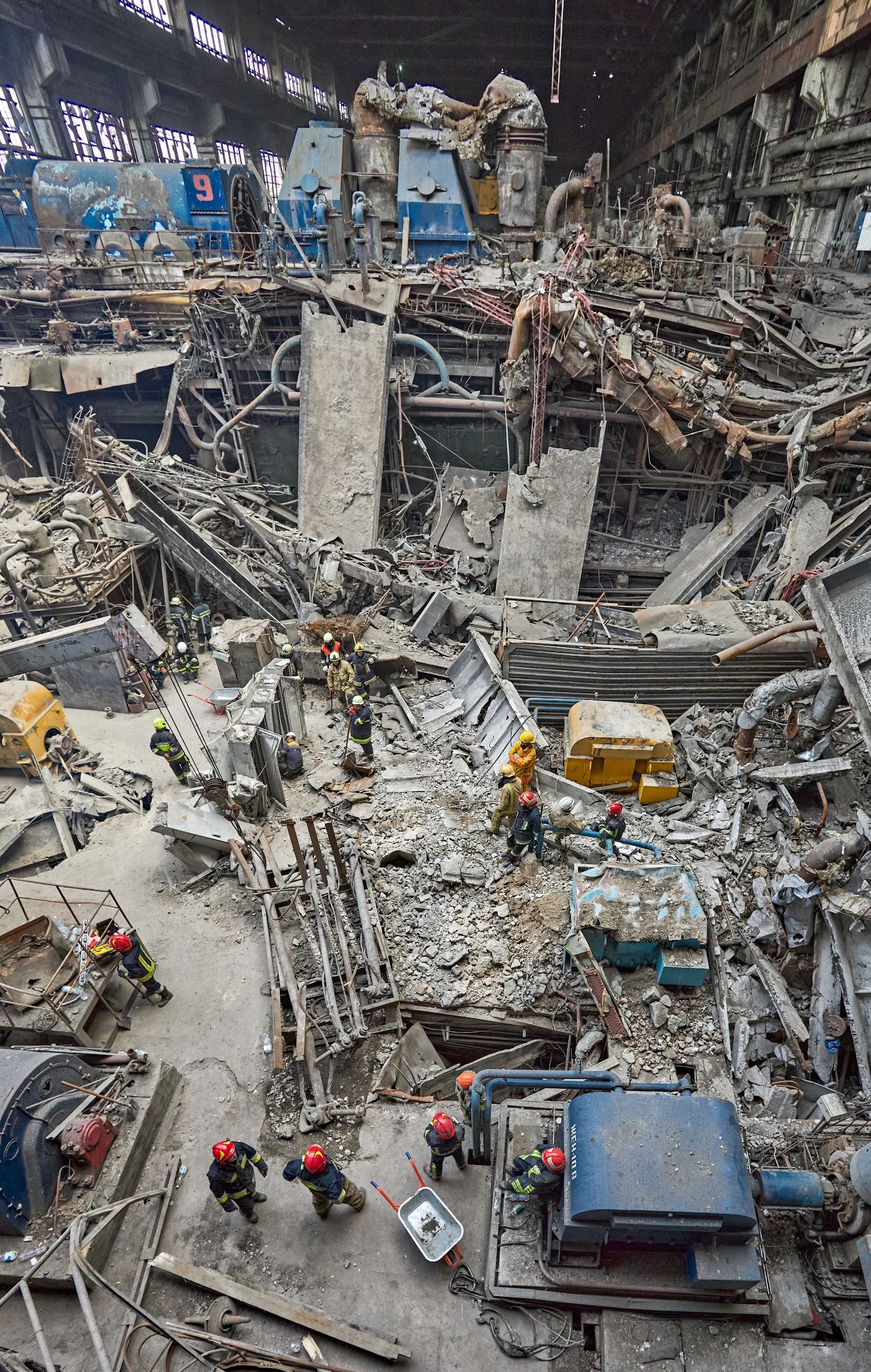
Photo: DTEK

It’s time to change the laws of war to punish and hopefully deter the insane and inhumane destruction of power grids. So argues my guest essay for The New York Times opinion pages.

For two years, it has pained me to observe and occasionally cover Russia’s increasingly destructive pummelling of Ukraine’s power grid. As a longtime student of power systems, I intimately know the engineering and operational sophistication that keeps power grids — the world’s largest machines — running at close to the speed of light. I know how entrenched power systems have become in modern life, assuring everything from home oxygen generators to sewage treatment. And I know that plugging in more is our best hope for stopping climate change.

Since Russia’s whole-scale grid attacks began in late 2022 I have questioned the legality of such wanton destruction. In my debut contribution to The Times I lay bare the holes in international law that legalize most attacks on power systems, and argue that the international community should draw brighter lines to protect them.

The Midwestern Pragmatists Behind the Renewables-Ready Power Grid

Power line congestion is forcing “dramatic drops” in wind power production, yet we need far more wind power and even more solar. As one renewable energy developer put it last week: “We are sprinting towards a brick wall.” My latest grid feature profiles the Made-in-the-Midwest fix that could vault North America’s power grids over the hurdles, forging a truly continental network to reliably deliver clean power for homes, highways and industries.

It’s a story of innovative policy and technology, advanced by a pragmatic yet tenacious band of environmental activists and industry planners who are determined to push the power grid to green greatness. And it’s my first for an explicitly ecologically-focused publication like Sierra Magazine, whose readership is more likely to view power lines as an ecosystem disruptor.

In the 70s, Minnesota farmers were severing power lines with high-powered rifles and toppling transmission towers to block grid expansion. But 20 years ago they joined enviro activists, wind developers & utilities to back grid growth that fuelled a wind power boom, inspiring innovative planners at the Midcontinent Independent System Operator or MISO (the nonprofit entity that runs the Midwest’s grid).

Dale Osborn: Talking power grids over Swedish meatballs at the #MSP Ikea

MISO’s grid guru Dale Osborn took their winning policy formula and ran, showing how advanced transmission technology could extend MISO’s approach to deliver massive renewables and shutter coal nationwide.

MISO’s transmission train stalled when Gulf states’ utility Entergy joined the club, then used its monopoly muscle to gum up MISO’s grid planning. Trump’s fossil-friendly Energy Department killed action in Washington, DC, burying the evidence that Osborn’s ‘macrogrid’ scheme benefitted both consumers and the environment — political interference that I exposed for The Atlantic and InvestigateWest.

But MISO planners and Osborn’s macrogrid vision are making a comeback. Northern states recently broke Entergy’s filibuster, yielding a historic plan to more than double Midwestern solar & wind energy. And Osborn’s macrogrid plan has gone mainstream in Washington, D.C.

The question now: Can grid operators like MISO, political leaders and conservationists forge bipartisan consensus to build a truly national grid. Without which, it will be far harder to endure the ravages of climate change, and may be impossible to freeze it.

Read the full story online at Sierra Magazine

Climate-Proof Grids Require Transparency

Power and gas utilities—especially when pushing their own internal energy projects and products—often cloak their proposals for transmission lines, power plants and pipelines in proprietary data and models. And such scrutiny-averting tactics can lead to more costly infrastructure, squander opportunities for cleaner energy, and reduce public acceptance of system upgrades. “Companies get away with bad planning, hiding their cherry-picked assumptions in models nobody can see. This erodes confidence and costs consumers dearly,” says Tom Brown, an energy modeling expert at the Technical University of Berlin.

Such concerns are gaining traction within Europe’s official bodies, where greater transparency is seen as the only way to plan a robust and sustainable grid for tomorrow that taxpayers and communities will get behind today. Pressure is mounting project proponents and the organizations that coordinate the continent’s electricity and gas networks to switch to open-source models.

This week a European Commission-funded study concluded that open source codes can—and should—underpin official 10-year plans prepared for Europe’s gas and power networks. And its findings affirm a forceful endorsement of open modeling by the European Scientific Advisory Board on Climate Change. “Transparency of market and network models and calculations is key to ensuring public scrutiny of political investment decisions,” the independent council told the European Commission. As a result, it stated, the “traditionally closed and proprietary nature of energy system planning … is no longer fit for purpose.”

Read the full story @IEEE Spectrum.