Power Struggles and the Mediterranean Ring

‘The Mediterranean Ring’ would make a fitting title for a high-voltage action thriller where cut-throat crime gangs vie for control in the labyrinthine medieval medina’s of North Africa. Alas it is no such thing. And yet this project to connect the power grids of North Africa and Europe does boast a potentially destructive internal power struggle that could stymie its promise — clean power supplies for Europe, economic development for North Africa, and a much needed bond between neighbors.

MedRing’s power struggle spilled into the daylight on November 21, 2005 when power engineers activated a key electrical circuit linking Tunisia and Libya in a key test of the MedRing. For a moment nearly all of the AC power systems of North Africa operated synchronously with those of Europe. Power plants, transmission lines and controls from Syria to Morocco were in electrical conversation with those of the mighty UCTE, whose 240,000 kilometers of high-voltage lines connect 26 European countries. Add links to Turkey and the MedRing would have been complete.

Seven minutes later the grids had broken apart and the test had failed.

It was a tug of war between North African grid control systems that broke the synchronicity. Understanding why isn’t straightforward. Bear with me as I try because the failure of this early trial exemplifies the challenge inherent in connecting a robust power system like the UCTE’s — the world’s biggest — to much weaker grids such as those of North Africa.

Continue reading “Power Struggles and the Mediterranean Ring”
Solar PoweRING the Mediterranean

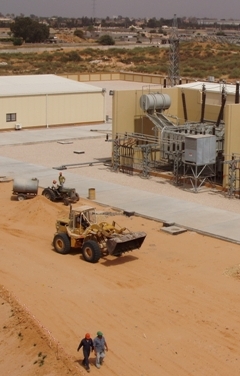
Areva's Bir Osta Milad substation in Libya copycreditpeterfairley2008Engineers working in the teeming cities and lonely deserts of North Africa are creating the last links in a power grid that will ring the Mediterranean Sea. Sharing electricity over this ‘Mediterranean Ring’ could secure Europe’s power supply with clean renewable energy, accelerating North Africa’s development and knitting together two worlds that seem to be racing apart — those of Muslim North Africa and an increasingly xenophobic Europe.

We make the case for all this unabashed optimism in Closing the Circuit – a feature story in this month’s issue of Spectrum. Closing the Circuit is the product of two years of on-again, off-again research that came to fruition with on-site reporting in Libya and Morocco this summer.

The timing is fortuitious: North African countries – in many ways among the most progressive in the Muslim world – face a rising threat of Islamic fundamentalism, including increasingly deadly attacks by Al Qaeda-aligned militants. Economic development and democratization are the best hope for a North African renaissance. At the same time Europe’s growing dependence on Russian oil and gas and desire to slash carbon emissions has intensified interest in North Africa’s energy resources.

The scale of the potential exchange is immense: Analyses by the German government estimate that solar power generated in scorching North Africa could meet Germany’s entire electricity demand. No wonder then that the Union for the Mediterranean launched by French president Nicolas Sarkozy this summer to spur cooperation between Europe and North Africa is fleshing out a “Mediterranean solar plan” as one of its first actions.

The geopolitical and social import could be bigger. Consider what Dominique Maillard, President of French grid operator Réseau de Transport de l’Electricité, said when asked last month what the Mediterranean Ring represents during an interview last month for the European Energy Review. Maillard began his response by noting that the electrical interconnections between the European countries got started in 1951 – well before the signing of the Treaty or Paris, which created a European coal and steel market, and before the Treaty of Rome in 1957. “At the dawn of Europe, energy – and even electrical energy – had therefore already preceded politics,” says Maillard.

The implication by extension is clear: Electrical interconnection can be the forerunner for peaceful codevelopment among the countries of the Mediterranean, even including Israel. Call it informed optimism.

add to del.icio.us : Add to Blinkslist : add to furl : Digg it : add to ma.gnolia : Stumble It! : add to simpy : seed the vine : : : TailRank

This post was created for EnergywiseIEEE Spectrum’s blog on green power, cars and climate

Negative Prices for Clean Power

How do you know that congestion on high-voltage transmission grids is stranding valuable renewable energy? When the price of electricity goes negative. American Wind Energy Association electricity industry analyst Michael Goggin delivers a snapshot of the phenomenon in a recent column for Renewable Energy World.

Goggin points to data from the Electricity Reliability Council of Texas or ERCOT, the state’s grid operator, showing an increasing incidence of generators paying buyers to take their power. According to Goggin, such conditions track the explosive installation of wind farms in West Texas — and are very bad news for their operators.

Prices fell below US -$30/MWh (megawatt-hour) on 63% of days during the first half of 2008, compared to 10% for the same period in 2007 and 5% in 2006. If prices fall far enough below zero that the cost for a wind plant to continue operating is higher than the value of the US $20/MWh federal renewable electricity production tax credit plus the value of other state incentives, wind plant operators will typically curtail the output of their plants.

Worse still, consumers in adjacent areas are paying top dollar for power because the transmission lines between them and the excess wind power are overloaded.

Texas is running into trouble because it pushed wind power harder and faster than other states, but it is also leading the way to address what is really a nationwide problem. This summer the Public Utility Commission of Texas approved a scheme called the Competitive Renewable Energy Zone (CREZ) process to incentivize construction of new transmission lines to evacuate stranded wind power. Earlier this month a consortium of major utilities including MidAmerican and AEP announced their intention to do so.

For a detailed yet accessible look at Texas’ renewable energy transmission challenge and efforts to clear out the bottlenecks, see this overview from the State Energy Conservation Office.

add to del.icio.us : Add to Blinkslist : add to furl : Digg it : add to ma.gnolia : Stumble It! : add to simpy : seed the vine : : : TailRank

This post was created for Tech Talk – Insights into tomorrow’s technology from the editors of IEEE Spectrum.

Electric Supergrids Gaining Traction

Greenpeace%20Belgium%20North%20Sea%20Grid%20Map.jpgIncomplete and constrained transmission grids pose a serious impediment to the use of renewable energy sources such as wind power. Proposals launched over the past week show that support for more lines is going mainstream.

Last week none other than Greenpeace called for an underwater power grid criss-crossing the North Sea to accelerate the installation of dozens of new offshore wind farms. In “A North Sea Electricity Grid [R]Evolution”, Greenpeace Belgium and Brussels-based environmental consulting firm 3E map out an offshore network composed of 6,200 kilometers of undersea lines. According to their models, this grid extension could add 68 gigawatts of wind power capacity by 2020 — enough to meet 13% of net power demand of seven North Sea countries.

Yesterday the Washington, D.C.-based Council on Competitiveness, an alliance of corporate CEOs, university presidents and labor leaders, lent its support to grid expansion, urging the next U.S. president to create a “national transmission superhighway.” The proposal is part of a broader “100-Day Energy Action Plan”. The Council would empower the Federal Energy Regulatory Commission to determine when and where expanded transmission capacity is needed, overriding state authorities. “As with the interstate highway system and the information superhighway, our leaders must knit together the current patchwork of regulations and oversight into a seamlessly connected electrical power highway,” states the plan.

Proposals that need to be debated.

add to del.icio.us : Add to Blinkslist : add to furl : Digg it : add to ma.gnolia : Stumble It! : add to simpy : seed the vine : : : TailRank

This post was created for Tech Talk – Insights into tomorrow’s technology from the editors of IEEE Spectrum.

Anticipating Wind Power’s Uncontrollable Ebbs and Flows

Two months ago, on the evening of February 26, power grid controllers at the Electric Reliability Council of Texas (ERCOT) found themselves in an uncomfortable position: they were rapidly running out of power. As consumption outstripped supply the frequency of the alternating current — nominally 60 hertz — began to slide, threatening to damage utility and customer equipment. At 6:41 pm the grid controllers declared a grid emergency and began ‘shedding load’ to restore the grid frequency. Which is to say, they shut off the power to some customers.

These customers had agreed in advance to participate in such “demand-response” situations and would be compensated for their trouble. Nevertheless, saying no to a buyer is as much a measure of last-resort for the power industry as for any other.

Wind power got the blame early on, because wind turbines in West Texas were delivering less power than their operators had projected. But subsequent studies showed that other factors were more important. In the 40 minutes leading up to the emergency conventional power plants delivered 350 megawatts less than they had promised, while wind generation slipped just 80 megawatts relative to plan. At the same time consumption rose by a whopping 1,185 MW more than ERCOT had forecast. ERCOT’s report to the Public Utility Commission of Texas highlights that electric load growth as a key cause.

Still, smarter integration of Texas’ wind power could have prevented the trouble. As ERCOT’s report shows, an independent wind power forecast prepared for ERCOT on February 25 under an ongoing pilot project predicted the February 26 wind power drop with “good fidelity.” Unfortunately ERCOT’s grid operators never saw the forecast and hence could not take steps in advance to ensure that alternate power supplies were available.

My story on TechReview.com today, Scheduling Wind Power, shows that grid controllers increasingly get the message: Integrating wind forecasting into grid planning is not only key to reliably accomodating much greater levels of wind power. It will also maximize the pollution reductions achieved in the process.

add to del.icio.us : Add to Blinkslist : add to furl : Digg it : add to ma.gnolia : Stumble It! : add to simpy : seed the vine : : : TailRank

A Power Grid Smartens Up

That’s the headline that an editor at MIT Technology Review popped onto my story (topping TechReview.com today) on a project to turn Boulder, Colorado’s power system into the world’s smartest grid. The punch phrase would be pronounced ‘schmahten up’ by my old boss at Ferranti-Dege, a professional photo shop in Harvard Square that finally gave way to the digital revolution and Boston’s soaring property values just a few years ago. And Bill’s sentiment would fit perfectly: You know how to do it right, so get to it.

Electrical engineers have the wherewithal to install smart meters and otherwise upgrade our power grids to deliver power more efficiently and accomodate intermittent but clean renewable energy. As utility IT chief Mike Carlson told me this week: “We’re not talking the Jetsons or Star Wars here.”

What is needed–and where Carlson’s project for Xcel Energy truly innovates–is a way of getting the required demonstrations paid for. To date conservative public utility commissions in state capitols around the country have been relucant to finance much-needed investments in grid modernization, without the kind of proof that Xcel hopes its Boulder project will provide.

That’s an emerging theme: Public utility commissions have immense control over investment in power infrastructure, but have a bottom-line mentality that tends to override environmental concerns. This is one factor delaying adotpion of coal gasification technology for power plants. The coal gasification or IGCC power plants are cleaner-burning but more expensive to build up front and, barring an EPA mandate to even consider the technology, public utility commissions have been relucant to approve the extra expense. 

For the full scoop on Boulder’s smart grid, click “A Power Grid Smartens Up”

add to del.icio.us : Add to Blinkslist : add to furl : Digg it : add to ma.gnolia : Stumble It! : add to simpy : seed the vine : : : TailRank

Naughty Editor Reveals Hidden Reports on Energy

Cranes over Erdos Inner Mongolia 2006 Peter FairleyOver the last month Carbon-Nation went quiet as its editor made noise elsewhere on the web. He should have kept you linked in. Bad editor! Here’s what you missed:

“Cheap Cashmere Sweaters”: A Connect the Dots photo feature on MSN Green tracking cashmere’s environmental footprints –carbon and otherwise– back to the desertified steppes of Central Asia. Bottom line message: The price of that cashmere sweater looks good now, but the cost to the environment will bite you in the end.

Two for IEEE Spectrum Online:

“Power Transmission Without the Power Electronics”: During their low-resolution beginnings digital music and photography delivered a jarring rendition of sounds and images. Today, digital devices used to control electricity flows are making a similar mess on power grids.

“Electric-Car Maker Touts 10-Minute Fill-Up”: Altair Nanotechnologies’ lithium ion batteries for electric vehicles charge up fast. Very fast. One of its 35 kilowatt-hour packs, capable of propelling an EV pickup truck for 160 kilometers, can fully charge in just 10 minutes-a feat that would be downright dangerous with most lithium batteries. But will such rapid-charging prove practical on the street?

And a troika for MIT’s Technology Review website:

“Prospecting for Power”: The ultra-sensitive detection of traces of helium rising from the Earth’s mantle may hold the key to sniffing out sites of hidden geothermal energy.

“Cleaner Nuclear Power?”: Senators representing several Western states are promoting thorium. They say it’s a cleaner-burning fuel for nuclear-power plants, with the potential to cut high-level nuclear-waste volumes in half. Some nuclear watchdogs agree.

“Carbon Capture Moves Ahead”: Carbon offsets marketer Blue Source is building the business case for carbon-capture and storage systems by storing CO2 in oil wells.