Japan Seeks to Rein In a Solar Juggernaut

Clashing energy interests on the Japanese island of Kyushu have prompted Japan’s government to clamp down on solar power development nationwide. While the government calls it a necessary revision to assure grid stability amidst rapidly rising levels of intermittent solar energy, critics see a pro-nuclear agenda at work—one that could stunt Japan’s renewable energy potential.

Solar development in Japan has exploded since the Fukushima nuclear disaster of 2011. Thanks to an attractive feed-in tariff (FIT) program that guarantees premium rates for renewable power generation pushed through in the disaster’s aftermath, developers have since installed over 10 gigawatts of solar capacity. The solar surge marks a return to glory for the country that once dominated the global PV industry.

But Japan’s solar revival has occurred under a cloud. The pro-nuclear Liberal Democratic Party regained power in late 2012, intent on restarting idled nuclear reactors that once generated nearly one-third of Japan’s electricity. The nuclear cloud produced its first lightning bolts on Kyushu in September, and has now spread nationwide. Continue reading “Japan Seeks to Rein In a Solar Juggernaut”
Solar Power and Grid Stability: Scenarios and solutions

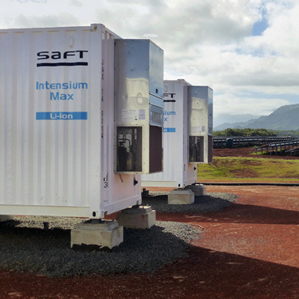
hawaii.gridx299Renewable energy is often intermittent, and that variability presents a variety of challenges to power grids. The nature and magnitude of the challenges depends on the time frame — from fractions of a second to seasonal or even multiyear variations — as well as the nature of the grid itself. The latter is evident in two of my articles from last week looking at how seconds-to-minutes fluctuations in solar power complicate grid controllers’ efforts to maintain alternating current at the 60 hertz frequency and the roughly 110 volt power levels required by North American devices.

Fluctuating AC frequency stars in my Technology Review dispatch from the paradise of Kauai, where the island utility is riding an electrical roller coaster as it pushes solar towards 80 percent of peak power flows Continue reading “Solar Power and Grid Stability: Scenarios and solutions”

Turning E-Waste into LIght

Bangalore street vendor with battery-powered light SOURCE IBM Research India
Bangalore street vendor with battery-powered light. Source: IBM Research India

Bangalore-based IBM Research India has a bright idea for keeping discarded lithium laptop batteries out of landfills: repurposing their cells as energy supplies for the powerless. The idea, presented at this weekend’s fifth annual Symposium on Computing for Development (DEV 2014) in San Jose, has passed a small proof-of-principle test run with Bangalore’s working poor. Continue reading “Turning E-Waste into LIght”

Internet-Exposed Energy Control Systems Abound

Two-and-a-half years ago researchers at Chicago-based cyber security firm Infracritical set out to measure how many industrial control systems are openly exposed to the Internet. Their disquieting findings are up for discussion today at the 2014 ICS Cyber Security Conference in Atlanta. Infracritical remotely identified over 2.2 million unique IP addresses linked to industrial control systems at energy-related sites including electrical substations, wind farms, and water purification plants. And they were still logging an average of 2,000-3,000 new addresses per day when they closed the count in January 2014. “We never reached bottom,” says Infracritical cofounder Bob Radvanovsky, an expert in securing supervisory control and data acquisition (SCADA) systems. Continue reading “Internet-Exposed Energy Control Systems Abound”

Germany’s Grid: Renewables-Rich and Rock-Solid

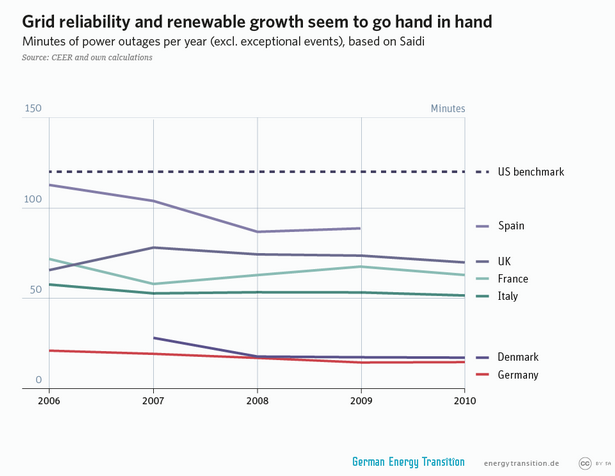
Grid graph German Energy TransitionLast Friday Germany’s grid regulator released the 2013 data for grid reliability, and the figures have renewable energy advocates crowing. The latest numbers (released in German) reveal no sign of growing instability despite record levels of renewable energy on the grid — 28.5 percent of the power supplied in the first half of 2014. In fact, Germany’s grid is one of the world’s most reliable. Continue reading “Germany’s Grid: Renewables-Rich and Rock-Solid”

Amid Blackouts, India’s New Leader Vows 24-7 Power for All

Blackouts this week in New Delhi and surrounding states are providing a dramatic backdrop for a bold promise by India’s new prime minister, Narendra Modi, whose Hindu nationalist party swept to power in a landslide election last month. As a scorching heatwave drove power consumption beyond the grid’s capacity, Modi’s government vowed to deliver “round-the-clock power for all by 2022,” reports the Wall Street Journal.

That will be an awesome task. Nearly one-quarter of India’s 1.26 billion citizens lack grid access. And India’s utilities have struggled to keep up with demand from those who are connected. Power cuts are frequent. Continue reading “Amid Blackouts, India’s New Leader Vows 24-7 Power for All”

Time to Rightsize the Grid?

Does Size Matter Source CarrerasLast week a team of systems scientists known for counter-intuitive insights on power grids delivered a fresh one that questions one of the tenets of grid design: bigger grids, they argue, may not make for better grids. University of Iowa electrical engineering professor Ian Dobson and physicists David Newman and Ben Carreras make the case for optimal sizing of power grids in last week’s issue of the nonlinear sciences journal Chaos.

In a nutshell, the systems scientists use grid modeling to show that grid benefits such as frequency stabilization and power trading can be outweighed by the debilitating impacts of big blackouts. As grids grow larger, they become enablers for ever larger cascading blackouts. The Northeast Blackout of 2003 was a classic case. From a tripped line in northern Ohio, the outage cascaded in all directions to unplug more than 50 million people from western Michigan and Toronto to New York City. Continue reading “Time to Rightsize the Grid?”