
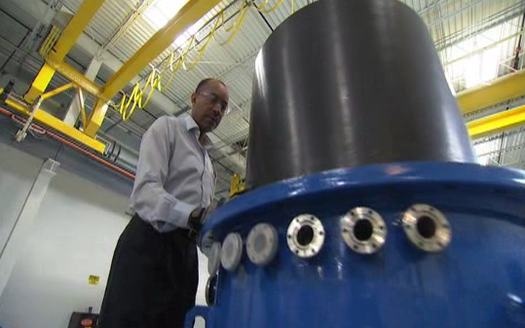
 Flywheel energy storage developer Beacon Power filed for bankruptcy last weekend, prompting immediate comparisons to infamously failed solar manufacturer Solyndra. But while both firms used millions of dollars in federal loan guarantees to expand their businesses, Beacon Power — which Spectrum profiled this summer — has working assets and a good shot at restructuring and carrying on. Continue reading “Beacon Power Hits a Speed-bump, but it’s No Solyndra”
Category: Power Grids
Notorious Grid Bottleneck Spawns Western Blackout
 The blackout that squelched power flows to nearly 5 million residents of Arizona, California and northern Mexico last night and shut down California’s San Onofre nuclear power plant may be the latest sign of strain in an outdated U.S. power grid. The incident began during maintenance at a substation in Yuma, Arizona that lies at the center of a sclerotic section of the grid between Phoenix and Tucson—one long recognized as critically congested and thus at heightened risk of failure. Continue reading “Notorious Grid Bottleneck Spawns Western Blackout”
Fukushima Inspires Change in Germany & China
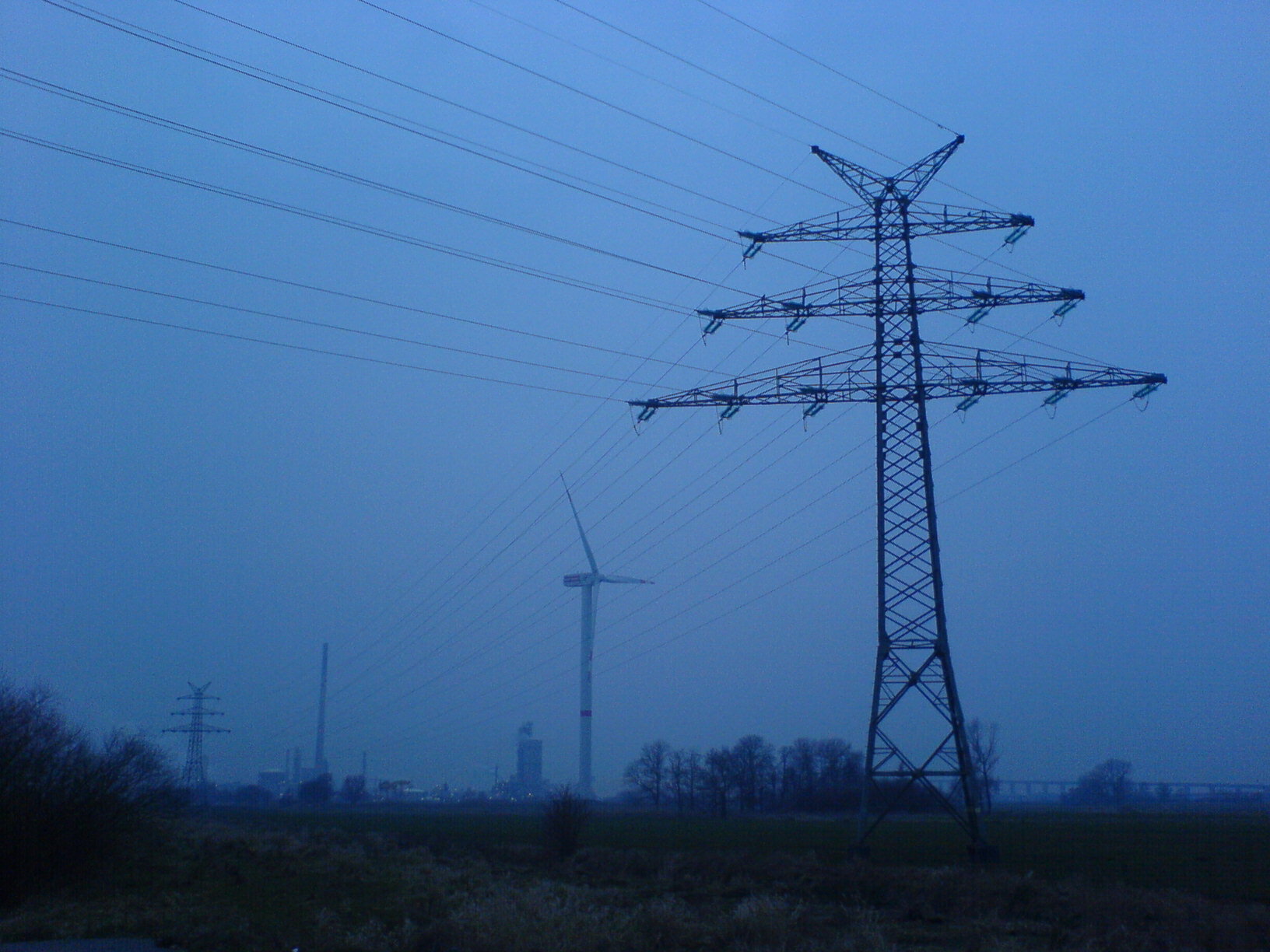 Amidst the stubbornly disappointing string of news emanating from Japan’s Fukushima Daiichi nuclear complex, there are signs that its melting nuclear fuel rods are inspiring some important and long-overdue developments in global power systems. And there’s good news for both nuclear supporters and critics.
Hopeful spinoff number one: Berlin is getting serious about upgrading the balkanized and inadequate transmission grid that represents a serious liability for Germany’s renewable energy ambitions.
Chancellor Angela Merkel’s decision last month to shut down Germany’s oldest nuclear reactors and temporarily scrub life extensions for the rest was widely seen as a sop to voters in the state of Baden-Württemberg. Well, Merkel’s Conservative Democrats lost the state to the Green Party, and she hasn’t looked back. Last week a document leaked from Germany’s Economy Ministry and reported by Bloomberg revealed plans to revamp the power grid–a precondition to replacing nuclear energy with solar, wind and other renewable power sources. Continue reading “Fukushima Inspires Change in Germany & China”
Europe and Turkey’s High-Power Embrace
Ethnic and economic tensions may have stalled Turkey’s longstanding bid to join the European Union, but electrical circuits can be color blind. As of September the alternating current on the Turkish power grid will flow in synchrony with Continental Europe’s, according to the European Network of Transmission System Operators for Electricity (ENTSO-E), which took control of Europe’s power grids last summer.
Yesterday’s announcement means that Turkey can trade electricity with Europe and benefit from the bigger grid’s stability, in turn helping to stabilize the lines in neighboring Bulgaria and Greece. The link will run for at least one year, with power exchanges ramping up in stages.
Turkey’s integration provides hope for would-be regional developers in the Mediterranean, who face rising protectionism, ethnic tensions, and seemingly endless diplomatic bombshells from Israel and the Palestinian territories. The Middle East troubles caused the Union for the Mediterranean organized by French President Nicolas Sarkozy to delay a second summit scheduled to convene in Barcelona yesterday until November, according to the AP. Continue reading “Europe and Turkey’s High-Power Embrace”
Nissan Joins the EV Charging Market
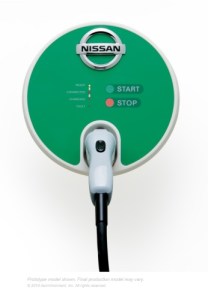 Nissan doesn’t plan to leave buyers of its battery-powered LEAF sedan, which goes on sale in December, to their own devices when it comes to vehicle charging. Nissan will offer a home-charging program to LEAF buyers which will start with an electrician visiting the buyer’s home to, among other things, check the quality of their electrical service, according to an announcement this week at the Detroit Auto Show.
Electric vehicle enthusiasts may poo-poo the practical and technical challenges posed by home-vehicle charging — witness the hostile comments to my coverage of concerns voiced by California such as PG&E and Southern California Edison that clusters of EVs could burn out block-level power circuits (see “Speed Bumps Ahead for Electric Vehicle Charging”). But Nissan, like the utilities, is leaving nothing to chance.
The idea is to make sure that infrastructure-induced challenges don’t detract from the on-street excitement of driving an EV, according to a Nissan spokesperson quoted in a BNET post from the Detroit show today by New York Times clean-car blogger Jim Motavalli:
“We didn’t want to say, ‘Here’s your car, now you’re on your own.”
— Mark Perry, a Nissan spokesman handling the Leaf introduction
China’s Grid-Limited Wind Energy Potential
China’s wind power industry barely noticed the international financing crisis, doubling installations in 2008 for the fifth year in a row. Readers of Carbon-Nation shouldn’t be surprised, as we have already documented the state and market share-driven industry’s insensitivity to quaint financial targets such as profitability. What may ultimately check China’s seemingly unstoppable wind power surge is the capacity of its power grids to absorb the resulting energy.
 That conclusion emerges when one examines a report in Science last week by researchers at Harvard’s Kennedy School of Government and Beijing’s Tsinghua University, which combines meteorological and engineering models to predict that wind farms could meet all new electricity demand in China through 2030 at reasonably low cost. My coverage of the report, published yesterday by MIT’s Technology Review.com, concludes that China’s grid is the key hurdle to realizing this bold prediction, noting hopefully that China is already leading the world in the development of high voltage direct current (HVDC) transmission technology — the sort needed to share variable renewable energy sources such as wind power on a trans-continental scale, thereby minimizing the power supply’s vulnerability to regional weather patterns.
Analysts, however, doubt that China can build such renewables-ready supergrids fast enough to replace anticipated additions of coal and nuclear power, as projected by the Harvard-Tsinghua report. Caitlin Pollock, who prepares Asia wind market forecasts for Cambridge, MA-based consutancy Emerging Energy Research, says grid challenges make the growth level proposed “unfeasible and unlikely.” She notes that grid integration already lags wind-farm installation: “While China’s wind market has indeed doubled for the past two years, approximately 30% of this new capacity remained unconnected to the grid at the end of each year.” Continue reading “China’s Grid-Limited Wind Energy Potential”
China’s Wind Surge Ignores Financial Mess
The global wind power industry is bottoming out thanks to the global financing crisis. Everywhere but China, that is, according to a research update issued this week by consultancy Emerging Energy Research (Cambridge, MA).
EER adds up the impact of “a steady flow of wind industry CAPEX reductions, project postponements, order cancellations, and corporate downsizings on a scale never seen before in this relatively young segment of the energy sector.” They forecast a 24% decline in megawatts installed in the US this year over 2008, and a 19% decline in Europe.
Then there’s China, which EER calls “the only major market left standing in the face of the crisis.” EER projects a 59% jump in megawatts added there in 2009 — enough to make up for the U.S. and European losses.
Carbon-Nation readers will recall our June 2008 reporting on China’s wind sector that was already, then, notable for (a) its “endurance in the face of below-cost pricing” and, (b) low quality assurance that had even its trade association calling for slower growth. Looks like its too late for the latter.
 :
:  :
:  :
:  :
:  :
:  :
:  :
:  :
:  :
:  :
: 
This post was created for Energywise, IEEE Spectrum’s blog on green power, cars and climate
 Peter Fairley