Mideast Morass Dims Mediterranean Solar Hopes

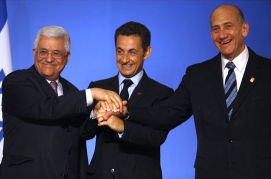
abbas-sarkozy-and-olmert-at-paris-summit-credit-l-blevennec-elysee-photo-servicePlanning for massive development of North Africa’s solar energy potential became “collateral damage” of the war in Gaza this winter and won’t restart for at least another month, according to French newspaper Le Monde (article en Français).

The 43 countries of the Union for the Mediterranean, which includes Muslim nations such as Egypt and Algeria as well as Israel, adopted solar energy as its keynote project last summer. And last fall the European Commission endorsed the need for a high voltage DC supergrid to share the resulting clean energy with Europe. Planning froze in late December, however, after Israeli tanks rolled into Gaza in response to rocket fire.

Participation of Muslim countries in a development partnership with Israel — a coup for French President Nicolas Sarkozy when he launched the Union for the Mediterranean last summer — became politically untenable as Gaza crumbled.

Continue reading “Mideast Morass Dims Mediterranean Solar Hopes”

Deja Vu as France Plans National EV Charging Network – Again

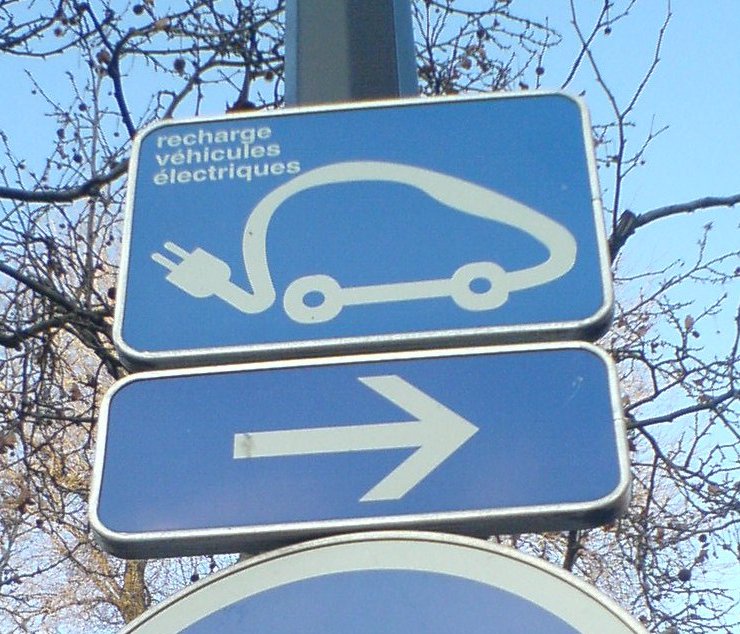
paris-ev-charge-station-sign-credit-peter-fairleyFrance’s government launched a working group this week to coordinate installation of a standardized national charging network for plug-in hybrid electric vehicles and battery-powered EVs. Many may be experience deja vu, so to speak, because this would apparently be the second such charging network the country has installed.

President Nicolas Sarkozy has set a goal of seeing 100,000-plus electric-mode vehicles on the road in 2012 and has offered French automakers bailout funding partially tied to development of EVs as summarized by Earth Times. But as French state minister for industry Luc Chatel told French business magazine Usine Nouvelle [French], “Their battery serves no point without the infrastructure to go with it.” Hence the working group struck last week, representing automakers, energy distributors such as state-owned nuclear utility EDF, municipalities and other players, which is to deliver a plan in June.

Continue reading “Deja Vu as France Plans National EV Charging Network – Again”

FERC Boss Dubs the Plug-in a ‘Cashback’ Hybrid

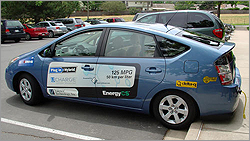
nrel-prius-plug-in-hybrid-demo-vehicleThe head of the Federal Energy Regulatory Commission (FERC) predicts that plug-in hybrid vehicles will provide immense benefit to power grid operators — enough for utilities to provide kickbacks to their customers, paying down the extra cost of a plug-in in as little as three years. Jon Wellinghoff, FERC’s acting chairman, made that comment at a Las Vegas trade show last week according to coverage by the Las Vegas Review-Journal (which I picked up on thanks to the keen newswatching eyes of specialty publication EV World).

Wellinghoff’s comments refer to plug-in hybrids equipped with the smarts to communicate with the power grid, which he termed the “Cashback Hybrid” according to the Review-Journal article:

When the Cashback is plugged in, motorists can allow the utility to vary the speed at which the battery recharges so that the utility can more closely match supply and demand for power on the electric grid…In return, the car owner could obtain cash back or a credit from the utility that makes the electricity free, he said.

Continue reading “FERC Boss Dubs the Plug-in a ‘Cashback’ Hybrid”

Electric Vehicles Can Cut Power Plant Pollution

Last week we saw that doing right by the environment is more complicated than simply downsizing the carbon footprint. Shifting to soot-free power sources will reduce mortality in cities, we noted, while increased use of variable wind power could jack up emissions of smog-forming NOx from the ‘peaking power’ plants that ramp up and down to balance electrical supply and demand.

Now power grid modelers at the National Renewable Energy Laboratory add another twist to this story with a report that electric vehicles (EVs) plugged into the grid can reduce NOx emissions and possibly more. Their report “Emissions Impacts and Benefits of Plug-In Hybrid Electric Vehicles and Vehicle-to-Grid Services” appears in the January 22 issue of the journal Environmental Science & Technology.

Continue reading “Electric Vehicles Can Cut Power Plant Pollution”

Saying Adieu to the Mighty UCTE

By summer the Union for the Co-ordination of Transmission of Electricity (UCTE), whose 240,000 kilometers of high-voltage lines connect 26 European countries, may cease to exist. Europe is not giving up electricity. Electrons will still flow on the world’s largest interconnection of power grids. Rather, the 57-year-old UCTE will be subsumed within a new and broader organization designed to, among other improvements, make Europe’s grids renewables-ready: the European Network of Transmission System Operators for Electricity (ENTSO-E).

CEOs from 42 transmission system operator companies in 34 European countries unanimously decided to create the new association last month. Whereas UCTE was limited to ensuring the interoperability of largely self-sufficient national grids, ENTSO-E is to play a proactive role in coordinating grid development to create a truly European grid that can operate on a larger scale. This is exactly what’s needed as Europe increasingly seeks to widely distribute electricity generated from concentrated renewable resources such as wind power in the North Sea and Baltic Sea and Mediterranean solar power.

Moving power across regions implies a European-scale supergrid, while the European Commission (EC) has struggled simply to add small interconnections between the states. Last month for Spectrum Online I profiled the EC’s latest desperate attempt to overcoming inertia in transmission expansion: recruiting high-profile volunteers to sell the interconnections.

One of those volunteers, Władysław Mielczarski, the Polish electric power engineering expert whom the EC recruited to unstick projects connecting Poland to Lithuania and Germany, minced no words in describing his best efforts to get things as no substitute for European institutions dedicated to grid planning. “If we’re going to do a professional job on interconnection,” said Mielczarski, “we must have professional people working full time, and we must have more support from the commission.”

add to del.icio.us : Add to Blinkslist : add to furl : Digg it : add to ma.gnolia : Stumble It! : add to simpy : seed the vine : : : TailRank

This post was created for Energywise, IEEE Spectrum’s blog on green power, cars and climate

Probing for Fluff in Europe’s Supergrids Vision

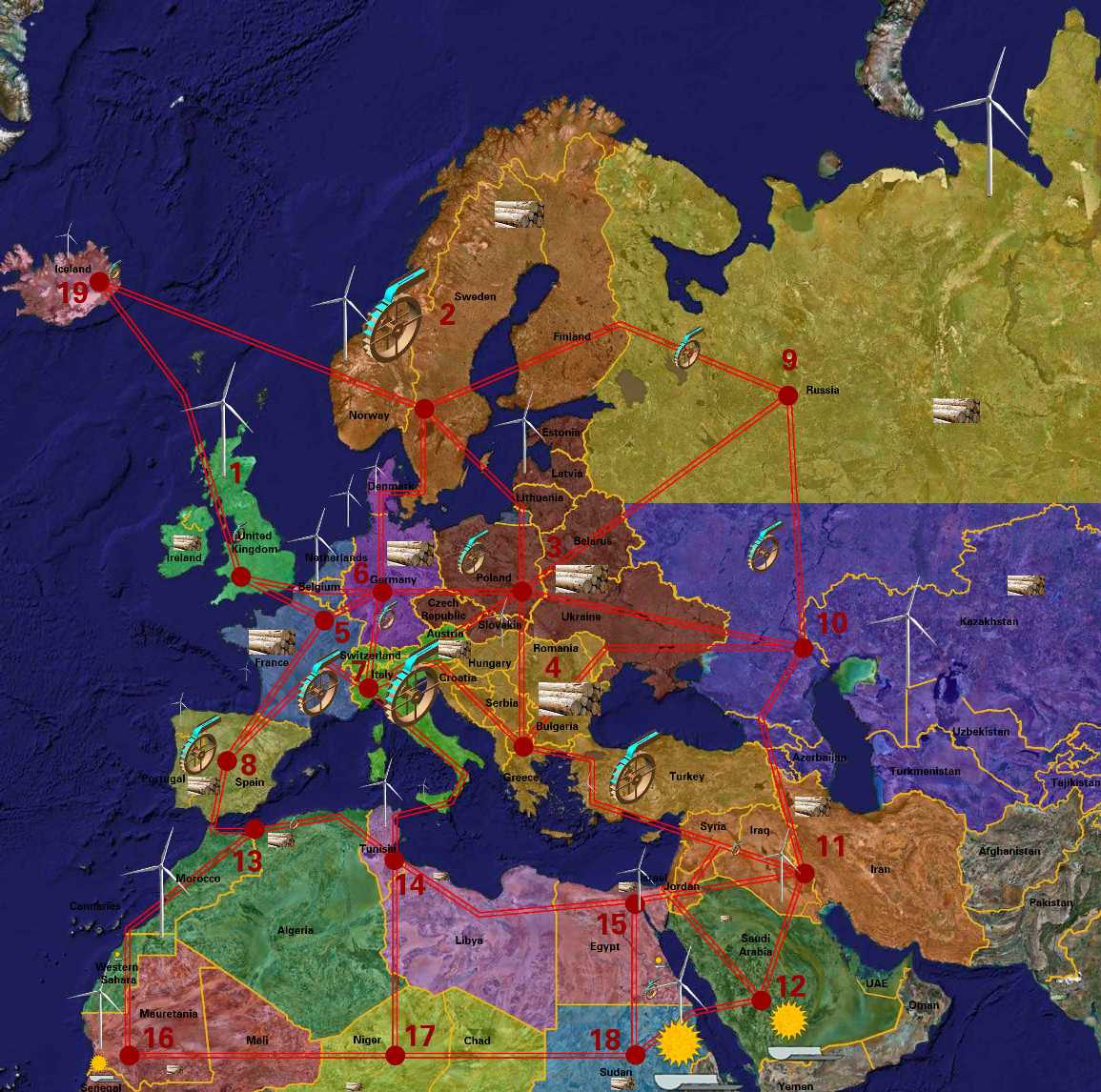
European renewable energy supergrid map Credit Wibke von FlemmingLast month the European Commission (EC) called for construction of regional power transmission grids that would ultimately merge into a supergrid distributing Mediterranean solar energy and offshore wind energy across Europe. Today, in MIT’s Technology Review, I test the political reality of sharing power across Europe (see “Europe Backs Supergrids”) and show that the EC just might pull it off.

Why be skeptical? Because for over a decade the EC has been pushing the liberalization of the European electricity market. Whereas, given the limited capacity for exchange of power between many European countries one could fairly question whether a ‘European market’ for electricity even exists.

Wind power developer Eddie O’Connor, for example, told me that his priority – building an offshore grid to connect tens of gigawatts of North Sea wind farms to be installed in the coming decade – would remain a dream so long as the European states and their politically powerful utilities control tranmission planning. “The utilities are the enemy,” says O’Connor, founder of wind developer Airtricity and CEO of Mainstream Renewable Power. “Even at this stage they’re still the enemy.”

What my report for TechReview shows, however, is that change is possible. The best example is a French-Spanish agreement this summer — under intense prodding from the EC — clearing the way for a much-needed second powerline across the Pyrenees. A special envoy appointed by the EC broke what had been a 15-year impasse complicated by local environmental concerns, Catalan fury, and diverging interests of the utilities involved. 

Even O’Connor is optimistic. He believes that new international institutions must be created to conjur up the supergrid Europe needs to carry renewable energy. But, says O’Connor, both are possible: “I believe the building of the supergrid is imminent.”  

Stay tuned for more on the EC’s energy envoys.

This post was created for EnergywiseIEEE Spectrum’s blog on green power, cars and climate

add to del.icio.us : Add to Blinkslist : add to furl : Digg it : add to ma.gnolia : Stumble It! : add to simpy : seed the vine : : : TailRank

Nukes, Gas, Oil and Coal All Losers in EU Energy Strategy

The European Commission issued its Strategic Energy Review yesterday, proposing energy efficiency investments, a shift to alternative fuel vehicles to end oil dependence in transport, and more aggressive deployment of renewable energy and carbon capture and storage to “decarbonise” the EU electricity supply. Figuring prominantly among its first six “priorities essential for the EU’s energy security” are the North Sea offshore electric power supergrid that Energywise covered in September and the Mediterranean Ring electric interconnection of Europe and North Africa that I’ve been harping on this week.

The EC energy strategy not only endorses the MedRing, but views it as a component of a future supergrid traversing Europe and stretching beyond the Mediterranean to Iraq, the Middle East and Sub-Saharan Africa.

How would this new vision (and $100/barrel oil) alter the complexion of European energy consumption? The energy review projects that by 2020 total energy demand drops from the equivalent of 1811 metric tons of oil in 2005 to 1672 MTOE in 2020. Demand met by renewables such as wind, solar and hydro more than doubles in real terms from 123 to 274 MTOE, while their share of total demand leaps from 6.8% to 16.4%. Imported renewables – with the MedRing delivering North African wind and solar power – jump 10-fold from 0.8% in 2005 to 8.8% in 2020.

Oil, gas, coal and nuclear, meanwhile, all see a diminished role, both in real terms and as a share of European energy demand. Interestingly the role of natural gas – the low-carbon fossil fuel – drops the most, from 25% to 21%, reflecting EU concern over dependence on gas imports from Russia. Nuclear’s share drops the least, from just slightly over to slightly under 14% of demand; this assumes that nuclear phaseout plans, particularly Germany’s, are followed through.

How to make it all come true? Accompanying the EC review is a ‘green paper‘ (the EU’s unbleached alternative terminology for what we’d call a ‘white paper’) outlining a variety of new regulatory and financial mechanisms. The EU is already a world leader in terms of incentives for lower carbon energy with strong price supports for solar and wind and a carbon cap and trade program up and running (though still lacking teeth as my Energywise colleague Bill Sweet notes). However, the energy review warns that the primarily national-level financing that drives energy projects today are inadequate to drive infrastructure that is pan-European or larger. A perfect example is the massive investment in high-voltage dc lines needed to turn the MedRing into a bulk power mover (see the second half of our feature on MedRing: “Closing the Circuit”).

Even less viable under existing financing mechanisms are those projects that entail considerable “non-commercial risks” such as threats of political instability or terrorism. Did someone say North Africa?

add to del.icio.us : Add to Blinkslist : add to furl : Digg it : add to ma.gnolia : Stumble It! : add to simpy : seed the vine : : : TailRank

This post was created for EnergywiseIEEE Spectrum’s blog on green power, cars and climate