
Negative Prices for Clean Power

How do you know that congestion on high-voltage transmission grids is stranding valuable renewable energy? When the price of electricity goes negative. American Wind Energy Association electricity industry analyst Michael Goggin delivers a snapshot of the phenomenon in a recent column for Renewable Energy World.

Goggin points to data from the Electricity Reliability Council of Texas or ERCOT, the state’s grid operator, showing an increasing incidence of generators paying buyers to take their power. According to Goggin, such conditions track the explosive installation of wind farms in West Texas — and are very bad news for their operators.

Prices fell below US -$30/MWh (megawatt-hour) on 63% of days during the first half of 2008, compared to 10% for the same period in 2007 and 5% in 2006. If prices fall far enough below zero that the cost for a wind plant to continue operating is higher than the value of the US $20/MWh federal renewable electricity production tax credit plus the value of other state incentives, wind plant operators will typically curtail the output of their plants.

Worse still, consumers in adjacent areas are paying top dollar for power because the transmission lines between them and the excess wind power are overloaded.

Texas is running into trouble because it pushed wind power harder and faster than other states, but it is also leading the way to address what is really a nationwide problem. This summer the Public Utility Commission of Texas approved a scheme called the Competitive Renewable Energy Zone (CREZ) process to incentivize construction of new transmission lines to evacuate stranded wind power. Earlier this month a consortium of major utilities including MidAmerican and AEP announced their intention to do so.

For a detailed yet accessible look at Texas’ renewable energy transmission challenge and efforts to clear out the bottlenecks, see this overview from the State Energy Conservation Office.

add to del.icio.us : Add to Blinkslist : add to furl : Digg it : add to ma.gnolia : Stumble It! : add to simpy : seed the vine : : : TailRank

This post was created for Tech Talk – Insights into tomorrow’s technology from the editors of IEEE Spectrum.

Electric Supergrids Gaining Traction

Greenpeace%20Belgium%20North%20Sea%20Grid%20Map.jpgIncomplete and constrained transmission grids pose a serious impediment to the use of renewable energy sources such as wind power. Proposals launched over the past week show that support for more lines is going mainstream.

Last week none other than Greenpeace called for an underwater power grid criss-crossing the North Sea to accelerate the installation of dozens of new offshore wind farms. In “A North Sea Electricity Grid [R]Evolution”, Greenpeace Belgium and Brussels-based environmental consulting firm 3E map out an offshore network composed of 6,200 kilometers of undersea lines. According to their models, this grid extension could add 68 gigawatts of wind power capacity by 2020 — enough to meet 13% of net power demand of seven North Sea countries.

Yesterday the Washington, D.C.-based Council on Competitiveness, an alliance of corporate CEOs, university presidents and labor leaders, lent its support to grid expansion, urging the next U.S. president to create a “national transmission superhighway.” The proposal is part of a broader “100-Day Energy Action Plan”. The Council would empower the Federal Energy Regulatory Commission to determine when and where expanded transmission capacity is needed, overriding state authorities. “As with the interstate highway system and the information superhighway, our leaders must knit together the current patchwork of regulations and oversight into a seamlessly connected electrical power highway,” states the plan.

Proposals that need to be debated.

add to del.icio.us : Add to Blinkslist : add to furl : Digg it : add to ma.gnolia : Stumble It! : add to simpy : seed the vine : : : TailRank

This post was created for Tech Talk – Insights into tomorrow’s technology from the editors of IEEE Spectrum.

Wind and the Whale

Humpback whales are surprisingly agile, executing tight banking turns in spite of their 40-ton hulk. How? One factor may be ten or so fibrous ‘tubercles’ protruding from the leading edge of their pectoral flippers. These protruding, oversized knuckles (a humpback’s flippers are analogous to your arms, but most of the length is finger) alter the airflow over the flipper. The result is an airfoil that is largely immune to the sudden loss of lift or ‘stall’ can trip up fighter pilots when they try to carve into turns too aggressively.

What does all that have to do with our energy future? Toronto-based airfoil designer WhalePower Corp. thinks that the serrated profile of the humpback fin could hold the key to smoother-running pumps, fans and wind turbines. Find all that a bit much? Would you believe the scientist behind this novel airfoil design is Frank Fish?

Read more about the promise of this technology in the current issue of Discover Magazine (see “Wind Turbine That Imitates Flippers Could Increase Efficiency”).

A note of caution: Convincing risk-averse wind turbine builders and buyers to try something new will require some, “pretty hard test data,” according to Bob Thresher, director of the U.S. Department of Energy’s National Wind Technology Center. In other words WhalePower has plenty more work ahead than the hopeful tagline on its website – “A Million Years Of Field Tests” – would suggest.

add to del.icio.us : Add to Blinkslist : add to furl : Digg it : add to ma.gnolia : Stumble It! : add to simpy : seed the vine : : : TailRank

Realistic Expectations for Renewable Energy

RenewableEnergyWorld’s Inside Renewable Energy podcast returned to the potential green bubble this week. Carbon-Nation readers will recall that in May this podcast reviewed our reporting on organic photovoltaics, and the allegations that researchers developing that very promising (but still quite nascent) approach to solar power had overstated their advances. This week’s entry, “Keeping the Industry in Check”, broadens the issue to take on overheated hyperbole coming from the renewables industry writ large.

Podcast Editor Stephen Lacey’s quotes from wind energy expert Mack Sagrillo capture the conversation’s overall message: Buyer beware. “It’s great that people are looking for alternatives, but it’s amazing how little people know when they seek them out. That leaves people open to purchasing a product that is less-than-reliable. We are a very gullible culture, we’re always looking for the magic bullet,” says Sagrillo.

Lacey brings me in to speak to media’s role. Some of my touchstones: Asking uncomfortable questions; providing caveats that make the story a little more messy but a lot more accurate; and letting readers know when technology advocates are providing only half the story.

The most important audience for the above? The editors that serve as the ultimate gatekeepers for the reader and, all too often in my opinion, underestimate their audience’s appetite for complexity.

add to del.icio.us : Add to Blinkslist : add to furl : Digg it : add to ma.gnolia : Stumble It! : add to simpy : seed the vine : : : TailRank

China ‘Gets It’ On Green Jobs

Threatened American jobs and higher gas prices were the points of attack that deep-sixed the latest effort to put a price on U.S. greenhouse gas emissions — a cap-and-trade bill that died in the Senate on Friday. This defensive posture, seeking to preserve energy-intensive transportation and industries, is short-sighted in light of the transition to alternative forms of energy underway worldwide.

China gets it. Not only is it racing to implement renewable energy (ie setting a nationwide renewable portfolio standard for utilities, installing enough wind power in just the last two years to edge out wind-energy pioneer Denmark for fifth place in the Global Wind Energy Council’s annual capacity rankings, and building a photovoltaics export business essentially overnight). China designs these initiatives to favor the development of domestic industries.

In a recent article for Spectrum magazine I show how China’s dramatic installation of wind power parks is occuring despite rock-bottom pricing — a situation that analysts say favors local players. See China Doubles Wind Watts in Spectrum’s May 2008 issue.

Note that while John McCain and Barack Obama both claim to get it on both green jobs and climate change, neither bothered to show up for Friday’s vote.

add to del.icio.us : Add to Blinkslist : add to furl : Digg it : add to ma.gnolia : Stumble It! : add to simpy : seed the vine : : : TailRank

A Steadier Platform for Floating Wind Power

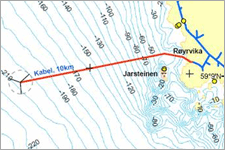
The Norwegian North Sea site for StatoilHydro\'s first floating wind turbineThose of you who mistook CN’s April 2 post Wind Power That Floats for a belated April Fool’s joke will want to consider last month’s project launch by Norway’s StatoilHydro. The North Sea oil and gas giant has teamed up with engineering conglomerate Siemens AG to anchor a full-scale commercial wind turbine in over 200 meters of water off Norway’s southwest tip.

StatoilHydro and Siemens plan to take a different tack from the startups profiled in the April 2 piece. As I show today in Wind Power Moves into Deep Waters at TechnologyReview.com, these big players are selecting components conservatively to prove that the concept of floating wind turbines is workable rather than trying to engineer the optimal floating system from the start. 

Consider the turbine itself. Tech startup Sway is designing a downwind rotor, and rival Blue H Group is building a two-bladed rotor with hinged blades. Both designs could reduce the forces on the machine and thus reduce the weight of the entire system–including the super-pricey counterweights required to anchor giant buoys to the seabed. But both designs were also left behind as the commercial wind power industry went mainstream in the mid to late 1990s and coalesced around the less elegant but more durable upwind three-bladed rotors now universally used on utility scale turbines.

StatoilHydro and Siemens will use a well-tested Siemens three-blade upwind machine, thus simplifying both their design process and their demonstration of the floating wind concept. As StatoilHydro’s vp for wind power notes in my story, if the demo fails in any way they’ll know that it’s not the turbine itself that’s to blame.

add to del.icio.us : Add to Blinkslist : add to furl : Digg it : add to ma.gnolia : Stumble It! : add to simpy : seed the vine : : :

Solar Squabble Tops Renewable Energy Podcast

Carbon-Nation returns today from a month-long hiatus that took editor Peter Fairley on a fact-finding mission to North Africa. More to come on that. For instant gratification we refer you to the latest installment of Renewable Energy World’s Inside Renewable Energy podcast, released this morning. Topping this week’s podcast is an interview with C-N’s editor on the growing acrimony within organic photovoltaics research over the credibility of recent reports touting record power output from this promising next-generation approach to solar power.

Call it another friendly effort to pop the solar bubble before unrealized hype damages the entire industry. Akin to lancing a wound to stem a life-threatening infection. 

add to del.icio.us : Add to Blinkslist : add to furl : Digg it : add to ma.gnolia : Stumble It! : add to simpy : seed the vine : : : TailRank