
5 Megawatts-a-Pop and Prepped for High Seas Action

Here’s a shot of the prototype of REpower System’s 5-megawatt (MW) offshore wind turbine, which has been generating power since 2004 in Brunsbüttel near the mouth of the Elbe River on Germany’s North Sea. I stopped to see the original REpower 5M last week while reporting an upcoming feature for IEEE Spectrum and clocked the turbine’s 126-meter diameter rotor swinging at 11 rpm, nearly full speed. The 5M marks an awesome juxtaposition, with the 120-meter high turbine (hub height) towering over Brunsbüttel’s spongy marshland, chemical complexes and a nuclear power plant.

The 5M is creating buzz these days after RWE Innogy, the renewable energy subsidiary of German utility RWE, signed a deal to install 250 of them over the next five years. At a total value of €2 billion it is the biggest deal yet for offshore wind. It also cements plans for RWE’s Nordsee 1 wind farm, which could be Germany’s first worldscale offshore farm if the first 30 5Ms are installed in 2011 as planned. Nordsee 1, about 50 kilometers offshore, could ultimately grow to 1000 MW — the same scale as large coal and nuclear-fueled thermal power plants.
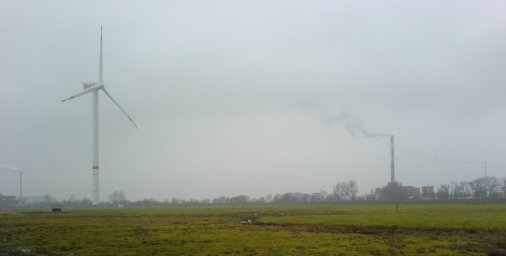
REpower's-5M-prototype-in-Brunsbuttel

add to del.icio.us : Add to Blinkslist : add to furl : Digg it : add to ma.gnolia : Stumble It! : add to simpy : seed the vine : : : TailRank

This post was created for Energywise, IEEE Spectrum’s blog on green power, cars and climate
Sarkozy Keeping Nuclear Atop France’s Energy Pile

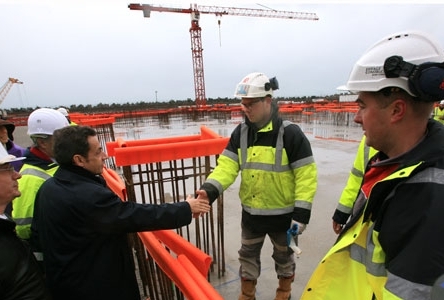
french-president-nicolas-sarkozy-at-flamanvilleFrench president Nicolas Sarkozy was in Normandy last week at the construction site of France’s first new nuclear reactor in two decades, highlighting plans to commence a second new reactor and,  according to Paris-based daily Le Monde (Google translation here), calling nuclear energy a key part of the country’s economic recovery plan. The move is evidence of further diversity in how countries are seeking to shape their energy futures via recovery plans, as President Barack Obama negotiates with Congress to keep renewable energy atop his plan and Canada’s latest budget pursues a heavy emphasis on carbon capture and storage.

A who’s-who list of French corporate heavyweights angling for a piece of Sarkozy’s action leaves no doubt that government dollars impact industrial strategy. French state-owned power giant Electricité de France (EDF) is building the reactor at Flammanville that Sarkozy visited last week, using the third-generation EPR reactor designed by French nuclear technology firm Areva. But Sarkozy says a second EPR to be built further up the Normandy coast at Penly will unite EDF and France’s number two player in electricity, GDF Suez; Reuters reported today that French oil and gas firm Total also wants a “double-digit” stake in the project.

Continue reading “Sarkozy Keeping Nuclear Atop France’s Energy Pile”

Canadian ‘Stimulus’ Targets Carbon Capture & Nuclear

canadian-prime-minister-stephen-harper

Canada’s Conservative government unveiled a budget yesterday with an energy balance distinctly different from that contemplated by President Obama in his economic stimulus package. “Green Causes Left Out of Budget” is how the Toronto-based National Post headlined its coverage of the Canadian budget proposed yesterday. Toronto Star columnist Chantal Hebert writes that environmentalists may be the only “constituency, friendly or hostile to the Conservatives, that will not get a piece of the multibillion-dollar stimulus package.”

Whereas Obama’s $819-billion stimulus package proposes to give renewables a big boost, Prime Minister Stephen Harper’s C$33-billion (US$27-billion) ‘Economic Action Plan’ would leave unchanged Canada’s EcoEnergy support program for renewable energy. Canadian Wind Energy Association president Robert Hornung predicts the program may run out of cash before the end of the coming fiscal year, blunting the industry’s ability to draw investment amidst a superhot U.S. market:

“Our ability to compete with the United States for investment in wind energy projects and manufacturing opportunities will decline as a result of this budget. At a time when the United States has made measures to support renewable energy deployment a key component of its plans to stimulate the US economy, Canada is moving in the opposite direction.”

Continue reading “Canadian ‘Stimulus’ Targets Carbon Capture & Nuclear”

Electric Vehicles Can Cut Power Plant Pollution

Last week we saw that doing right by the environment is more complicated than simply downsizing the carbon footprint. Shifting to soot-free power sources will reduce mortality in cities, we noted, while increased use of variable wind power could jack up emissions of smog-forming NOx from the ‘peaking power’ plants that ramp up and down to balance electrical supply and demand.

Now power grid modelers at the National Renewable Energy Laboratory add another twist to this story with a report that electric vehicles (EVs) plugged into the grid can reduce NOx emissions and possibly more. Their report “Emissions Impacts and Benefits of Plug-In Hybrid Electric Vehicles and Vehicle-to-Grid Services” appears in the January 22 issue of the journal Environmental Science & Technology.

Continue reading “Electric Vehicles Can Cut Power Plant Pollution”

Big Footprints Next to Carbon’s

nejm-logoThe U.S. carbon footprint looms large as Washington prepares to finally begin, in earnest, a shift away from fossil fuels under a new President promising international action to, “roll back the specter of a warming planet,” as Agence France Presse highlighted in its reporting of Obama’s inaugural address. Debate is already raging, for example, around whether President Obama will allow California and other states to ratchet up the fuel efficiency improvements automakers must make in the years to come.
But research published yesterday in the New England Journal of Medicine provides a needed reminder that burning less fossil fuels can also directly reduce mortality from air pollution, as reported yesterday by CNN’s health desk. (Carbon-Nation readers will recall that the network’s sci/tech/environment desk is currently unavailable, having been eliminated by CNN last month.)

Continue reading “Big Footprints Next to Carbon’s”

Tidal Power Flowing Stronger

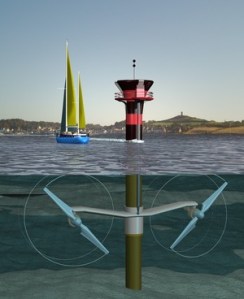
mct-seagen-system-with-yacht1Tidal power developments by British firms show this renewable power technology achieving impressive scale and continued design innovation. Bristol-based Marine Current Turbines (MCT) revealed last month that its SeaGen dual-turbine system achieved full power operation of 1.2 megawatts. MCT’s power peak is four times the global record for a tidal stream system set by the company in 2004, according to U.K.-based renewables journal REFocus, and 30-times more than the output from the tidal turbines pumping electricity in New York’s East River.

Meanwhile the U.K. Guardian reported yesterday that more largescale demonstrations are on the way as Cardiff-based Tidal Energy Ltd prepares to test a 1-MW version of its triple-rotor design by next year off the coast of Wales.

Achieving full power operation clears a major hurdle for MCT. As TechReview reported last July, the company suffered a setback early on when the powerful tidal streams of Northern Ireland’s Strangford Lough damaged one of its blades shortly after installation. In an odd way it’s an affirmation of MCT’s design, which enables the dual rotors to be lifted clear up out of the water for easy maintenance and repair.

While at a considerably earlier phase of development, MCT rival Tidal Energy’s triple-rotor concept provides an equally innovative means of ready repair. Tidal Energy’s rotors sit at the corners of a three-legged platform that can be deposited on the seabed and held in place by the systems 250-ton heft. That should not only ease recovery of the system for maintenance, but also simplify installation by eliminating the need for a fixed foundation in the seabed.

To see these concepts in action see MCT and Tidal Energy’s dueling animations.

add to del.icio.us : Add to Blinkslist : add to furl : Digg it : add to ma.gnolia : Stumble It! : add to simpy : seed the vine : : : TailRank

This post was created for the Technology Review guest blog: Insights, opinions and analysis of the latest in emerging technologies

Saying Adieu to the Mighty UCTE

By summer the Union for the Co-ordination of Transmission of Electricity (UCTE), whose 240,000 kilometers of high-voltage lines connect 26 European countries, may cease to exist. Europe is not giving up electricity. Electrons will still flow on the world’s largest interconnection of power grids. Rather, the 57-year-old UCTE will be subsumed within a new and broader organization designed to, among other improvements, make Europe’s grids renewables-ready: the European Network of Transmission System Operators for Electricity (ENTSO-E).

CEOs from 42 transmission system operator companies in 34 European countries unanimously decided to create the new association last month. Whereas UCTE was limited to ensuring the interoperability of largely self-sufficient national grids, ENTSO-E is to play a proactive role in coordinating grid development to create a truly European grid that can operate on a larger scale. This is exactly what’s needed as Europe increasingly seeks to widely distribute electricity generated from concentrated renewable resources such as wind power in the North Sea and Baltic Sea and Mediterranean solar power.

Moving power across regions implies a European-scale supergrid, while the European Commission (EC) has struggled simply to add small interconnections between the states. Last month for Spectrum Online I profiled the EC’s latest desperate attempt to overcoming inertia in transmission expansion: recruiting high-profile volunteers to sell the interconnections.

One of those volunteers, Władysław Mielczarski, the Polish electric power engineering expert whom the EC recruited to unstick projects connecting Poland to Lithuania and Germany, minced no words in describing his best efforts to get things as no substitute for European institutions dedicated to grid planning. “If we’re going to do a professional job on interconnection,” said Mielczarski, “we must have professional people working full time, and we must have more support from the commission.”

add to del.icio.us : Add to Blinkslist : add to furl : Digg it : add to ma.gnolia : Stumble It! : add to simpy : seed the vine : : : TailRank

This post was created for Energywise, IEEE Spectrum’s blog on green power, cars and climate