
Sarkozy Keeping Nuclear Atop France’s Energy Pile

french-president-nicolas-sarkozy-at-flamanvilleFrench president Nicolas Sarkozy was in Normandy last week at the construction site of France’s first new nuclear reactor in two decades, highlighting plans to commence a second new reactor and,  according to Paris-based daily Le Monde (Google translation here), calling nuclear energy a key part of the country’s economic recovery plan. The move is evidence of further diversity in how countries are seeking to shape their energy futures via recovery plans, as President Barack Obama negotiates with Congress to keep renewable energy atop his plan and Canada’s latest budget pursues a heavy emphasis on carbon capture and storage.

A who’s-who list of French corporate heavyweights angling for a piece of Sarkozy’s action leaves no doubt that government dollars impact industrial strategy. French state-owned power giant Electricité de France (EDF) is building the reactor at Flammanville that Sarkozy visited last week, using the third-generation EPR reactor designed by French nuclear technology firm Areva. But Sarkozy says a second EPR to be built further up the Normandy coast at Penly will unite EDF and France’s number two player in electricity, GDF Suez; Reuters reported today that French oil and gas firm Total also wants a “double-digit” stake in the project.

Continue reading “Sarkozy Keeping Nuclear Atop France’s Energy Pile”

GPS-enabled Software Boosts Hybrid Vehicle Efficiency

Mechatronics meets the plug-in hybrid this month at IEEE Spectrum Online:
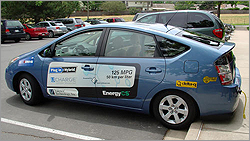
Drivers use all manner of data these days to travel efficiently, and vehicles should follow their lead, according to University of Wisconsin-Milwaukee mechatronics expert Yaoyu Li. He predicts that vehicles privy to data in the latest GPS-enabled electronic navigators — which download real-time traffic data to update route suggestions on the fly — will provide substantial fuel savings in the decades to come.

That’s because:

An uninformed plug-in is almost certain to discharge its battery power either too quickly or too slowly. If it simply uses the battery until it is discharged, it will lack an electric option for later stop-and-go situations where running the internal combustion engine is inefficient. Alternatively, if the plug-in acts like a conventional hybrid and lives in the moment, blending its electric and gasoline energy based on the driving conditions that second, it is likely to arrive at its destination with leftover battery charge. Either way, the plug-in will have consumed more gasoline than necessary.

Continue reading “GPS-enabled Software Boosts Hybrid Vehicle Efficiency”

FERC Boss Dubs the Plug-in a ‘Cashback’ Hybrid

nrel-prius-plug-in-hybrid-demo-vehicleThe head of the Federal Energy Regulatory Commission (FERC) predicts that plug-in hybrid vehicles will provide immense benefit to power grid operators — enough for utilities to provide kickbacks to their customers, paying down the extra cost of a plug-in in as little as three years. Jon Wellinghoff, FERC’s acting chairman, made that comment at a Las Vegas trade show last week according to coverage by the Las Vegas Review-Journal (which I picked up on thanks to the keen newswatching eyes of specialty publication EV World).
Wellinghoff’s comments refer to plug-in hybrids equipped with the smarts to communicate with the power grid, which he termed the “Cashback Hybrid” according to the Review-Journal article:

When the Cashback is plugged in, motorists can allow the utility to vary the speed at which the battery recharges so that the utility can more closely match supply and demand for power on the electric grid…In return, the car owner could obtain cash back or a credit from the utility that makes the electricity free, he said.

Continue reading “FERC Boss Dubs the Plug-in a ‘Cashback’ Hybrid”

Canadian ‘Stimulus’ Targets Carbon Capture & Nuclear

canadian-prime-minister-stephen-harper

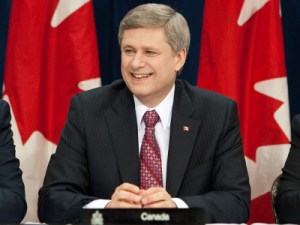
Canada’s Conservative government unveiled a budget yesterday with an energy balance distinctly different from that contemplated by President Obama in his economic stimulus package. “Green Causes Left Out of Budget” is how the Toronto-based National Post headlined its coverage of the Canadian budget proposed yesterday. Toronto Star columnist Chantal Hebert writes that environmentalists may be the only “constituency, friendly or hostile to the Conservatives, that will not get a piece of the multibillion-dollar stimulus package.”

Whereas Obama’s $819-billion stimulus package proposes to give renewables a big boost, Prime Minister Stephen Harper’s C$33-billion (US$27-billion) ‘Economic Action Plan’ would leave unchanged Canada’s EcoEnergy support program for renewable energy. Canadian Wind Energy Association president Robert Hornung predicts the program may run out of cash before the end of the coming fiscal year, blunting the industry’s ability to draw investment amidst a superhot U.S. market:

“Our ability to compete with the United States for investment in wind energy projects and manufacturing opportunities will decline as a result of this budget. At a time when the United States has made measures to support renewable energy deployment a key component of its plans to stimulate the US economy, Canada is moving in the opposite direction.”

Continue reading “Canadian ‘Stimulus’ Targets Carbon Capture & Nuclear”

Electric Vehicles Can Cut Power Plant Pollution

Last week we saw that doing right by the environment is more complicated than simply downsizing the carbon footprint. Shifting to soot-free power sources will reduce mortality in cities, we noted, while increased use of variable wind power could jack up emissions of smog-forming NOx from the ‘peaking power’ plants that ramp up and down to balance electrical supply and demand.

Now power grid modelers at the National Renewable Energy Laboratory add another twist to this story with a report that electric vehicles (EVs) plugged into the grid can reduce NOx emissions and possibly more. Their report “Emissions Impacts and Benefits of Plug-In Hybrid Electric Vehicles and Vehicle-to-Grid Services” appears in the January 22 issue of the journal Environmental Science & Technology.

Continue reading “Electric Vehicles Can Cut Power Plant Pollution”

Pushing Geoengineering Out of the Closet

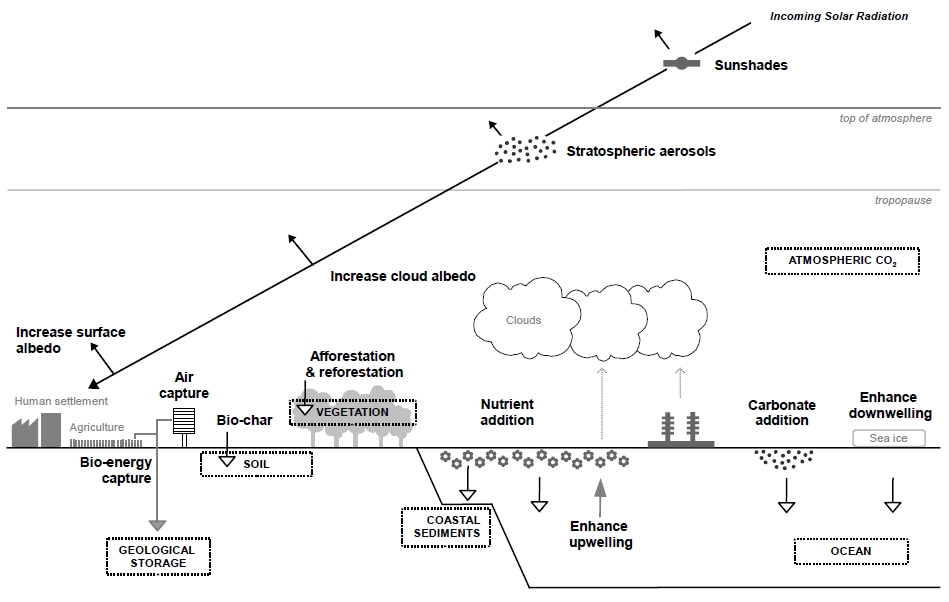
geoengineering-options-diagram-source-east-anglia-universityWhen Time Magazine included geoengineering in its “What’s Next for 2008” report it wrote that, “a few scientists are beginning to quietly raise the possibility of cooling the planet’s fever directly…as an option of last resort.” Today scientists at the University of East Anglia (UEA) are definitively smashing the hush surrounding geoengineering, publishing the first comprehensive assessment of the climate cooling potential of the various schemes being contemplated to re-engineer Earth.

“The realisation that existing efforts to mitigate the effects of human-induced climate change are proving wholly ineffectual has fuelled a resurgence of interest in geo-engineering,” explains UEA Environmental Sciences professor Tim Lenton, who wrote the report with UEA colleague Naomi Vaughan. Their report in today’s issue of the journal Atmospheric Chemistry and Physics Discussions shows that the benefits of some schemes have been exaggerated in the past by “significant” errors in calculations, but the best will likely play a constributing role in blunting climate change:

“We found that some geoengineering options could usefully complement mitigation, and together they could cool the climate, but geoengineering alone cannot solve the climate problem.”

Continue reading “Pushing Geoengineering Out of the Closet”

Big Footprints Next to Carbon’s

nejm-logoThe U.S. carbon footprint looms large as Washington prepares to finally begin, in earnest, a shift away from fossil fuels under a new President promising international action to, “roll back the specter of a warming planet,” as Agence France Presse highlighted in its reporting of Obama’s inaugural address. Debate is already raging, for example, around whether President Obama will allow California and other states to ratchet up the fuel efficiency improvements automakers must make in the years to come.

But research published yesterday in the New England Journal of Medicine provides a needed reminder that burning less fossil fuels can also directly reduce mortality from air pollution, as reported yesterday by CNN’s health desk. (Carbon-Nation readers will recall that the network’s sci/tech/environment desk is currently unavailable, having been eliminated by CNN last month.)

Continue reading “Big Footprints Next to Carbon’s”