Can you imagine an electric cooler compact enough to fit in your pocket and flexible enough to wear? If not, think again because engineers at the University of California at Los Angeles and SRI International have one working: A 5-millimeter-thick device that is the world’s first solid-state cooler combining practicality, energy efficiency, and high performance. Solid-state cooling has become a highly-competitive field in recent years, as researchers race to develop alternatives to refrigerators and air conditioners that gobble energy and release potent greenhouse gases. In 2014 General Electric heralded a “breakthrough” using materials that heat and cool when moved near and away from magnets, enthusing that its “magnetocaloric” system could be “inside your fridge by the end of the decade.” The comparatively simple working device from UCLA and SRI, reported in today’s issue of the journal Science, may give GE the chills.
Are UN Climate Assessments Obsolete?
The sweeping multi-year assessments produced by the Intergovernmental Panel on Climate Change set the gold standard for global scientific consensus on how humanity is altering Earth’s climate, and how to anticipate and minimize those changes. Some top climate scientists, however, are reviving a harsh critique of the IPCC’s assessment process, saying that it takes too long and that the delay could actually be creating an excuse for political inaction. The production cycle for what will become IPCC Sixth Assessment Report—began in 2015 and will not conclude until 2022. That seven-year schedule is simply unacceptable for a document that is “relied on by countless decision makers around the world every day,” said Katharine Hayhoe, an atmospheric scientist and co-director of the Climate Science Center at Texas Tech. Read on at InsideClimate News
Palmetto State’s $9-bn Nuclear Boondoggle
“Public trust is at stake here, folks.” That’s how South Carolina’s top power industry regulator described the gravity of local utilities’ decision to walk away from a pair of partially-built nuclear reactors, according to Charleston’s Post and Courier. Public Service Commission chairman Swain Whitfield added that the reactors’ cancellation after $9 billion of investment — more than the state’s annual budget — “is going to shatter lives, hopes and dreams” in South Carolina. South Carolina-based Santee Cooper and SCANA’s abandonment of their pair of new reactors, announced on Monday, also have broader ramifications for the nuclear industry’s self-declared “nuclear renaissance.” The cost overruns and delays afflicting this project and a sister project in Georgia drove the reactor designer and builder Westinghouse Electric Co. into bankruptcy. Cost overruns and political concerns are also squeezing nuclear suppliers from France, South Korea, and Russia. Continue reading “Palmetto State’s $9-bn Nuclear Boondoggle”
Can U.S. Grids Handle 100% Renewables?
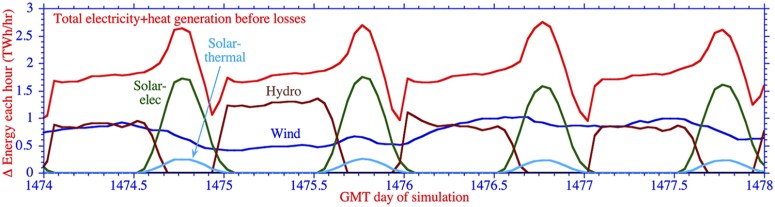
A battle royale between competing visions for the future of energy blew open today on the pages of a venerable science journal. The conflict pits 21 climate and power system experts against Stanford University civil and environmental engineer Mark Jacobson and his vision of a world fuelled 100 percent by renewable solar, wind, and hydroelectric energy. The criticism of his “wind, water and sun” solution and an unapologetic rebuttal from Jacobson and three Stanford colleagues appear today in the Proceedings of the National Academy of Sciences. In fact, while both sides claim to be objectively weighing the energy options, the arguments and backgrounds of the protagonists belie well-informed affinities for various energy sources (and informed biases against others). As sociologists of science would say, their choice of data and their reading of it reflects hunches, values, and priorities.
Commentary: Photo Ops with Miners No Substitute for Climate Policy
President Donald Trump surrounded himself with coal miners at the EPA yesterday as he signed an executive order calling for a clean sweep of federal policies hindering development of fossil fuel production in the United States. The order instructs EPA to kill Obama’s Clean Power Plan and thus, according to Trump’s rhetoric, revive coal-fired power generation and the miners who fuel it. The electric power sector, however, responded with polite dismissal. What separates President Trump and some of his top officials from power engineers and utilities? The latter operate in a world governed by science and other measurable forces. Unlike President Trump, scientists, engineers, and executives suffer reputational and financial losses when they invent new forms of logic that are unsupported by evidence. And a world of fallacies underlies the President and his administration’s rejection of climate action. Continue reading “Commentary: Photo Ops with Miners No Substitute for Climate Policy”
Trump Budget Dumps Climate Science, Innovation
Al Gore didn’t really claim to invent the Internet in 1999, but he did champion a NASA mission that installed a deep space webcam pointed at Earth in 2015. And yesterday President Trump put a bullseye on that mission. Trump’s 2018 budget blueprint asks Congress to defund the Earth-facing instruments on the Deep Space Climate Observatory (DSCOVR). Selectively deep-sixing well-functioning instruments on a satellite 1.5 million kilometers from Earth is one of the stranger entries in President Trump’s first pass at a budget request. But it fits a pattern: Throughout the document programs aimed at comprehending or addressing climate change take deep cuts, even where there is no obvious fiscal justification. Continue reading “Trump Budget Dumps Climate Science, Innovation”
The Self-Driving Car’s Bicycle Problem
Robotic cars are great at tracking other cars, and they’re getting better at noticing pedestrians, squirrels, and birds. The main challenge, though, is posed by the lightest, quietest, swerviest vehicles on the road. “Bicycles are probably the most difficult detection problem that autonomous vehicle systems face,” says UC Berkeley research engineer Steven Shladover. Nuno Vasconcelos, a visual computing expert at the University of California, San Diego, says bikes pose a complex detection problem because they are relatively small, fast and heterogenous. “A car is basically a big block of stuff. A bicycle has much less mass and also there can be more variation in appearance — there are more shapes and colors and people hang stuff on them.” Bikes are also being left behind by the machine learning techniques that enable detection systems to train themselves by studying thousands of images in which known objects are labeled. Most of the training, to date, has employed images featuring cars, with far fewer bikes. Continue reading “The Self-Driving Car’s Bicycle Problem”

