Giving FutureGen a Second Chance

FutureGen — the carbon-neutral coal power project initiated and then killed under the Bush Administration — looks increasingly likely to be resuscitated under President Obama after proponents met with Energy Secretary Steven Chu this week. There is now good reason to take a fresh look at this proposed coal gasification power plant which integrates carbon capture and storage (CCS) from the ground up.

Those words don’t come easy for this longtime FutureGen critic. But the context has changed since FutureGen was conceived in 2003, and even since Bush Energy Secretary Samuel Bodman killed it in January of 2008. While Energywise recently noted ongoing concern over FutureGen’s cost, here are five arguments that could justify heavy federal financing:

  • Project scope: In its early years FutureGen was viewed as a PR exercise because it framed carbon-neutral coal as a research project, positioning the use of commercially-ready Integrated Gasification Combined Cycle power plants as a moon-shot. Chu has indicated that the project would be streamlined. My sources say one element likely to go will be plans to generate fuel-cell grade hydrogen.
  • Financing: The most fundamental block to commercialization of IGCC technology was Bush’s refusal to put a price on carbon emissions, which thwarted even utilities such as AEP that wanted to build cleaner coal plants. Carbon pricing may arrive under Obama–if he can push it through Congress–but the financial collapse has now slashed utilities’ appetite to pore capital into big projects.

Continue reading “Giving FutureGen a Second Chance”

Chu Entertains FutureGen Alliance

Potential Energy has learned that Energy Secretary Steven Chu met with representatives of the FutureGen Alliance today, reinforcing positive signals from Chu two weeks ago that the troubled project could be revived. The public-private partnership to prove the integration of carbon capture and storage and coal gasification technology was killed by the Bush Administration in January 2008 using what Congressional investigators have shown to be specious accounting.

In an email to TechReview today, Department of Energy press secretary Stephanie Mueller confirms that Chu and the Alliance had a “good discussion” and that the Secretary Chu “believes that the FutureGen proposal has real merit”:

Secretary Chu believes that investment in carbon capture and storage research and development is critical to meeting our energy and climate change challenges. Unfortunately, the prior Administration simply walked away from FutureGen after years of work … In the coming weeks, the Department will be working with the Alliance and members of Congress to strengthen the proposal and try to reach agreement on a path forward.

Continue reading “Chu Entertains FutureGen Alliance”

Canadian ‘Stimulus’ Targets Carbon Capture & Nuclear

canadian-prime-minister-stephen-harper

Canada’s Conservative government unveiled a budget yesterday with an energy balance distinctly different from that contemplated by President Obama in his economic stimulus package. “Green Causes Left Out of Budget” is how the Toronto-based National Post headlined its coverage of the Canadian budget proposed yesterday. Toronto Star columnist Chantal Hebert writes that environmentalists may be the only “constituency, friendly or hostile to the Conservatives, that will not get a piece of the multibillion-dollar stimulus package.”

Whereas Obama’s $819-billion stimulus package proposes to give renewables a big boost, Prime Minister Stephen Harper’s C$33-billion (US$27-billion) ‘Economic Action Plan’ would leave unchanged Canada’s EcoEnergy support program for renewable energy. Canadian Wind Energy Association president Robert Hornung predicts the program may run out of cash before the end of the coming fiscal year, blunting the industry’s ability to draw investment amidst a superhot U.S. market:

“Our ability to compete with the United States for investment in wind energy projects and manufacturing opportunities will decline as a result of this budget. At a time when the United States has made measures to support renewable energy deployment a key component of its plans to stimulate the US economy, Canada is moving in the opposite direction.”

Continue reading “Canadian ‘Stimulus’ Targets Carbon Capture & Nuclear”

Dispelling Carbon Capture’s Scaling Myth

Critics of carbon capture and storage (CCS) often deride the scale of infrastructure required for CSS to make a meaningful dent in global carbon emissions — not just in equipment to capture emissions at power plants (and other ‘point’ sources of CO2) but also in pipelines to move the captured CO2 to storage sites. But an overlooked recent study by the Richland, WA-based Pacific Northwest National Laboratory (PNNL) makes a convincing case that, at least where pipelines are concerned, the scale of CO2 infrastructure required is well within the realm of current industrial activities.

First to the critics, who like to compare (unfavorably) CCS infrastructure to the heft of the oil industry. Take Joseph Romm, who writes in his Climate Progress blog that, “We need to put in place a dozen or so clean energy “stabilization wedges” by mid-century to avoid catastrophic climate outcomes … For CCS to be even one of those would require a flow of CO2 into the ground equal to the current flow of oil out of the ground. That would require, by itself, re-creating the equivalent of the planet’s entire oil delivery infrastructure, no mean feat.” [Emphasis by Romm]

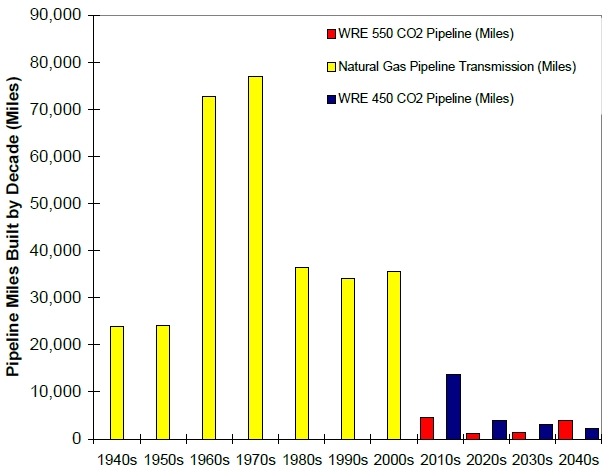
The PNNL study determines the feat is feasible not by taking issue with  estimates such as Romm’s, but rather by projecting a realistic implementation path for CCS technology. The research, presented by PNNL senior scientist Jim Dooley at November’s 9th International Conference on Greenhouse Gas Technologies, first projects how rapidly CCS could grow in the U.S. under agressive climate policies. Then it compares the pace of pipeline construction implied with the historic evolution of natural gas pipelines.

PNNL’s conclusion: “The sheer scale of the required infrastructure should not be seen as representing a significant impediment to US deployment of CCS technologies.”

PNNL Comparison of CCS and natural gas infrastructure growthBetween 11,000 and 23,000 miles of dedicated CO2 pipeline would need to be layed in the U.S. before 2050, according to PNNL’s estimates, in addition to the 3,900 miles already in place (which carry mostly naturally-occuring CO2 used to stimulate production from aging oil wells). The attached graph from Dooley’s presentation breaks the projected CO2 pipeline mileage down by decade of installation (see red and blue bars), and shows just how puny it is relative to the U.S. natural gas network (yellow bars).

Note that MIT’s 2007 Future of Coal report also compared CCS infrastructure favorably to natural gas pipelines. The MIT report estimated that capturing all of the roughly 1.5 billion tons per year of CO2 generated by coal- burning power plants in the U.S. would generate a CO2 flow with just one-third the volume of the natural gas flowing in the U.S. gas pipeline system.

That scale is certainly immense. But so is the challenge posed by climate change.

add to del.icio.us : Add to Blinkslist : add to furl : Digg it : add to ma.gnolia : Stumble It! : add to simpy : seed the vine : : : TailRank

This post was created for the Technology Review guest blog: Insights, opinions and analysis of the latest in emerging technologies

The Sahara Reveals its Carbon Capture Success

The market’s blasé reaction to the oil production cut ordered by OPEC ministers meeting in Algeria this week–bad news for greentech investors–topped the Wall Street Journal’s green business blog this week. The more lasting news from the meeting, however, may be the conference sideshow that took journalists to one of the world’s largest carbon capture and storage operations: Algeria’s In Salah natural gas operation, which stores about 800,000 tons of carbon dioxide per year, 1.2 miles below ground.

In Salah, hidden deep in the Sahara desert some 700 miles south of Algiers, is operated by oil and gas giant BP, Norway’s Statoil, and Algerian state oil and gas firm Sonatrach. The field’s gas is about 7% CO2, which must be cut to 2% or less before it can be shipped on to European markets. In Salah cuts the CO2 to 0.3% and, instead of simply venting the removed CO2 as many gas operations do, pumps it into an aquifer below the gas reservoir. Given the scale of the gas flow, it’s the environmental equivalent of taking 200,000 cars off the road.

The reporters visiting In Salah this week reported that the CO2 seems to be staying put, as is the case with the other two large-scale CCS operations in operation — the natural gas-stripping operation at Statoil’s Sleipner field in the North Sea, and the Dakota Gasification coal-to-synthetic natural gas operation. The Associated Press quoted Mohamed Keddan, the station manager, expressing confidence that the layer of thick shale sealing the In Salah reservoir would hold the CO2 for good: “If it contained gas for millions of years without leakage, why would it start leaking now?” said Keddan, according to the AP.

Better still, the cost of storing the CO2 is relatively low. Business Week reported that the $100 million CCS operation was just 2.5% of the overall $4 billion cost of the In Salah gas production complex. That puts the cost of sequestering the CO2 at about $14/ton.

At that price BP, Statoil and Sonatrach could eventually make money on the stored CO2 by selling carbon credits earned at In Salah to other polluters, such as coal-fired utilities, facing steeper CCS costs. That is, if future treaties governing greenhouse gas emissions enable CCS operations in developing countries such as Algeria to earn carbon credits — a concept rejected for the time being by international climate negotiators meeting in Poland last week — which could be revived by the time a follow-on to the Kyoto protocol is to be hammered out in Copenhagen twelve months from now.

So, given its success and low cost, why do we hear so little about In Salah, whereas the Dakota Gasification and Sleipner CCS operations enjoy pinup status? Business Week’s correspondent may have hit on the answer, noting that about 2,000 people work at In Salah if one includes the “military units intended to deter attacks by Islamic militants, who are still a serious threat in Algeria.”

Sometimes, and some places, it pays to keep your head down.

add to del.icio.us : Add to Blinkslist : add to furl : Digg it : add to ma.gnolia : Stumble It! : add to simpy : seed the vine : : : TailRank

This post was created for the Technology Review guest blog: Insights, opinions and analysis of the latest in emerging technologies

Should Carbon Capture Capture Carbon Credits?

Click image to see IEA's Nobuo Tanaka zeroing in on CCS at Poznan
Click image to see IEA's Tanaka on CCS at Poznan

International climate change negotiators gathered in Poznan, Poland to draft a follow-on to the Kyoto protocol appear to have rejected the talks’ most controversial proposal: giving a big boost to carbon capture and storage (CCS), whereby carbon dioxide produced by coal-fired power plants is trapped deep underground. The proposal was to award carbon credits to developing countries that installed CCS equipment — credits that they could then sell to industrialized nations or companies — but this morning opponents successfully tabled the proposal until next June, according to climate policy blog Climatico.

Countries pushing the credits-for-CCS proposal included Japan, Norway, Australia and Canada. All are major coal consumers eyeing CCS to meet their own greenhouse gas reduction targets and/or oil and gas producers that could dual-purpose captured CO2 for enhanced oil recovery. Japan and Canada also figure among the nations furthest behind in meeting emissions cuts mandated by the Kyoto protocol, and could be big buyers of CCS-generated carbon credits.

International Energy Agency executive director Nobuo Tanaka had also added his support (see video). Tanaka calls credits a means of accelerating development of capture and sequestration technologies, which the IEA sees as crucial to control emissions in countries such as China that will remain heavily dependent on coal for decades to come. “These technologies need all the financial help they can get,” says Tanaka.

But the idea remained red-hot among the climate activists swarming Poznan this week as it unites a controversial technology with an already controversial program. They see carbon sequestration as a potentially risky technology that could delay the transition from coal to solar, wind and other forms of renewable energy. Meanwhile the UN’s Clean Development Mechanism (CDM), which manages the awarding of carbon credits to developing nations, attracts scorn from those who see carbon trading as a numbers game by which countries will avoid making real emissions cuts.

Many question whether emissions cuts certified for millions of dollars worth of credits under the CDM wouldn’t have occurred anyway — whether they offer ‘additionality’ in the UN lingo flowing in Poland this week.

The UN acknowledged possible problems after spot-checking a leading CDM certification firm and identifying a series of “non-conformities” in its auditing practices. The firm, DNV Certification AS, was suspended but insists it is addressing the concerns identified to regain its accreditation.

Poznan’s ministerial-level talks start tomorrow and should wrap up Friday. Unless they pop CCS back onto the agenda the credits proposal will be stalled until next June’s followup meeting in Bonn. That meeting is a prelude to the big game that will define global energy policy: final negotiations and, if all goes as planned, the signing of a ‘Kyoto II’ treaty in Copenhagen next December.

add to del.icio.us : Add to Blinkslist : add to furl : Digg it : add to ma.gnolia : Stumble It! : add to simpy : seed the vine : : : TailRank

This post was created for the Technology Review Editors Blog: Insights, opinions and analysis of the latest in emerging technologies

The EuroParliament’s Schwarzenegger Clause and CCS

Carbon sequestration — the notion that carbon dioxide from coal-fired power stations and other major greenhouse gas emitters can be captured and stored underground — is taking a lot of hits from environmental activists bent on banning coal outright. For a taste, check out this recent post on the Gristmill green blog by Joseph Romm, a most articulate carbon capture critic. Political leaders, in contrast, appear far more supportive, and it’s not just American presidential candidates wooing coal-country voters. Last week European parliamentarians voted to finance largescale sequestration demo projects with a generous €10-billion fund and, better still, approved what they called a ‘Schwarzenegger Clause’ to mandate carbon capture for new generating stations from 2015. Like an existing requirement approved by California’s governor the clause sets a 500 gram CO2 per kilowatt-hour emissions limit that coal-fired plants can beat only with carbon capture.

The U.K.’s Environment Agency had already recommended a ban new coal-fired power plants that don’t use carbon capture and storage (CCS) the week before.

Part of the European motivation, as French and British leaders have made clear, is that CCS is more than a key to meeting agressive climate change action goals. They are also a critical means of keeping coal in the mix and thus limiting Europe’s dependence on imported oil and gas from Russia and the Middle East.

In the U.S., meanwhile, Al Gore is calling for civil disobediance to force adoption of the same CCS mandate. In fact, there are already steps in this direction even in North America beyond Schwarzenegger’s innovations:A panel appointed by Arkansas’ governor recommended last month the state approve no new coal plants until CCS is ready; the Canadian government floated a plan this spring to require CCS at new bitumen-to-oil plants in Alberta’s tarsands from 2012; and last fall British Columbia decreed a no-new CO2 from coal policy that stalled two proposed coal-fired plants (one may go forward as a biomass plant to burn trees killed by a warming-enabled infestation of beetles).

A wildcard to watch: weakening political resolve in the face of the global finance crisis. According to this report from Agence France Press yesterday, a few European leaders are wavering on greenhouse gas emissions as energy-intensive industries face tough times ahead.

add to del.icio.us : Add to Blinkslist : add to furl : Digg it : add to ma.gnolia : Stumble It! : add to simpy : seed the vine : : :