Low-Carbon Fuel Rules

California is about to add to its record of leadership on clean energy policy with its innovative Low-Carbon Fuel Standard that goes into effect January 1. We highlight the program and its likely impact on alternative energy sources for transportation today at MIT TechReview.com in “Low-Carbon Fuel Rules”. As the tagline states, “California is about to implement a standard to boost cleaner fuels and punish the rest.”

One point is that California’s LCFS may not deliver the knock-out blow to Canada’s carbon-intensive tarsands that many climate change activists continue to hope for. Gasoline and diesel fuel refined from the tarsands’ asphaltine bitumen may escape being banned if its producers emphasize energy efficiency according to UC Davis’ Daniel Sperling.

Another observation I’ll be following up is the cohesiveness of the biotech industry. In the face of regulatory innovations such as the LCFS that would disadvantage corn ethanol production and advantage cash-hungry innovators developing more carbon-smart advanced biofuels, the latter seem to be quietly defending the status quo.

Then there’s the California standard’s nuanced approach to diesel, which is not addressed in the TechReview piece but which Carbon-Nation spotlighted last summer. The short take is that the LCFS mandates separate and equal reductions in the carbon footprint of the gasoline and diesel fuels sold in California. That approach eliminates the possibility that diesel use will be incentivized as an alternative to gasoline. The reason? California regulators believe that even today’s ‘clean diesels’ release more than their share of soot, which is a major cause of premature mortality and also a potential contributor to climate change in its own right.

We explore the climate challenge and opportunity posed by soot in the September issue of Discover magazine. See “The Easiest Way to Fight Global Warming?”

add to del.icio.us : Add to Blinkslist : add to furl : Digg it : add to ma.gnolia : Stumble It! : add to simpy : seed the vine : : : TailRank

Climate Denial Crock of the Week

Opponents of the theory of anthropogenic climate change are hard at work via Internet forums making a last stand against the present societal momentum to address our impact on global climate and, specifically, to reduce the carbon footprint of our energy systems. Midland, MI-based multimedia producer, cartoonist, and alternative energy enthusiast Peter Sinclair is returning fire, nugget-for-nugget, with his new YouTube-distributed video series, Climate Denial Crock of the Week.

Each episode of Crock answers one of the climate denial “hobby-horse arguments” with five minutes of science-based, semi-professionally produced video. The Vikings star in this week’s episode, Medieval Warming?, which explodes the notion that Earth was warmer in the Middle Ages:

Continue reading “Climate Denial Crock of the Week”

Clim’ City Animates the Climate Challenge

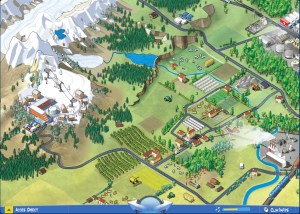
clim_city2French science center Cap Sciences takes flash-based learning to new heights in a free online game launched this week: Clim’ City (click Le Jeu to play). At present this climate change adventure is for those of you who read French or set learning to do so as a New Year’s goal. But here’s to hoping that Bordeaux-based Cap Sciences gets an English version out quick because this educational game is a beautifully crafted and ingeniously programmed device for learning the contingencies and costs that lie ahead on the road to a low-carbon energy future.

The action in Clim’ City takes place on a small map of an imaginary town animated by commuters driving here and there and all manner of agricultural, industrial and even entertainment operations (including a ski hill) energetically going about their business. The goal is to reduce the “Clim’s” carbon footprint and thus avert the town’s demise by tweaking the way its actors produce and consume energy.

Playing such games turns information into knowledge. According to the international Association of Science-Technology Centers’s program International Action on Global Warming, the gamers at Cap Sciences hope players will do some informed pondering of such questions as:

Why is global climate change accelerating? What kind of climate can we expect by the year 2100? What human activities contribute most to the emission of greenhouse gases? And how is it possible to reduce these emissions?

In my first stab at Clim’ City I have converted the town’s carbon-belching coal-fired power plant to biomass. To do so I was forced to first launch a forest management program, which really brought home the fact that collecting biomass to generate a meaningful amount of energy is, in itself, a substantial and complex task.

My powerplant conversion also came with an opportunity cost, drawing down my limited supply of government, corporate, and individual action points. In the words of International Action on Climate Change, this was a powerful reminder of the “sociopolitical constraints” facing decision makers today.

I’m not deep enough in to Clim’ City to know whether mine is going to make it. If accounts in the French press and blogosphere are to be believed there’s a good chance it won’t. This is a tough game and failure appears likely — at least early on — which imparts a healthy dose of realism.

But even if the Clim’s get cooked under my leadership, I can’t help learning.

add to del.icio.us : Add to Blinkslist : add to furl : Digg it : add to ma.gnolia : Stumble It! : add to simpy : seed the vine : : : TailRank

This post was created for the Technology Review guest blog: Insights, opinions and analysis of the latest in emerging technologies

Democracy and Climate Change

Here’s some elegant prose on the hopes that rest on the Obama Administration to come from R.K. Pachauri, director general of The Energy and Resources Institute (TERI) in New Dehli and Chairman of the Intergovernmental Panel on Climate Change (IPCC) – the UN body that seeks and sells scientific consensus on climate science and policy. In a statement released yesterday Pachauri elegantly explains why the election is a cause for optimism:

The presidential elections in the US have vindicated the power of democracy as the most responsive form of government of the people, by the people and for the people. In respect of policies related to climate change, there was obviously a major divergence between the position of the Federal Government and that of the people at large, state governments and the cities in the US.

President-elect Barack Obama has not only been very clear in emphasizing the need for the US to engage in global solutions to meet the challenge of climate change but also in respect of bringing about a major shift in US energy policy.

The US now has a unique opportunity to assume leadership in meeting the threat of climate change, and it would help greatly if the new President were to announce a coherent and forward looking policy soon after he takes office. There is every reason to believe that President Obama will actually do so. This should please people across the globe, because US leadership is critical for mounting global efforts to meet this threat effectively. For this reason itself, apart from several others, the election of Mr Obama is a development that should generate optimism all-round.

Pachauri’s statement was forwarded to members of the Society of Environmental Journalists by Arul Louis, a fellow at the International Center for Journalists in Washington, DC.

add to del.icio.us : Add to Blinkslist : add to furl : Digg it : add to ma.gnolia : Stumble It! : add to simpy : seed the vine : : : TailRank

This post was created for EnergywiseIEEE Spectrum’s blog on green power, cars and climate