
Rolling Power

Electricity moves down a wire at close to the speed of light. In March, a tiny tech firm in San Francisco drew a crowd to witness power moving 100 million times slower, at the very modest pace of a freight train bumping around a rail yard. And I mean literally at freight speed, because the aptly-named startup, SunTrain, convened us to watch a diesel locomotive hauling solar energy.

The star of this demonstration at the Port of San Francisco’s Pier 96 rail yard was a freight container that SunTrain had crammed full of lithium ion batteries and mounted on a standard 27-meter railcar…

So begins my latest feature for the solutions-oriented Anthropocene Magazine, profiling the creative thinkers who see railroads — the ultimate industrial dinosaur — as a lever to equip power grids for a wind and solar-powered future. SunTrain would turn railroads into a power transmission solution, using railroads to make an end run around grid congestion that’s holding up power projects across the U.S.

Imagine mile-long trains with 120 or more battery cars, charging up where wind and solar power is cheap and making daily deliveries of over two gigawatt-hours of clean energy each—enough to power a small city, port, or datacenter for days. 

I also cover a slightly more mature rail-to-grid concept: feeding power lines through rail corridors, thus avoiding the environmental impacts, cost and community upset that delay and frequently kill grid expansion. A handful of transmission projects in New England and New York already co-locate power lines beside rails. And the proposed SOO Green transmission project would follow rails for nearly all of its 560-kilometer journey from Iowa’s wind belt to Chicago.

The ultimate challenge facing both approaches is getting railroads to think outside the box and to make room for cleaner power. That will get easier if, as expected, even President Trump’s pro-carbon policies can’t keep the railroads’ rolling boxes full of coal.

Read the full story @Anthropocene
Getting Off Gas, Block by Block

Electrifying homes and businesses one at a time can be hard, and leave people behind. What if we could instead liberate entire neighborhoods from reliance on natural gas? A few utilities are taking baby steps to do just that, helping customers go all-electric en masse so it can start dismantling their gas grids.

Since 2018 San Francisco-based PG&E has been finding spots where it can make a buck by capping dodgy gas pipes rather than replacing them. After nipping pipes around the edges of its gas grid, removing pipes that serve just a handful of customers each, PG&E is now preparing to lop off some sizeable branches. The first large test moving forward targets 32,000 feet of gas pipes at a California State University campus, perched atop coastal dunes at a former army base north of Monterey. PG&E will ditch the pipes by equipping 600 student housing units with electric heat pumps, stoves and water heaters.

Such ‘strategic decommissioning’ of gas grids is not just a way to accelerate decarbonization. It’s simultaneously combating energy injustice. Without immediate reductions in spending on gas infrastructure, disadvantaged customers will be left paying for oversized gas grids as more affluent households go all-electric and quit the system. As Building Decarbonization Coalition executive director Panama Bartholomy told me: “Every time we put a new natural gas pipe in the ground, we’re knowingly putting a financial time bomb in the ground.”

Read my feature for Sierra Magazine, Getting Off Gas: Block By Block

A paired Sierra news piece profiles the pioneering geothermal network that Boston-based Eversource Energy and Massachusetts climate action group HEET started up this summer. Water pipes running under streets in Framingham, MA serve as the system’s circulatory system, democratizing access to 90 geothermal bore holes. Since August a fire hall, school, gas station, cabinet shop, city-run housing units for the elderly and disabled, and 22 single-family homes and duplexes have been heating and cooling by exchanging heat with the clay and rock 600 to 700 feet below the city. The super high efficiency of such thermal energy networks should reduce peak summer and winter electricity demand, slashing the need for new transmission lines by 33 percent according to a 2023 US national labs study. They also offer gas utilities and workers a post-combustion raison d’etre, potentially turning energy transition obstacles into a driving force for building decarbonization.

Read my Sierra news piece, Geothermal Helps Communities Get Off Fossil Gas

The Sierra articles are the 2nd and 3rd instalments in Tapping Off, a reporting project supported by the Society of Environmental Journalists’ Fund for Environmental Journalism. Part 1, published by The Tyee, profiled Washington state utility Puget Sound Energy’s use of customer electrification to put the brakes on gas expansion.

Read Part 1 online @The Tyee

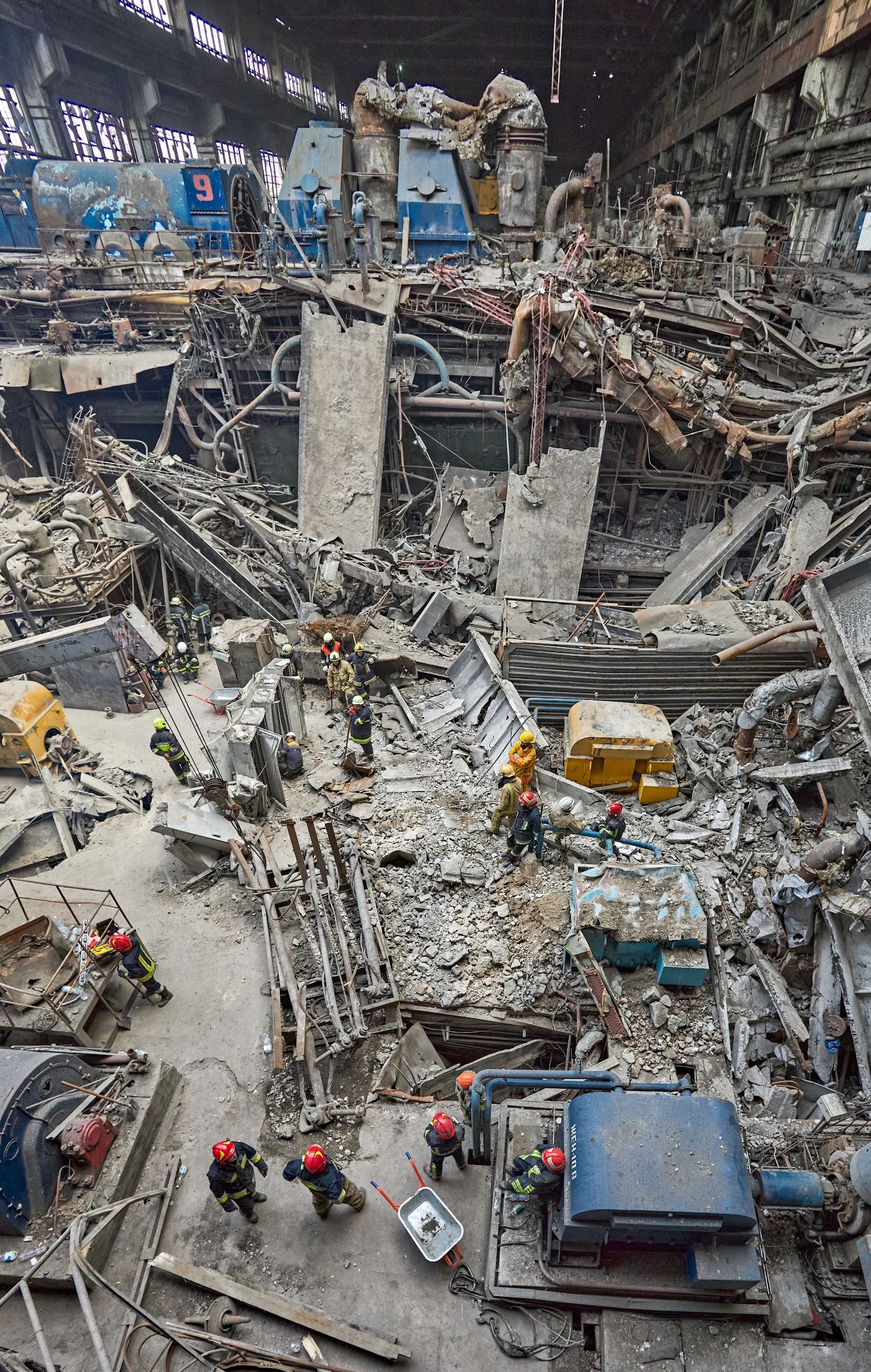
A Part of Modern Life So Essential That Armies Should Never Attack It Again

Photo: DTEK

It’s time to change the laws of war to punish and hopefully deter the insane and inhumane destruction of power grids. So argues my guest essay for The New York Times opinion pages.

For two years, it has pained me to observe and occasionally cover Russia’s increasingly destructive pummelling of Ukraine’s power grid. As a longtime student of power systems, I intimately know the engineering and operational sophistication that keeps power grids — the world’s largest machines — running at close to the speed of light. I know how entrenched power systems have become in modern life, assuring everything from home oxygen generators to sewage treatment. And I know that plugging in more is our best hope for stopping climate change.

Since Russia’s whole-scale grid attacks began in late 2022 I have questioned the legality of such wanton destruction. In my debut contribution to The Times I lay bare the holes in international law that legalize most attacks on power systems, and argue that the international community should draw brighter lines to protect them.

How to rescue biofuels from a sustainable dead end

In 2011, I scrutinized a gathering wave of biofuels for Nature, and that deep dive on making fuels from woody rather than sugary plant material remains one of my most-cited works. Perhaps because we nailed what emerged as the technology’s as-yet-insurmountable hurdle: making the conversion processes work consistently at industrial scale.

A little over a decade later Nature take another look at the sustainability of biofuels. The picture isn’t pretty, thanks in part to the failure of those cellulosic fuels.

Biofuels continue to grow in ways that overlap with food crops, contributing to agricultural expansion at the expense of carbon-storing forests and grasslands. And poorly conceived and regulated mechanisms for tracking and rewarding carbon storage by farms threaten to exacerbate the trouble.

It will take a “ground-up revamp” for agriculture to get biofuels right, both for the environment and for farm communities. As we conclude, it looks like déja vu all over again: “If the sustainability of biofuels depends on such fundamental changes, one has to wonder whether another next-generation biofuels failure isn’t the more likely outcome.”

Read the full story @Nature, or in Scientific American.

Obama and Xi Breathe New Qi into Global Climate Talks

Context is everything in understanding the U.S.-China climate deal struck in Beijing by U.S. President Barack Obama and Chinese President Xi Jinping last week. The deal’s ambitions may fall short of what climate scientists called for in the latest entreaty from the Intergovernmental Panel on Climate Change, but its realpolitik is important.

Obama and Xi’s accord sets a new target for reductions in U.S. greenhouse gas emissions: 26-28 percent below 2005 levels by 2025. And for the first time sets a deadline for China’s rising GHGs to peak: 2030. This is potentially strong medicine for cooperation, when seen in the context of recent disappointments for global climate policy. Continue reading “Obama and Xi Breathe New Qi into Global Climate Talks”

Winged Creatures Should Fear CO2, Not Wind Turbines

Benjamin Sovacool agrees that wind turbines kill birds and bats, but this University of Singapore public policy professor makes a convincing case that this fact desperately needs context. Reviewing avian mortality from power generation in the June issue of Energy Policy, Sovacool shows that — gigawatt-hour for gigawatt-hour — it is fossil-fired power by a longshot that will ground winged creatures.

Sovacool’s analysis estimates avian deaths throughout the fuel cycle for coal, oil and natural-gas fired power generation:

  • Coal mining = 0.02 deaths per gigawatt-hour (GWh). For example, habitat destruction by mountaintop removal coal mining in Appalachia has killed approximately 191,722 Cerulean Warblers.
  • Plant operations = 0.07 bird deaths/GWh. Electrocution at one well-observed power plant in Spain killed 467 birds over two years.
  • Acid rain = 0.05 deaths/GWh. Cornell’s Laboratory of Ornithology estimated in 2002 that acid rain reduced the U.S. wood thrush population by 2–5%.
  • Mercury emissions = 0.06 deaths/GWh. Impacts include hampered reproduction and survival, observed in everything from albatross and woodstorks to bald eagles. Continue reading “Winged Creatures Should Fear CO2, Not Wind Turbines”

China’s Wind Surge Ignores Financial Mess

The global wind power industry is bottoming out thanks to the global financing crisis. Everywhere but China, that is, according to a research update issued this week by consultancy Emerging Energy Research (Cambridge, MA).

EER adds up the impact of “a steady flow of wind industry CAPEX reductions, project postponements, order cancellations, and corporate downsizings on a scale never seen before in this relatively young segment of the energy sector.” They forecast a 24% decline in megawatts installed in the US this year over 2008, and a 19% decline in Europe.

Then there’s China, which EER calls “the only major market left standing in the face of the crisis.” EER projects a 59% jump in megawatts added there in 2009 — enough to make up for the U.S. and European losses.

Carbon-Nation readers will recall our June 2008 reporting on China’s wind sector that was already, then, notable for (a) its “endurance in the face of below-cost pricing” and, (b) low quality assurance that had even its trade association calling for slower growth. Looks like its too late for the latter.

add to del.icio.us : Add to Blinkslist : add to furl : Digg it : add to ma.gnolia : Stumble It! : add to simpy : seed the vine : : :

This post was created for Energywise, IEEE Spectrum’s blog on green power, cars and climate