Europe Shortlists Capture Projects for Stimulus

European leaders shortlisted a dozen proposals to demonstrate large-scale carbon capture and storage at coal-fired power plants last month as eligible to share €900 million of the EU’s €5-billion stimulus funding package. The goal is to bring down the cost of carbon-neutral coal power — which the European Commission expects to continue to exceed the cost of conventional coal power in 2020 — and to gain more experience with underground storage of CO2.

Seven propose to capture CO2 post-combustion from the exhaust of conventional coal-fired power plants, a relatively inefficient process that nonetheless costs less up front — an attractive feature given today’s financial mess. Three are Integrated Combined Cycle Gasification or IGCC power plants that would pull CO2 out of coal-derived gases prior to combustion, akin to the U.S. FutureGen project that Bush killed and Obama may be reviving. Two more would concentrate their CO2 exhaust by burning coal in purified oxygen — the oxyfuel approach that Sweden’s Vattenfall is testing at a pilot plant in Germany.

Continue reading “Europe Shortlists Capture Projects for Stimulus”
Giving FutureGen a Second Chance

FutureGen — the carbon-neutral coal power project initiated and then killed under the Bush Administration — looks increasingly likely to be resuscitated under President Obama after proponents met with Energy Secretary Steven Chu this week. There is now good reason to take a fresh look at this proposed coal gasification power plant which integrates carbon capture and storage (CCS) from the ground up.

Those words don’t come easy for this longtime FutureGen critic. But the context has changed since FutureGen was conceived in 2003, and even since Bush Energy Secretary Samuel Bodman killed it in January of 2008. While Energywise recently noted ongoing concern over FutureGen’s cost, here are five arguments that could justify heavy federal financing:

  • Project scope: In its early years FutureGen was viewed as a PR exercise because it framed carbon-neutral coal as a research project, positioning the use of commercially-ready Integrated Gasification Combined Cycle power plants as a moon-shot. Chu has indicated that the project would be streamlined. My sources say one element likely to go will be plans to generate fuel-cell grade hydrogen.
  • Financing: The most fundamental block to commercialization of IGCC technology was Bush’s refusal to put a price on carbon emissions, which thwarted even utilities such as AEP that wanted to build cleaner coal plants. Carbon pricing may arrive under Obama–if he can push it through Congress–but the financial collapse has now slashed utilities’ appetite to pore capital into big projects.

Continue reading “Giving FutureGen a Second Chance”

Toyota’s Secret: The Clean Air Act of 1970

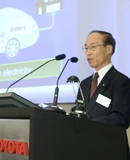
masatami-takimoto-credit-toyotaHow many automotive engineering leaders from Detroit or Stuttgart would identify the U.S. Clean Air Act Amendments of 1970 as the inspiration of their engineering career? Yet that’s exactly what Masatami Takimoto did when I spoke with the Toyota executive vice president responsible for R&D and powertrain engineering earlier this month at the Geneva Motor Show.
Since Takimoto retires in June, I asked him to identify the most exciting chapter of his 39-year career with Toyota. His reply brought a smile: “You’re familiar with the Muskie law?,” asked Takimoto. I’d been asked the same question five years earlier, in Tokyo, while interviewing Takehisa Yaegashi (revered within Toyota as ‘the father of the hybrid’) for a cover story on hybrid vehicles for MIT’s Technology Review.

Thanks to Yaegashi I knew that it was Senator Ed Muskie of Maine who drove through the 1970 amendments to the U.S. air pollution law. And I knew that Muskie’s law, which required the federal government to set tailpipe emissions standards,  had inspired a lot more at Toyota than pollution-eating catalytic converters: Toyota’s engineers also began experimenting with new propulsion concepts such as the battery-powered electrical vehicle that produce inherently less pollution.

Continue reading “Toyota’s Secret: The Clean Air Act of 1970”

Climate Denial Crock of the Week

Opponents of the theory of anthropogenic climate change are hard at work via Internet forums making a last stand against the present societal momentum to address our impact on global climate and, specifically, to reduce the carbon footprint of our energy systems. Midland, MI-based multimedia producer, cartoonist, and alternative energy enthusiast Peter Sinclair is returning fire, nugget-for-nugget, with his new YouTube-distributed video series, Climate Denial Crock of the Week.

Each episode of Crock answers one of the climate denial “hobby-horse arguments” with five minutes of science-based, semi-professionally produced video. The Vikings star in this week’s episode, Medieval Warming?, which explodes the notion that Earth was warmer in the Middle Ages:

Continue reading “Climate Denial Crock of the Week”

FERC Boss Dubs the Plug-in a ‘Cashback’ Hybrid

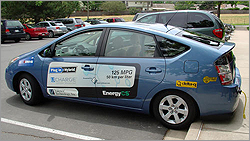
nrel-prius-plug-in-hybrid-demo-vehicleThe head of the Federal Energy Regulatory Commission (FERC) predicts that plug-in hybrid vehicles will provide immense benefit to power grid operators — enough for utilities to provide kickbacks to their customers, paying down the extra cost of a plug-in in as little as three years. Jon Wellinghoff, FERC’s acting chairman, made that comment at a Las Vegas trade show last week according to coverage by the Las Vegas Review-Journal (which I picked up on thanks to the keen newswatching eyes of specialty publication EV World).

Wellinghoff’s comments refer to plug-in hybrids equipped with the smarts to communicate with the power grid, which he termed the “Cashback Hybrid” according to the Review-Journal article:

When the Cashback is plugged in, motorists can allow the utility to vary the speed at which the battery recharges so that the utility can more closely match supply and demand for power on the electric grid…In return, the car owner could obtain cash back or a credit from the utility that makes the electricity free, he said.

Continue reading “FERC Boss Dubs the Plug-in a ‘Cashback’ Hybrid”

Big Footprints Next to Carbon’s

nejm-logoThe U.S. carbon footprint looms large as Washington prepares to finally begin, in earnest, a shift away from fossil fuels under a new President promising international action to, “roll back the specter of a warming planet,” as Agence France Presse highlighted in its reporting of Obama’s inaugural address. Debate is already raging, for example, around whether President Obama will allow California and other states to ratchet up the fuel efficiency improvements automakers must make in the years to come.

But research published yesterday in the New England Journal of Medicine provides a needed reminder that burning less fossil fuels can also directly reduce mortality from air pollution, as reported yesterday by CNN’s health desk. (Carbon-Nation readers will recall that the network’s sci/tech/environment desk is currently unavailable, having been eliminated by CNN last month.)

Continue reading “Big Footprints Next to Carbon’s”

Major Automakers Spurred by California’s Higher Expectations

Honda execs John Mendel and Yasunari Seki relaunch the Insight hybrid in DetroitMajor automakers such as Honda and Chrysler are realizing that it’s time to throw away the old game plan and chart a new one around the sale of smaller, more fuel-efficient vehicles. Ironically, some of the most direct evidence of this changed thinking lies buried at the end of an otherwise apologistic report on the U.S. auto industry’s troubles in the L.A. Times earlier this week.

The story reports on a likely forthcoming waiver from President Obama’s EPA effectively allowing states to demand better fuel economy than the federal CAFE standard. After declaring this a “nightmare scenario for automakers,” the article delivers desperate quotes from General Motors and the Alliance of Automobile Manufacturers — the trade group that fought (unsuccessfully) to block California’s standards in court. A GM spokesperson sets the tone, saying that subjecting a depressed industry to these tough standards is like asking a cancer patient to, “finish chemo and then go run the Boston Marathon.”

Here’s an alternative bedside analogy that looks to a deeper cancer: Setting lower standards than the European Union and China are already phasing in is reminiscent of the fatalistic approach to cancer treatment in which doctors hid from their patients the full extent of their sickness.

Continue reading “Major Automakers Spurred by California’s Higher Expectations”