

Clim’ City Animates the Climate Challenge

clim_city2French science center Cap Sciences takes flash-based learning to new heights in a free online game launched this week: Clim’ City (click Le Jeu to play). At present this climate change adventure is for those of you who read French or set learning to do so as a New Year’s goal. But here’s to hoping that Bordeaux-based Cap Sciences gets an English version out quick because this educational game is a beautifully crafted and ingeniously programmed device for learning the contingencies and costs that lie ahead on the road to a low-carbon energy future.

The action in Clim’ City takes place on a small map of an imaginary town animated by commuters driving here and there and all manner of agricultural, industrial and even entertainment operations (including a ski hill) energetically going about their business. The goal is to reduce the “Clim’s” carbon footprint and thus avert the town’s demise by tweaking the way its actors produce and consume energy.

Playing such games turns information into knowledge. According to the international Association of Science-Technology Centers’s program International Action on Global Warming, the gamers at Cap Sciences hope players will do some informed pondering of such questions as:

Why is global climate change accelerating? What kind of climate can we expect by the year 2100? What human activities contribute most to the emission of greenhouse gases? And how is it possible to reduce these emissions?

In my first stab at Clim’ City I have converted the town’s carbon-belching coal-fired power plant to biomass. To do so I was forced to first launch a forest management program, which really brought home the fact that collecting biomass to generate a meaningful amount of energy is, in itself, a substantial and complex task.

My powerplant conversion also came with an opportunity cost, drawing down my limited supply of government, corporate, and individual action points. In the words of International Action on Climate Change, this was a powerful reminder of the “sociopolitical constraints” facing decision makers today.

I’m not deep enough in to Clim’ City to know whether mine is going to make it. If accounts in the French press and blogosphere are to be believed there’s a good chance it won’t. This is a tough game and failure appears likely — at least early on — which imparts a healthy dose of realism.

But even if the Clim’s get cooked under my leadership, I can’t help learning.

add to del.icio.us : Add to Blinkslist : add to furl : Digg it : add to ma.gnolia : Stumble It! : add to simpy : seed the vine : : : TailRank

This post was created for the Technology Review guest blog: Insights, opinions and analysis of the latest in emerging technologies
CNN’s Climate Change Denial Darkens a Dimming Media Picture

CNN axed their entire science, environment and technology unit in December, as documented by the Columbia Journalism Review. The Society of Environmental Journalists (disclaimer: I serve on the board of directors) joined three other journalism groups on a letter to CNN’s leadership protesting this “short-sighted” move “at a time when science coverage could not be more important in our national and international discourse.” Unfortunately, further developments suggest that we can expect further occular dysfunction from the media majors in general and CNN in particular.

This week CNN anchor Lou Dobbs gets the silliness award for devoting prescious broadcast minutes to a poorly documented rehash of climate change skepticism, putting sunspots and natural cycles in the climate change driver’s seat rather than anthropogenic greenhouse gas emissions. See the video clip below, immortalized by progressive media watchdog group Media Matters’ County Fair blog:

Vodpod videos no longer available.

The deterioration of science reporting threatens to spread as other major media outlets follow suit with budget-slashing bloodletting. Joel Makower, a pioneer in reporting on sustainable business, made that point last month in a discouraging post entitled Are Environmental Journalists an Endangered Species?. Makower sees the cuts at CNN as just one example of a “devestating” trend, noting the recent loss of senior journalists at Fortune magazine, The Weather Channel, and the Los Angeles Times.

The likely result is that fewer reports on the environment (ie energy according to the IPCC, which Dobbs ignores) will run. As Makower points out, those that do run will be delivered by generalist reporters scrambling to get up to speed on complex topics:

I hear from such reporters every week: general-assignment reporters from newspapers and broadcast stations around the U.S., niche trade magazines, and others seeking comment or context on a story they’re covering. I can tell you unequivocally that the nature of their questions reveals a high degree of ignorance. I’m happy to bring them up to speed, but it’s a slog.

One of the few bright spots is the New York Times, where the environment team is still growing. However, given that the paper recently announced plans to re-mortgage its headquarters building to make up for slumping ad revenues, one wonders how long the leadership will last.

add to del.icio.us : Add to Blinkslist : add to furl : Digg it : add to ma.gnolia : Stumble It! : add to simpy : seed the vine : : : TailRank

This post was created for Energywise, IEEE Spectrum’s blog on green power, cars and climate

Dispelling Carbon Capture’s Scaling Myth

Critics of carbon capture and storage (CCS) often deride the scale of infrastructure required for CSS to make a meaningful dent in global carbon emissions — not just in equipment to capture emissions at power plants (and other ‘point’ sources of CO2) but also in pipelines to move the captured CO2 to storage sites. But an overlooked recent study by the Richland, WA-based Pacific Northwest National Laboratory (PNNL) makes a convincing case that, at least where pipelines are concerned, the scale of CO2 infrastructure required is well within the realm of current industrial activities.

First to the critics, who like to compare (unfavorably) CCS infrastructure to the heft of the oil industry. Take Joseph Romm, who writes in his Climate Progress blog that, “We need to put in place a dozen or so clean energy “stabilization wedges” by mid-century to avoid catastrophic climate outcomes … For CCS to be even one of those would require a flow of CO2 into the ground equal to the current flow of oil out of the ground. That would require, by itself, re-creating the equivalent of the planet’s entire oil delivery infrastructure, no mean feat.” [Emphasis by Romm]

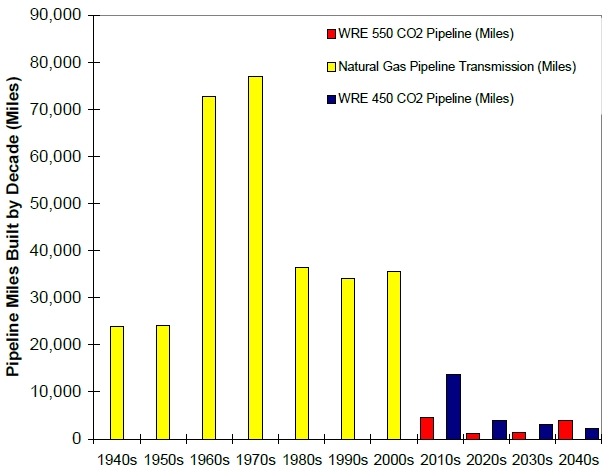
The PNNL study determines the feat is feasible not by taking issue with  estimates such as Romm’s, but rather by projecting a realistic implementation path for CCS technology. The research, presented by PNNL senior scientist Jim Dooley at November’s 9th International Conference on Greenhouse Gas Technologies, first projects how rapidly CCS could grow in the U.S. under agressive climate policies. Then it compares the pace of pipeline construction implied with the historic evolution of natural gas pipelines.

PNNL’s conclusion: “The sheer scale of the required infrastructure should not be seen as representing a significant impediment to US deployment of CCS technologies.”

PNNL Comparison of CCS and natural gas infrastructure growthBetween 11,000 and 23,000 miles of dedicated CO2 pipeline would need to be layed in the U.S. before 2050, according to PNNL’s estimates, in addition to the 3,900 miles already in place (which carry mostly naturally-occuring CO2 used to stimulate production from aging oil wells). The attached graph from Dooley’s presentation breaks the projected CO2 pipeline mileage down by decade of installation (see red and blue bars), and shows just how puny it is relative to the U.S. natural gas network (yellow bars).

Note that MIT’s 2007 Future of Coal report also compared CCS infrastructure favorably to natural gas pipelines. The MIT report estimated that capturing all of the roughly 1.5 billion tons per year of CO2 generated by coal- burning power plants in the U.S. would generate a CO2 flow with just one-third the volume of the natural gas flowing in the U.S. gas pipeline system.

That scale is certainly immense. But so is the challenge posed by climate change.

add to del.icio.us : Add to Blinkslist : add to furl : Digg it : add to ma.gnolia : Stumble It! : add to simpy : seed the vine : : : TailRank

This post was created for the Technology Review guest blog: Insights, opinions and analysis of the latest in emerging technologies

Tidal Power Flowing Stronger

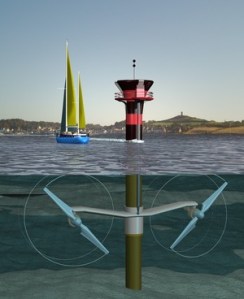
mct-seagen-system-with-yacht1Tidal power developments by British firms show this renewable power technology achieving impressive scale and continued design innovation. Bristol-based Marine Current Turbines (MCT) revealed last month that its SeaGen dual-turbine system achieved full power operation of 1.2 megawatts. MCT’s power peak is four times the global record for a tidal stream system set by the company in 2004, according to U.K.-based renewables journal REFocus, and 30-times more than the output from the tidal turbines pumping electricity in New York’s East River.

Meanwhile the U.K. Guardian reported yesterday that more largescale demonstrations are on the way as Cardiff-based Tidal Energy Ltd prepares to test a 1-MW version of its triple-rotor design by next year off the coast of Wales.

Achieving full power operation clears a major hurdle for MCT. As TechReview reported last July, the company suffered a setback early on when the powerful tidal streams of Northern Ireland’s Strangford Lough damaged one of its blades shortly after installation. In an odd way it’s an affirmation of MCT’s design, which enables the dual rotors to be lifted clear up out of the water for easy maintenance and repair.

While at a considerably earlier phase of development, MCT rival Tidal Energy’s triple-rotor concept provides an equally innovative means of ready repair. Tidal Energy’s rotors sit at the corners of a three-legged platform that can be deposited on the seabed and held in place by the systems 250-ton heft. That should not only ease recovery of the system for maintenance, but also simplify installation by eliminating the need for a fixed foundation in the seabed.

To see these concepts in action see MCT and Tidal Energy’s dueling animations.

add to del.icio.us : Add to Blinkslist : add to furl : Digg it : add to ma.gnolia : Stumble It! : add to simpy : seed the vine : : : TailRank

This post was created for the Technology Review guest blog: Insights, opinions and analysis of the latest in emerging technologies

Gorilla in the Greenhouse Meets the Coal Machine

The Natural Resources Defense Council embarrassed the coal industry last week by acquiring and distributing video of Don Blankenship, CEO of number-four U.S. coal producer Massey Energy, proudly professing his continued denial that climate change is real. Now multimedia producer Jay Golden and environmental media firm SustainLane have released video that’s considerably more entertaining and, thus, potentially far more damaging: a high-energy, Scooby Doo-esque production called “Turn It Up Day” from their savvy Gorilla in the Greenhouse cartoon series:

Vodpod videos no longer available.

I heartily endorse the review by online videobiz blog NewTeeVee, which calls Gorilla in the Greenhouse “genuinely entertaining and informative”:

Green gorilla KJ is an enigmatic environmental savant, telling the future through riddles that the kids who share his greenhouse must solve in order to ward off threats to the planet. (And in their spare time, they have a rock band. Of course.)

In the 7-minute episode released last week, the Green Gorillas gang exposes the blend of complacency and deception that allows our civilization to literally chew through mountains in search of the coal that fuels half of U.S. electricity production. With sage advice from KJ and a little follow-the-wire detective work, the kids trace the cause-and-effect connections between their own profligate energy use, the ‘turn it up’ hype embedded in popular media, and mountaintop removal mining.

As NewTeeVee put’s it, the Green Gorillas’ 2nd episode “fires on all cylinders”:

It teaches complex issues in a digestible way; it shows the characters taking practical action; and it even goes a little deeper, teaching kids to not buy into the hype about something just because it calls itself green, but to really learn about what’s going on behind the scenes.

My favorite character is the talking worm that plays the coal baron, Wormulus, who delivers several crucial Seussian rhymatribes. His malicious gloating opens the show: “My Wormulator chops the rocks, making loads of watts per hour. So They get their precious energy, but it’s Me who gets the power!” Later his willful deception is exposed in this dialogue with Dr. Morlon Hufflebot, whose brain Wormulus inhabits: “Our robot tears at the Earth as fast as it can,” says Hufflebot. “It’s a cause and effect they don’t understand,” says Wormulus.

Kentucky author, poet and social critic Wendell Berry noted how hard it is for people to connect power use and coal mining when he spoke at the Society of Environmental Journalists’ conference in Roanoke, VA this fall. He also told a poignant Christmas tale of direct action that helped me make the connection. Recalling a holiday season advertisement years ago by the coal industry with the message, “We dig coal to light your tree,” Berry said he never again allowed an electrified Christmas tree in his home. The tale struck a nerve: I’ve been avoiding escalators ever since.

AND NOW A NOTE FROM OUR SPONSOR: The 800-pound savant in Gorilla in the Greenhouse, KJ, is in no way related to the Green Gorilla power spray system, highlighted last week as a “special gift for the gardener in your life” by Canada’s Financial Post. That Green Gorilla puts an end to hand pumping garden sprays thanks to its rechargable lithium ion-powered pressurizer. “No more sore arms and sore backs,” assures the Post. It’s a steal at C$71.95! (Solar charging kit not included.) Or buy direct and get the dual-tank bundle for just US$94.99! (With separate tanks for your herbicides and insecticides you’ll “never cross contaminate again”!)

Season’s Greenings from Carbon-Nation!

add to del.icio.us : Add to Blinkslist : add to furl : Digg it : add to ma.gnolia : Stumble It! : add to simpy : seed the vine : : : TailRank

This post was created for Energywise, IEEE Spectrum’s blog on green power, cars and climate

Stealth Coal: Like it or lump it

Oil and gas major ConocoPhilips and coal giant Peabody Energy applied for a permit yesterday to build a plant in Muhlenberg County, Kentucky to turn coal into synthetic natural gas. What interests me are not so much the details of their project but the fact that it’s just one more example of what a longtime source of mine, Gasification Technologies Council CEO Jim Childress, calls stealth coal.

Childress uttered this colorful term while I was interviewing him on Chinese versus U.S. developments in coal gasification for power generation using integrated gasification combined cycle or IGCC technology. (‘Combined cycle’ because it uses a gas turbine to generate power from expanding combustion gases plus a steam turbine that generates power from the heat released.) My conclusion, reported today for MIT TechReview in China Closes the Clean-Coal Gap, is that climate concerns have paralyzed IGCC projects in the U.S. whereas air quality concerns are helping push Chinese projects forward.

Stealth coal figures in Childress’ argument that neglect of IGCC technology in the U.S. does not mean we’re through with generating electricity from coal. To the contrary. As utilities turn to natural gas for more and more of their baseload power generation, they will drive demand for gas beyond what drilling can deliver. Childress predicts that coal-to-gas plants such as the ConocoPhillips-Peabody Energy project will keep the gas-fired plants running:

Right now coal plants in the planning stages are stopped dead in their tracks and the default fuel is natural gas. So we’re looking at a tightening of the natural gas market and that’s good news for coal gasification. It may not go [directly] to power but it will substitute for natural gas.

To my ear the word stealth makes coal-derived synthetic gas sound kind of sinister but its climate impact could be negligible according to a University of Kentucky study cited yesterday by Green Car Congress. Visual thinkers may prefer this report by Fox News on Dakota Gasification, the synthetic gas operation that pioneered carbon capture and storage in the U.S. (I’d send you to CNN, but they just axed their entire science, environment and technology team.)

Of course, one should also consider the environmental costs of coal mining. We’ve written recently about upstream impacts of mountaintop-removal mining in Appalachia.

Yesterday Kentucky’s governor Steve Beshear focused instead on coal development’s economic impact — about 1,000 construction jobs and 200 full time jobs for a $1 billion plant according to a Louisville Courier-Journal report. Beshear translates that into political terms in Peabody Energy’s press release on their proposed gas plant: “Projects like this … enjoy rock solid support: More than 80 percent of Kentucky residents support coal gasification.”

I’m not sure about Governor Beshear’s poll data, but one thing’s for sure: There’s nothing stealthy about his feelings for coal.

add to del.icio.us : Add to Blinkslist : add to furl : Digg it : add to ma.gnolia : Stumble It! : add to simpy : seed the vine : : : TailRank

This post was created for Energywise, IEEE Spectrum’s blog on green power, cars and climate

Black Liquor as Biofuel’s White Knight

Biofuels have really taken a beating this year in the court of public opinion, as concerns mounted over the impact of biofuel production on everything from biodiversity to food prices to water supplies. IEEE Spectrum reader Luc Rolland of Preston, England captured the sense of disillusionment in his letter to the editors this summer: “Valuing biofuel is very controversial—it impoverishes developing countries, and the true energy cost of biofuel is not worth it.”

But there are low-hanging fruit that respond to all of Rolland’s concerns. Today, at MIT’s TechReview.com, I take a look at the biofuel that appears to hang the lowest: dimethyl ether produced via gasification of black liquor. That’s quite a mouthful, so let’s define our terms:

  • black liquor: the blend of caustic inorganic chemicals and dissolved wood generated in pulp and paper mills
  • gasification: subjected to high heat and pressure, organic matter breaks down into a stream of principally hydrogen and carbon monoxide called syngas that can be catalytically reassembled into chemicals and fuels
  • dimethyl ether or DME: a clean-burning substitute for diesel fuel and liquid petroleum gas (LPG) that’s easily synthesized from syngas

Note that this is very similar in principle to the synthesis of methanol via coal gasification. In fact methanol is an intermediate in the synthesis of DME. Production of both methanol and DME from coal is exploding in China, and provides substantial local air quality benefits.

Gasifying black liquor to generate DME, or bio-DME for short, adds ecological and climate benefits, which is why the European Renew study released in July called it one of “the most advanced concepts for fuel production.” Net conversion efficiency on a lifecycle basis of 69%, the highest for any biofuel, means that for every hectare of agricultural production this fuel delivers the biggest energy bang. Greenhouse gas emissions, meanwhile, are on the order of 1/20th that of conventional diesel.

Bio-DME alone will not render personal transportation sustainable. Gasification of all of the black liquor generated in US mills would supply enough DME to displace just 3% of total fuel demand in the U.S., according to Jonas Rudberg, CEO of Swedish biomass gasification developer Chemrec. (For Canada, which has a higher pulp to car ratio, bio-DME could satisfy 7%).

But bio-DME’s potential looks much larger if one views it as a forerunner to broader application of gasification to solid biomass feedstocks such as switchgrass. Solid biomass tends to gum up gasification plants, as Germany’s Choren Industries may be learning as it seeks to start up the 18 million liter/year biomass-to-diesel plant it finished building in April. Mass application of black liquor gasification would invariably accelerate the diffusion of the technology.

If it does,  biomass gasification could deliver more than a fifth of Europe’s transport fuel by 2030 according to Volvo Group, which is coordinating a European bio-DME R&D consortium. Of course, how low all that fruit will hang remains to be seen.

For more on bio-DME, see the TechReview article: “Taking Pulp to the Pump”.

add to del.icio.us : Add to Blinkslist : add to furl : Digg it : add to ma.gnolia : Stumble It! : add to simpy : seed the vine : : : TailRank

This post was created for Energywise, IEEE Spectrum’s blog on green power, cars and climate