
Should Carbon Capture Capture Carbon Credits?

Click image to see IEA's Nobuo Tanaka zeroing in on CCS at Poznan
Click image to see IEA's Tanaka on CCS at Poznan

International climate change negotiators gathered in Poznan, Poland to draft a follow-on to the Kyoto protocol appear to have rejected the talks’ most controversial proposal: giving a big boost to carbon capture and storage (CCS), whereby carbon dioxide produced by coal-fired power plants is trapped deep underground. The proposal was to award carbon credits to developing countries that installed CCS equipment — credits that they could then sell to industrialized nations or companies — but this morning opponents successfully tabled the proposal until next June, according to climate policy blog Climatico.

Countries pushing the credits-for-CCS proposal included Japan, Norway, Australia and Canada. All are major coal consumers eyeing CCS to meet their own greenhouse gas reduction targets and/or oil and gas producers that could dual-purpose captured CO2 for enhanced oil recovery. Japan and Canada also figure among the nations furthest behind in meeting emissions cuts mandated by the Kyoto protocol, and could be big buyers of CCS-generated carbon credits.

International Energy Agency executive director Nobuo Tanaka had also added his support (see video). Tanaka calls credits a means of accelerating development of capture and sequestration technologies, which the IEA sees as crucial to control emissions in countries such as China that will remain heavily dependent on coal for decades to come. “These technologies need all the financial help they can get,” says Tanaka.

But the idea remained red-hot among the climate activists swarming Poznan this week as it unites a controversial technology with an already controversial program. They see carbon sequestration as a potentially risky technology that could delay the transition from coal to solar, wind and other forms of renewable energy. Meanwhile the UN’s Clean Development Mechanism (CDM), which manages the awarding of carbon credits to developing nations, attracts scorn from those who see carbon trading as a numbers game by which countries will avoid making real emissions cuts.

Many question whether emissions cuts certified for millions of dollars worth of credits under the CDM wouldn’t have occurred anyway — whether they offer ‘additionality’ in the UN lingo flowing in Poland this week.

The UN acknowledged possible problems after spot-checking a leading CDM certification firm and identifying a series of “non-conformities” in its auditing practices. The firm, DNV Certification AS, was suspended but insists it is addressing the concerns identified to regain its accreditation.

Poznan’s ministerial-level talks start tomorrow and should wrap up Friday. Unless they pop CCS back onto the agenda the credits proposal will be stalled until next June’s followup meeting in Bonn. That meeting is a prelude to the big game that will define global energy policy: final negotiations and, if all goes as planned, the signing of a ‘Kyoto II’ treaty in Copenhagen next December.

add to del.icio.us : Add to Blinkslist : add to furl : Digg it : add to ma.gnolia : Stumble It! : add to simpy : seed the vine : : : TailRank

This post was created for the Technology Review Editors Blog: Insights, opinions and analysis of the latest in emerging technologies
Probing for Fluff in Europe’s Supergrids Vision

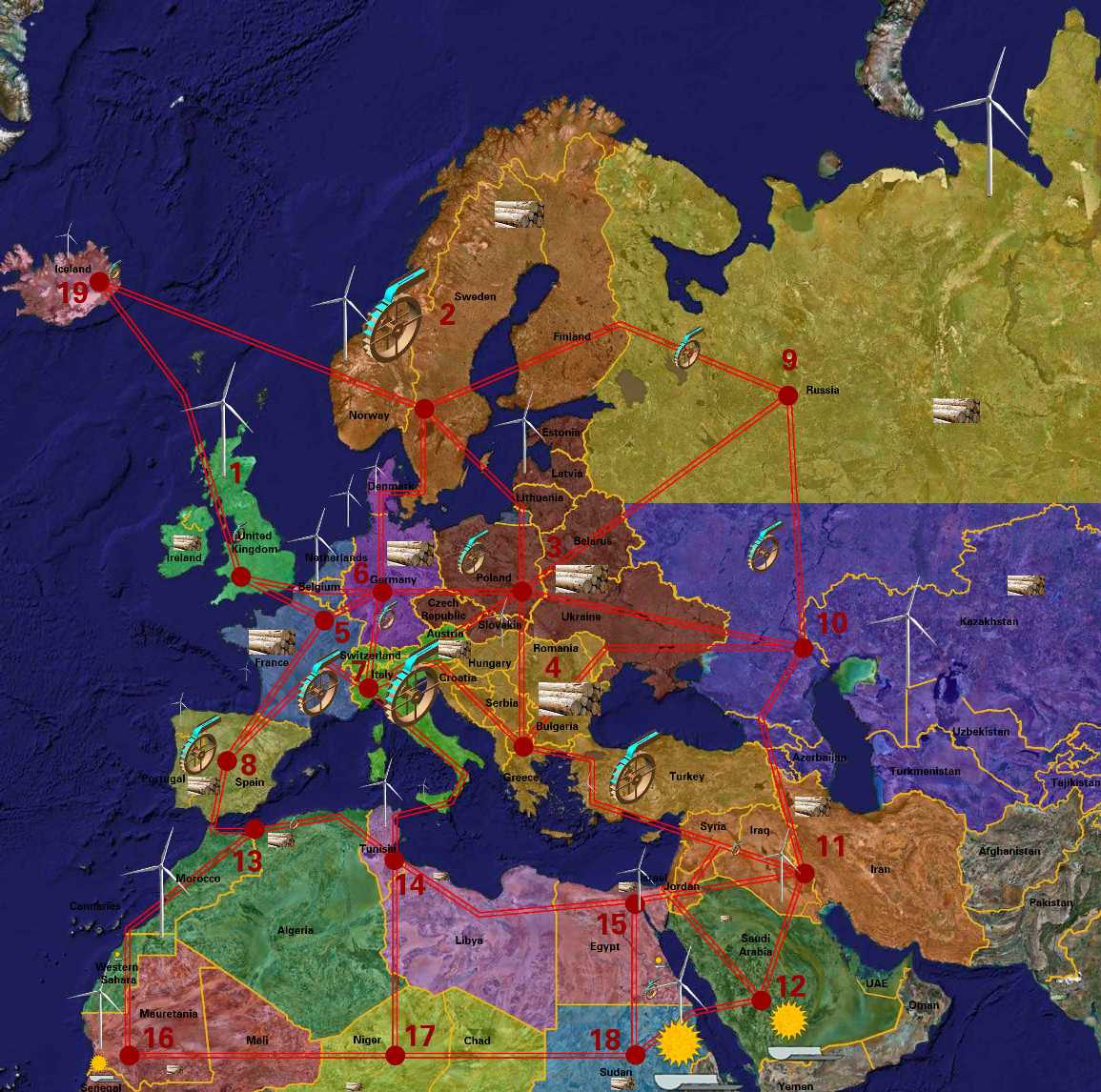
European renewable energy supergrid map Credit Wibke von FlemmingLast month the European Commission (EC) called for construction of regional power transmission grids that would ultimately merge into a supergrid distributing Mediterranean solar energy and offshore wind energy across Europe. Today, in MIT’s Technology Review, I test the political reality of sharing power across Europe (see “Europe Backs Supergrids”) and show that the EC just might pull it off.

Why be skeptical? Because for over a decade the EC has been pushing the liberalization of the European electricity market. Whereas, given the limited capacity for exchange of power between many European countries one could fairly question whether a ‘European market’ for electricity even exists.

Wind power developer Eddie O’Connor, for example, told me that his priority – building an offshore grid to connect tens of gigawatts of North Sea wind farms to be installed in the coming decade – would remain a dream so long as the European states and their politically powerful utilities control tranmission planning. “The utilities are the enemy,” says O’Connor, founder of wind developer Airtricity and CEO of Mainstream Renewable Power. “Even at this stage they’re still the enemy.”

What my report for TechReview shows, however, is that change is possible. The best example is a French-Spanish agreement this summer — under intense prodding from the EC — clearing the way for a much-needed second powerline across the Pyrenees. A special envoy appointed by the EC broke what had been a 15-year impasse complicated by local environmental concerns, Catalan fury, and diverging interests of the utilities involved. 

Even O’Connor is optimistic. He believes that new international institutions must be created to conjur up the supergrid Europe needs to carry renewable energy. But, says O’Connor, both are possible: “I believe the building of the supergrid is imminent.”  

Stay tuned for more on the EC’s energy envoys.

This post was created for EnergywiseIEEE Spectrum’s blog on green power, cars and climate

add to del.icio.us : Add to Blinkslist : add to furl : Digg it : add to ma.gnolia : Stumble It! : add to simpy : seed the vine : : : TailRank

Nukes, Gas, Oil and Coal All Losers in EU Energy Strategy

The European Commission issued its Strategic Energy Review yesterday, proposing energy efficiency investments, a shift to alternative fuel vehicles to end oil dependence in transport, and more aggressive deployment of renewable energy and carbon capture and storage to “decarbonise” the EU electricity supply. Figuring prominantly among its first six “priorities essential for the EU’s energy security” are the North Sea offshore electric power supergrid that Energywise covered in September and the Mediterranean Ring electric interconnection of Europe and North Africa that I’ve been harping on this week.

The EC energy strategy not only endorses the MedRing, but views it as a component of a future supergrid traversing Europe and stretching beyond the Mediterranean to Iraq, the Middle East and Sub-Saharan Africa.

How would this new vision (and $100/barrel oil) alter the complexion of European energy consumption? The energy review projects that by 2020 total energy demand drops from the equivalent of 1811 metric tons of oil in 2005 to 1672 MTOE in 2020. Demand met by renewables such as wind, solar and hydro more than doubles in real terms from 123 to 274 MTOE, while their share of total demand leaps from 6.8% to 16.4%. Imported renewables – with the MedRing delivering North African wind and solar power – jump 10-fold from 0.8% in 2005 to 8.8% in 2020.

Oil, gas, coal and nuclear, meanwhile, all see a diminished role, both in real terms and as a share of European energy demand. Interestingly the role of natural gas – the low-carbon fossil fuel – drops the most, from 25% to 21%, reflecting EU concern over dependence on gas imports from Russia. Nuclear’s share drops the least, from just slightly over to slightly under 14% of demand; this assumes that nuclear phaseout plans, particularly Germany’s, are followed through.

How to make it all come true? Accompanying the EC review is a ‘green paper‘ (the EU’s unbleached alternative terminology for what we’d call a ‘white paper’) outlining a variety of new regulatory and financial mechanisms. The EU is already a world leader in terms of incentives for lower carbon energy with strong price supports for solar and wind and a carbon cap and trade program up and running (though still lacking teeth as my Energywise colleague Bill Sweet notes). However, the energy review warns that the primarily national-level financing that drives energy projects today are inadequate to drive infrastructure that is pan-European or larger. A perfect example is the massive investment in high-voltage dc lines needed to turn the MedRing into a bulk power mover (see the second half of our feature on MedRing: “Closing the Circuit”).

Even less viable under existing financing mechanisms are those projects that entail considerable “non-commercial risks” such as threats of political instability or terrorism. Did someone say North Africa?

add to del.icio.us : Add to Blinkslist : add to furl : Digg it : add to ma.gnolia : Stumble It! : add to simpy : seed the vine : : : TailRank

This post was created for EnergywiseIEEE Spectrum’s blog on green power, cars and climate

Power Struggles and the Mediterranean Ring

‘The Mediterranean Ring’ would make a fitting title for a high-voltage action thriller where cut-throat crime gangs vie for control in the labyrinthine medieval medina’s of North Africa. Alas it is no such thing. And yet this project to connect the power grids of North Africa and Europe does boast a potentially destructive internal power struggle that could stymie its promise — clean power supplies for Europe, economic development for North Africa, and a much needed bond between neighbors.

MedRing’s power struggle spilled into the daylight on November 21, 2005 when power engineers activated a key electrical circuit linking Tunisia and Libya in a key test of the MedRing. For a moment nearly all of the AC power systems of North Africa operated synchronously with those of Europe. Power plants, transmission lines and controls from Syria to Morocco were in electrical conversation with those of the mighty UCTE, whose 240,000 kilometers of high-voltage lines connect 26 European countries. Add links to Turkey and the MedRing would have been complete.

Seven minutes later the grids had broken apart and the test had failed.

It was a tug of war between North African grid control systems that broke the synchronicity. Understanding why isn’t straightforward. Bear with me as I try because the failure of this early trial exemplifies the challenge inherent in connecting a robust power system like the UCTE’s — the world’s biggest — to much weaker grids such as those of North Africa.

Continue reading “Power Struggles and the Mediterranean Ring”

Solar PoweRING the Mediterranean

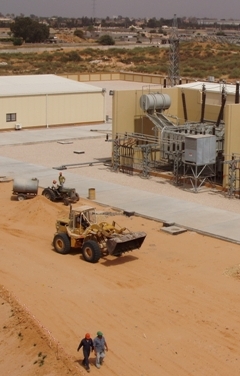
Areva's Bir Osta Milad substation in Libya copycreditpeterfairley2008Engineers working in the teeming cities and lonely deserts of North Africa are creating the last links in a power grid that will ring the Mediterranean Sea. Sharing electricity over this ‘Mediterranean Ring’ could secure Europe’s power supply with clean renewable energy, accelerating North Africa’s development and knitting together two worlds that seem to be racing apart — those of Muslim North Africa and an increasingly xenophobic Europe.

We make the case for all this unabashed optimism in Closing the Circuit – a feature story in this month’s issue of Spectrum. Closing the Circuit is the product of two years of on-again, off-again research that came to fruition with on-site reporting in Libya and Morocco this summer.

The timing is fortuitious: North African countries – in many ways among the most progressive in the Muslim world – face a rising threat of Islamic fundamentalism, including increasingly deadly attacks by Al Qaeda-aligned militants. Economic development and democratization are the best hope for a North African renaissance. At the same time Europe’s growing dependence on Russian oil and gas and desire to slash carbon emissions has intensified interest in North Africa’s energy resources.

The scale of the potential exchange is immense: Analyses by the German government estimate that solar power generated in scorching North Africa could meet Germany’s entire electricity demand. No wonder then that the Union for the Mediterranean launched by French president Nicolas Sarkozy this summer to spur cooperation between Europe and North Africa is fleshing out a “Mediterranean solar plan” as one of its first actions.

The geopolitical and social import could be bigger. Consider what Dominique Maillard, President of French grid operator Réseau de Transport de l’Electricité, said when asked last month what the Mediterranean Ring represents during an interview last month for the European Energy Review. Maillard began his response by noting that the electrical interconnections between the European countries got started in 1951 – well before the signing of the Treaty or Paris, which created a European coal and steel market, and before the Treaty of Rome in 1957. “At the dawn of Europe, energy – and even electrical energy – had therefore already preceded politics,” says Maillard.

The implication by extension is clear: Electrical interconnection can be the forerunner for peaceful codevelopment among the countries of the Mediterranean, even including Israel. Call it informed optimism.

add to del.icio.us : Add to Blinkslist : add to furl : Digg it : add to ma.gnolia : Stumble It! : add to simpy : seed the vine : : : TailRank

This post was created for EnergywiseIEEE Spectrum’s blog on green power, cars and climate

Democracy and Climate Change

Here’s some elegant prose on the hopes that rest on the Obama Administration to come from R.K. Pachauri, director general of The Energy and Resources Institute (TERI) in New Dehli and Chairman of the Intergovernmental Panel on Climate Change (IPCC) – the UN body that seeks and sells scientific consensus on climate science and policy. In a statement released yesterday Pachauri elegantly explains why the election is a cause for optimism:

The presidential elections in the US have vindicated the power of democracy as the most responsive form of government of the people, by the people and for the people. In respect of policies related to climate change, there was obviously a major divergence between the position of the Federal Government and that of the people at large, state governments and the cities in the US.

President-elect Barack Obama has not only been very clear in emphasizing the need for the US to engage in global solutions to meet the challenge of climate change but also in respect of bringing about a major shift in US energy policy.

The US now has a unique opportunity to assume leadership in meeting the threat of climate change, and it would help greatly if the new President were to announce a coherent and forward looking policy soon after he takes office. There is every reason to believe that President Obama will actually do so. This should please people across the globe, because US leadership is critical for mounting global efforts to meet this threat effectively. For this reason itself, apart from several others, the election of Mr Obama is a development that should generate optimism all-round.

Pachauri’s statement was forwarded to members of the Society of Environmental Journalists by Arul Louis, a fellow at the International Center for Journalists in Washington, DC.

add to del.icio.us : Add to Blinkslist : add to furl : Digg it : add to ma.gnolia : Stumble It! : add to simpy : seed the vine : : : TailRank

This post was created for EnergywiseIEEE Spectrum’s blog on green power, cars and climate

Return of the Solar Power Tower

Last week Spectrum Online ran my profile of Andasol 1, a solar thermal power plant that’s set to startup in Andalucia with the largest installation built expressly for storing renewable energy: a set of molten salt storage tanks that will hold enough heat energy to run its 50 MW steam turbine for 7.5 hours after dark. This week brought decisive evidence that another solar thermal design that makes even better use of energy storage — a so-called ‘power tower’ whereby sunlight is focused on a central tower — will also have its moment in the Andalucian sun.

The project, dubbed Gemasolar, will employ sun-tracking mirrors covering an area equal to 40 soccer fields to focus light at the top of a roughly 120-meter-high tower. There the sunlight will heat a solar receiver full of molten salt. In contrast, Andasol 1 (like most of the solar thermal plants under construction in the U.S., Spain, North Africa and the Gulf) uses thousands of square meters of trough-shaped mirrors to focus light on a synthetic oil; energy is stored via heat exchangers that transfer the synthetic oil’s heat to a molten salt.

One advantage of the power tower is thus obvious: heating salt directly eliminates the need for heat exchangers, reducing installation and operating costs. Another lies in the fortuitous thermodynamics of heating molten salts, whose maximum safe temperature of 565 C is about 165 C higher than the synthetic oil’s.

Sandia National Lab researchers verified these power tower advantages in the second half of the 90s, but also suffered through a series of operational difficulties. Five years ago the European Commission provided funding for the Gemasolar project (then known as the Solar Tres) to demonstrate that the difficulties could be overcome, but the project foundered on legal issues and changes in Spain’s renewable energy law. But engineering continued and this March the project sprung back to life when its lead proponent, Spanish engineering firm Sener, clinched a solar thermal joint venture with Abu Dabi’s alternative energy program.

With Abu Dabi’s deep pockets Gemasolar’s financing just might survive the current financial crisis. Siemens confirmed that the tower was moving forward this week by disclosing that it would supply the steam turbine to convert the tower’s solar-generated heat into up to 19 MW of electricity for the Spanish grid. 

For further details on Gemasolar, see this frank telling of its origins, design and goals on Sener’s website. For details on a competing power tower design that directly produces steam, see this white paper from Spains’ Abengoa Solar.

add to del.icio.us : Add to Blinkslist : add to furl : Digg it : add to ma.gnolia : Stumble It! : add to simpy : seed the vine : : : TailRank

This post was created for Tech Talk – Insights into tomorrow’s technology from the editors of IEEE Spectrum.