Climate-Proof Grids Require Transparency

Power and gas utilities—especially when pushing their own internal energy projects and products—often cloak their proposals for transmission lines, power plants and pipelines in proprietary data and models. And such scrutiny-averting tactics can lead to more costly infrastructure, squander opportunities for cleaner energy, and reduce public acceptance of system upgrades. “Companies get away with bad planning, hiding their cherry-picked assumptions in models nobody can see. This erodes confidence and costs consumers dearly,” says Tom Brown, an energy modeling expert at the Technical University of Berlin.

Such concerns are gaining traction within Europe’s official bodies, where greater transparency is seen as the only way to plan a robust and sustainable grid for tomorrow that taxpayers and communities will get behind today. Pressure is mounting project proponents and the organizations that coordinate the continent’s electricity and gas networks to switch to open-source models.

This week a European Commission-funded study concluded that open source codes can—and should—underpin official 10-year plans prepared for Europe’s gas and power networks. And its findings affirm a forceful endorsement of open modeling by the European Scientific Advisory Board on Climate Change. “Transparency of market and network models and calculations is key to ensuring public scrutiny of political investment decisions,” the independent council told the European Commission. As a result, it stated, the “traditionally closed and proprietary nature of energy system planning … is no longer fit for purpose.”

Read the full story @IEEE Spectrum.

Scientific American: Solar And Wind Power Could Ignite A Hydrogen Energy Comeback

Hydrogen is flowing in pipes under the streets in Cappelle-la-Grande, helping to energize 100 homes in this northern France village. On a short side road adjacent to the town center, a new electrolyzer machine inside a small metal shed zaps water with electricity from wind and solar farms to create “renewable” hydrogen that is fed into the natural gas stream already flowing in the pipes. By displacing some of that fossil fuel, the hydrogen trims carbon emissions from the community’s furnaces, hot-water heaters and stove tops by up to 7 percent.

So begins my February 2020 feature article for Scientific American which explains why hydrogen energy — presumed dead after a round of hype and disillusion two decades ago — is roaring back. Renewable hydrogen is central to the European Commission’s vision for achieving net-zero carbon emissions by 2050, for example, and a growing focus for the continent’s industrial giants. As of next year, all new turbines for power plants made in the European Union are supposed to ship ready to burn a hydrogen–natural gas blend, and the E.U.’s manufacturers claim the turbines will be certified for 100 percent hydrogen by 2030.

This time around it is the push to decarbonize the electric grid and heavy industry—rather than hope for fuel cell vehicles—that is driving interest in hydrogen. “Everyone in the energy-modeling community is thinking very seriously about deep decarbonization,” says Tom Brown, who leads an energy-system modeling group at Germany’s Karlsruhe Institute of Technology. Cities, states and nations are charting paths to reach nearly net-zero carbon emissions by 2050 or sooner, in large part by adopting low-carbon wind and solar electricity. Integrated energy models show that they’ll have a hard time keeping the lights on during periods of low wind and sunlight without hydrogen, and that hydrogen will pay for itself long before it solves that problem.

EU Climate Summit Commits to 2030 Carbon Cuts

European leaders wrapped up a two-day climate summit in Brussels last week with a deal to cut the European Union’s total greenhouse gas emissions to 40 percent below 1990 levels. This would continue a downward trend – the EU is already on track to meet a 20 percent reduction from 1990 levels by 2020 – but the agreement is weak relative to Europe’s prior ambitions to confront climate change.

Investors in green tech pushed aggressively for the deal, seeking a longterm signal that the European market will continue to reward advances in energy efficiency and low-carbon energy production. The deal is also a shot in the arm for the Paris global climate talks, scheduled for December 2015, which will seek to achieve the decisive binding global targets for greenhouse gas reductions that failed to emerge from the 2009 Cophenhagen climate talks.

What the deal lacks is specificity and ambition regarding the mechanisms by which European countries are to achieve the carbon reduction. “Key aspects of the deal that will form a bargaining position for global climate talks in Paris next year were left vague or voluntary,” reported The Guardian. Continue reading “EU Climate Summit Commits to 2030 Carbon Cuts”

EC Sees Heavy Pricetag to UK Nukes Plan

UK prime minister David Cameron at Hinkley Point

Government incentives for a pair of proposed nuclear reactors could cost U.K. taxpayers as much as £17.62 billion, thus exceeding the reactors’ projected cost. The EC figure is a preliminary estimate included in an initial report to London published on Friday by European Commission competition czars. The letter notifies the British government that—as we predicted in December—Brussels is launching a formal investigation to assess whether the subsidies violate European state aid rules.

The preliminary findings suggest that the U.K. and E.C. are on a collision source. As the Financial Times summed it up this weekend: “The severity of [the EC’s] initial concerns will cast a shadow over government hopes to win approval for the deal.”

Continue reading “EC Sees Heavy Pricetag to UK Nukes Plan”

Europe Shortlists Capture Projects for Stimulus

European leaders shortlisted a dozen proposals to demonstrate large-scale carbon capture and storage at coal-fired power plants last month as eligible to share €900 million of the EU’s €5-billion stimulus funding package. The goal is to bring down the cost of carbon-neutral coal power — which the European Commission expects to continue to exceed the cost of conventional coal power in 2020 — and to gain more experience with underground storage of CO2.

Seven propose to capture CO2 post-combustion from the exhaust of conventional coal-fired power plants, a relatively inefficient process that nonetheless costs less up front — an attractive feature given today’s financial mess. Three are Integrated Combined Cycle Gasification or IGCC power plants that would pull CO2 out of coal-derived gases prior to combustion, akin to the U.S. FutureGen project that Bush killed and Obama may be reviving. Two more would concentrate their CO2 exhaust by burning coal in purified oxygen — the oxyfuel approach that Sweden’s Vattenfall is testing at a pilot plant in Germany.

Continue reading “Europe Shortlists Capture Projects for Stimulus”

Saying Adieu to the Mighty UCTE

By summer the Union for the Co-ordination of Transmission of Electricity (UCTE), whose 240,000 kilometers of high-voltage lines connect 26 European countries, may cease to exist. Europe is not giving up electricity. Electrons will still flow on the world’s largest interconnection of power grids. Rather, the 57-year-old UCTE will be subsumed within a new and broader organization designed to, among other improvements, make Europe’s grids renewables-ready: the European Network of Transmission System Operators for Electricity (ENTSO-E).

CEOs from 42 transmission system operator companies in 34 European countries unanimously decided to create the new association last month. Whereas UCTE was limited to ensuring the interoperability of largely self-sufficient national grids, ENTSO-E is to play a proactive role in coordinating grid development to create a truly European grid that can operate on a larger scale. This is exactly what’s needed as Europe increasingly seeks to widely distribute electricity generated from concentrated renewable resources such as wind power in the North Sea and Baltic Sea and Mediterranean solar power.

Moving power across regions implies a European-scale supergrid, while the European Commission (EC) has struggled simply to add small interconnections between the states. Last month for Spectrum Online I profiled the EC’s latest desperate attempt to overcoming inertia in transmission expansion: recruiting high-profile volunteers to sell the interconnections.

One of those volunteers, Władysław Mielczarski, the Polish electric power engineering expert whom the EC recruited to unstick projects connecting Poland to Lithuania and Germany, minced no words in describing his best efforts to get things as no substitute for European institutions dedicated to grid planning. “If we’re going to do a professional job on interconnection,” said Mielczarski, “we must have professional people working full time, and we must have more support from the commission.”

add to del.icio.us : Add to Blinkslist : add to furl : Digg it : add to ma.gnolia : Stumble It! : add to simpy : seed the vine : : : TailRank

This post was created for Energywise, IEEE Spectrum’s blog on green power, cars and climate

Probing for Fluff in Europe’s Supergrids Vision

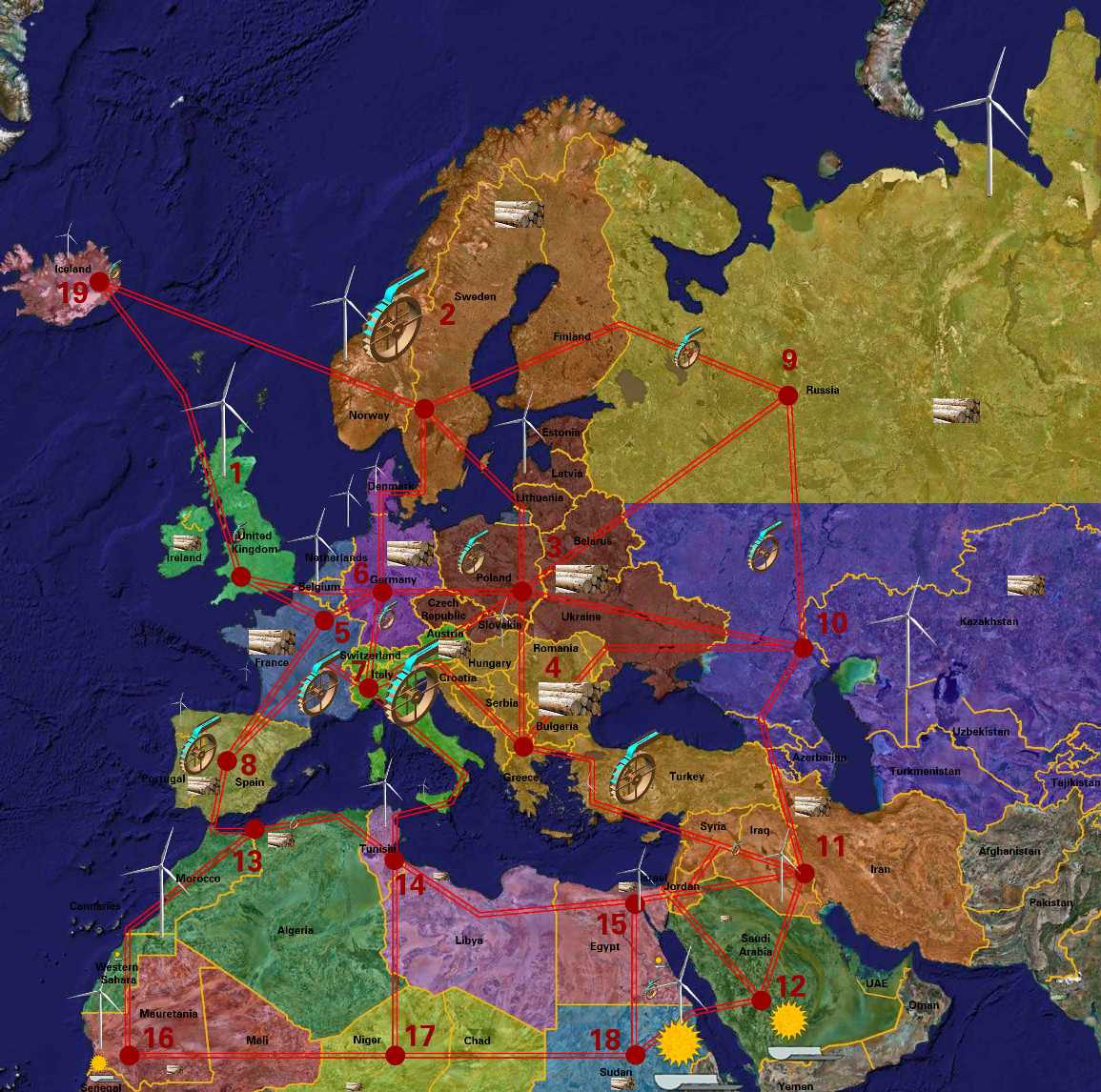
European renewable energy supergrid map Credit Wibke von FlemmingLast month the European Commission (EC) called for construction of regional power transmission grids that would ultimately merge into a supergrid distributing Mediterranean solar energy and offshore wind energy across Europe. Today, in MIT’s Technology Review, I test the political reality of sharing power across Europe (see “Europe Backs Supergrids”) and show that the EC just might pull it off.

Why be skeptical? Because for over a decade the EC has been pushing the liberalization of the European electricity market. Whereas, given the limited capacity for exchange of power between many European countries one could fairly question whether a ‘European market’ for electricity even exists.

Wind power developer Eddie O’Connor, for example, told me that his priority – building an offshore grid to connect tens of gigawatts of North Sea wind farms to be installed in the coming decade – would remain a dream so long as the European states and their politically powerful utilities control tranmission planning. “The utilities are the enemy,” says O’Connor, founder of wind developer Airtricity and CEO of Mainstream Renewable Power. “Even at this stage they’re still the enemy.”

What my report for TechReview shows, however, is that change is possible. The best example is a French-Spanish agreement this summer — under intense prodding from the EC — clearing the way for a much-needed second powerline across the Pyrenees. A special envoy appointed by the EC broke what had been a 15-year impasse complicated by local environmental concerns, Catalan fury, and diverging interests of the utilities involved. 

Even O’Connor is optimistic. He believes that new international institutions must be created to conjur up the supergrid Europe needs to carry renewable energy. But, says O’Connor, both are possible: “I believe the building of the supergrid is imminent.”  

Stay tuned for more on the EC’s energy envoys.

This post was created for EnergywiseIEEE Spectrum’s blog on green power, cars and climate

add to del.icio.us : Add to Blinkslist : add to furl : Digg it : add to ma.gnolia : Stumble It! : add to simpy : seed the vine : : : TailRank