Rolling Power

Electricity moves down a wire at close to the speed of light. In March, a tiny tech firm in San Francisco drew a crowd to witness power moving 100 million times slower, at the very modest pace of a freight train bumping around a rail yard. And I mean literally at freight speed, because the aptly-named startup, SunTrain, convened us to watch a diesel locomotive hauling solar energy.

The star of this demonstration at the Port of San Francisco’s Pier 96 rail yard was a freight container that SunTrain had crammed full of lithium ion batteries and mounted on a standard 27-meter railcar…

So begins my latest feature for the solutions-oriented Anthropocene Magazine, profiling the creative thinkers who see railroads — the ultimate industrial dinosaur — as a lever to equip power grids for a wind and solar-powered future. SunTrain would turn railroads into a power transmission solution, using railroads to make an end run around grid congestion that’s holding up power projects across the U.S.

Imagine mile-long trains with 120 or more battery cars, charging up where wind and solar power is cheap and making daily deliveries of over two gigawatt-hours of clean energy each—enough to power a small city, port, or datacenter for days. 

I also cover a slightly more mature rail-to-grid concept: feeding power lines through rail corridors, thus avoiding the environmental impacts, cost and community upset that delay and frequently kill grid expansion. A handful of transmission projects in New England and New York already co-locate power lines beside rails. And the proposed SOO Green transmission project would follow rails for nearly all of its 560-kilometer journey from Iowa’s wind belt to Chicago.

The ultimate challenge facing both approaches is getting railroads to think outside the box and to make room for cleaner power. That will get easier if, as expected, even President Trump’s pro-carbon policies can’t keep the railroads’ rolling boxes full of coal.

Read the full story @Anthropocene
A Part of Modern Life So Essential That Armies Should Never Attack It Again

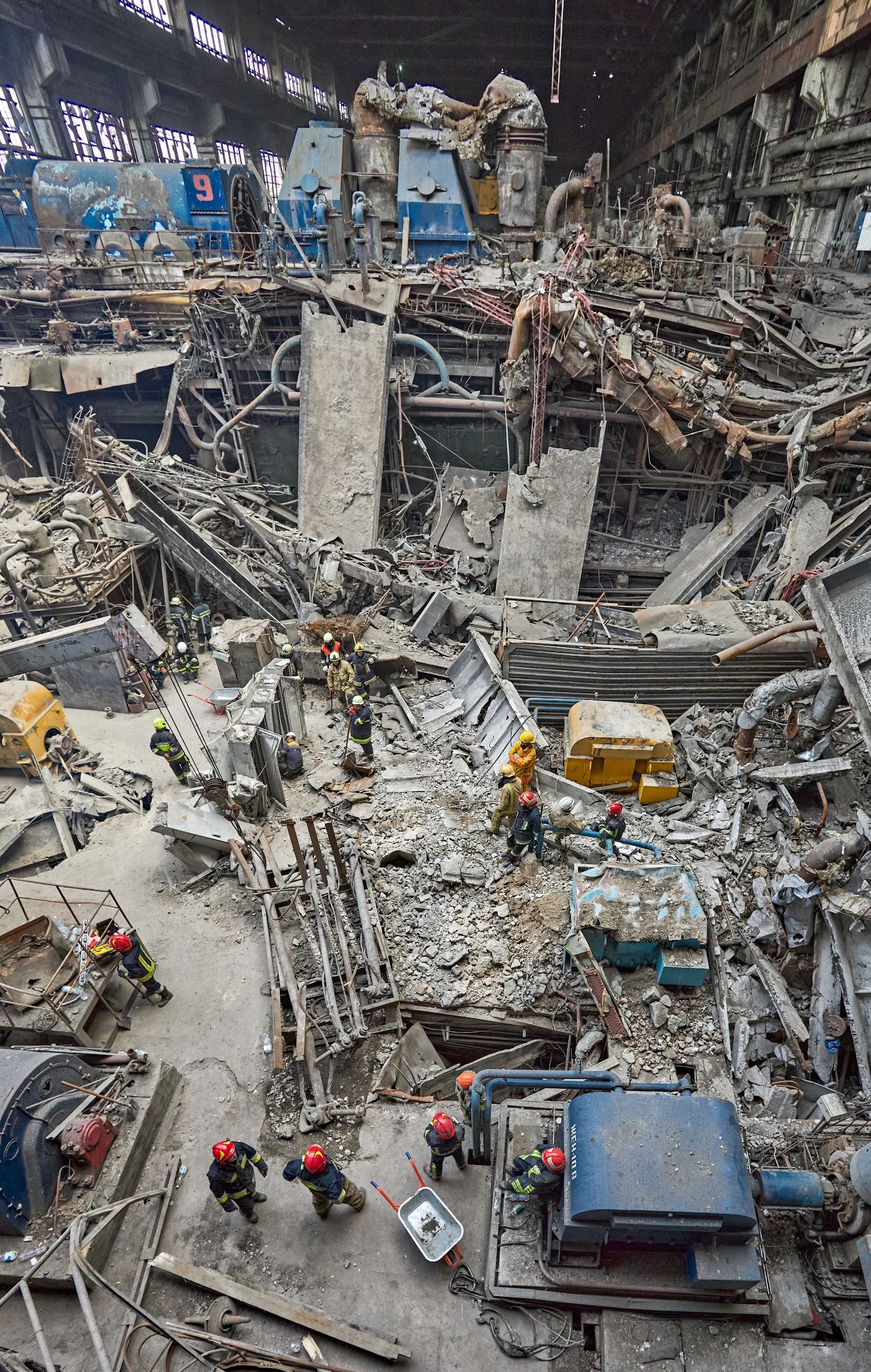
Photo: DTEK

It’s time to change the laws of war to punish and hopefully deter the insane and inhumane destruction of power grids. So argues my guest essay for The New York Times opinion pages.

For two years, it has pained me to observe and occasionally cover Russia’s increasingly destructive pummelling of Ukraine’s power grid. As a longtime student of power systems, I intimately know the engineering and operational sophistication that keeps power grids — the world’s largest machines — running at close to the speed of light. I know how entrenched power systems have become in modern life, assuring everything from home oxygen generators to sewage treatment. And I know that plugging in more is our best hope for stopping climate change.

Since Russia’s whole-scale grid attacks began in late 2022 I have questioned the legality of such wanton destruction. In my debut contribution to The Times I lay bare the holes in international law that legalize most attacks on power systems, and argue that the international community should draw brighter lines to protect them.

The Midwestern Pragmatists Behind the Renewables-Ready Power Grid

Power line congestion is forcing “dramatic drops” in wind power production, yet we need far more wind power and even more solar. As one renewable energy developer put it last week: “We are sprinting towards a brick wall.” My latest grid feature profiles the Made-in-the-Midwest fix that could vault North America’s power grids over the hurdles, forging a truly continental network to reliably deliver clean power for homes, highways and industries.

It’s a story of innovative policy and technology, advanced by a pragmatic yet tenacious band of environmental activists and industry planners who are determined to push the power grid to green greatness. And it’s my first for an explicitly ecologically-focused publication like Sierra Magazine, whose readership is more likely to view power lines as an ecosystem disruptor.

In the 70s, Minnesota farmers were severing power lines with high-powered rifles and toppling transmission towers to block grid expansion. But 20 years ago they joined enviro activists, wind developers & utilities to back grid growth that fuelled a wind power boom, inspiring innovative planners at the Midcontinent Independent System Operator or MISO (the nonprofit entity that runs the Midwest’s grid).

Dale Osborn: Talking power grids over Swedish meatballs at the #MSP Ikea

MISO’s grid guru Dale Osborn took their winning policy formula and ran, showing how advanced transmission technology could extend MISO’s approach to deliver massive renewables and shutter coal nationwide.

MISO’s transmission train stalled when Gulf states’ utility Entergy joined the club, then used its monopoly muscle to gum up MISO’s grid planning. Trump’s fossil-friendly Energy Department killed action in Washington, DC, burying the evidence that Osborn’s ‘macrogrid’ scheme benefitted both consumers and the environment — political interference that I exposed for The Atlantic and InvestigateWest.

But MISO planners and Osborn’s macrogrid vision are making a comeback. Northern states recently broke Entergy’s filibuster, yielding a historic plan to more than double Midwestern solar & wind energy. And Osborn’s macrogrid plan has gone mainstream in Washington, D.C.

The question now: Can grid operators like MISO, political leaders and conservationists forge bipartisan consensus to build a truly national grid. Without which, it will be far harder to endure the ravages of climate change, and may be impossible to freeze it.

Read the full story online at Sierra Magazine

How to rescue biofuels from a sustainable dead end

In 2011, I scrutinized a gathering wave of biofuels for Nature, and that deep dive on making fuels from woody rather than sugary plant material remains one of my most-cited works. Perhaps because we nailed what emerged as the technology’s as-yet-insurmountable hurdle: making the conversion processes work consistently at industrial scale.

A little over a decade later Nature take another look at the sustainability of biofuels. The picture isn’t pretty, thanks in part to the failure of those cellulosic fuels.

Biofuels continue to grow in ways that overlap with food crops, contributing to agricultural expansion at the expense of carbon-storing forests and grasslands. And poorly conceived and regulated mechanisms for tracking and rewarding carbon storage by farms threaten to exacerbate the trouble.

It will take a “ground-up revamp” for agriculture to get biofuels right, both for the environment and for farm communities. As we conclude, it looks like déja vu all over again: “If the sustainability of biofuels depends on such fundamental changes, one has to wonder whether another next-generation biofuels failure isn’t the more likely outcome.”

Read the full story @Nature, or in Scientific American.

Bark Versus Bite on Trump and Clean Energy

President-elect Donald Trump is a self-declared climate-change denier who, on the campaign trail, criticized solar power as “very, very expensive” and said wind power was bad for the environment because it was “killing all the eagles.” He also vowed to eliminate federal action on climate change, including the Clean Power Plan, President Obama’s emissions reduction program for the power sector. Trump’s rhetoric has had renewable-energy stocks gyrating since the election. But the impact on renewable-energy businesses could be far less drastic than many worst-case scenarios. “At the end of the day what Trump says and what is actually implemented are two completely different things,” says Yuan-Sheng Yu, an energy analyst with Lux Research. Read on at MIT Technology Review

Might That Emperor of Electricity, the Power Grid, Have No Clothes?

Distributed energy solutions, such as rooftop solar, should be the electrification solution for the 1.1 billion people who are not plugged into a national power grid, not just a stopgap measure. That is the message from a new global industry group, Power for All, that brings together businesses and NGOs that distribute off-grid solar systems. They say bottom-up distributed energy solutions are faster, cleaner, and cheaper than extending power grids to rugged or sparsely-populated regions. Figures released this week by the joint UN-World Bank energy access program—Sustainable Energy for All—lend credence to their argument. Continue reading “Might That Emperor of Electricity, the Power Grid, Have No Clothes?”

Hawaii Says ‘Aloha’ to 100% Renewable Power

Hawaii’s legislature voted yesterday to stake the state’s future on renewable energy. According to House Bill 623, the archipelago’s power grids must deliver 100 percent renewable electricity by the end of 2045. If the compromise bill is signed by the governor as expected, Hawaii will become the first U.S. state to set a date for the total decarbonization of its power supply. Renewable energy has been booming. Between 2008 and 2013, renewable energy jumped from 7.5 percent to 18 percent of the state’s capacity. HB623 seeks to extend and turbo-boost that trend, calling for 30 percent renewables in 2020 and 70 percent by 2030 en route to the final leap to 100 percent. That last jump could be difficult, says Peter Crouch, a power grid simulation expert and dean of engineering at the University of Hawaii’s flagship Manoa campus. “Today I don’t know whether we can do it,” he says. Continue reading “Hawaii Says ‘Aloha’ to 100% Renewable Power”