Power line congestion is forcing “dramatic drops” in wind power production, yet we need far more wind power and even more solar. As one renewable energy developer put it last week: “We are sprinting towards a brick wall.” My latest grid feature profiles the Made-in-the-Midwest fix that could vault North America’s power grids over the hurdles, forging a truly continental network to reliably deliver clean power for homes, highways and industries.
It’s a story of innovative policy and technology, advanced by a pragmatic yet tenacious band of environmental activists and industry planners who are determined to push the power grid to green greatness. And it’s my first for an explicitly ecologically-focused publication like Sierra Magazine, whose readership is more likely to view power lines as an ecosystem disruptor.
In the 70s, Minnesota farmers were severing power lines with high-powered rifles and toppling transmission towers to block grid expansion. But 20 years ago they joined enviro activists, wind developers & utilities to back grid growth that fuelled a wind power boom, inspiring innovative planners at the Midcontinent Independent System Operator or MISO (the nonprofit entity that runs the Midwest’s grid).
Dale Osborn: Talking power grids over Swedish meatballs at the #MSP Ikea
MISO’s grid guru Dale Osborn took their winning policy formula and ran, showing how advanced transmission technology could extend MISO’s approach to deliver massive renewables and shutter coal nationwide.
MISO’s transmission train stalled when Gulf states’ utility Entergy joined the club, then used its monopoly muscle to gum up MISO’s grid planning. Trump’s fossil-friendly Energy Department killed action in Washington, DC, burying the evidence that Osborn’s ‘macrogrid’ scheme benefitted both consumers and the environment — political interference that I exposed for The Atlantic and InvestigateWest.
But MISO planners and Osborn’s macrogrid vision are making a comeback. Northern states recently broke Entergy’s filibuster, yielding a historic plan to more than double Midwestern solar & wind energy. And Osborn’s macrogrid plan has gone mainstream in Washington, D.C.
The question now: Can grid operators like MISO, political leaders and conservationists forge bipartisan consensus to build a truly national grid. Without which, it will be far harder to endure the ravages of climate change, and may be impossible to freeze it.
“Logic clearly dictates that the needs of the many outweigh the needs of the few.” So declares Spock, Star Trek’s Vulcan hero, as he sacrifices himself to save the Starship Enterprise and its crew in the 1982 film Star Trek: The Wrath of Khan. Today Stanford University researchers presented the clearest proof to date that self-sacrifice can also benefit wind farms. In their demonstration at an Alberta wind farm, one turbine sacrifices a fifth of its generating potential to enable better performance by neighboring turbines, boosting the group’s collective output.
And while Spock’s heroics necessitated a major plot twist to revive his character for the next Star Trek sequel, teaching turbines to behave altruistically requires just a small (but intelligent) tweak to their control systems. What they learn is how to share the wind. Continue reading “Teaching Wind Turbines Altruism to Rev-up Wind Farms”
My first contribution to award-winning Hakai Magazine, which covers coastal science, ecology and communities
Moloka‘i is a bastion of sanity and understatement at the center of the Hawaiian archipelago. Just 40 kilometers of open water away from O‘ahu, the island is a far cry from Honolulu’s hectic tiki bars and tourists, universities, cargo yards, and warships. On Moloka‘i, agriculture and subsistence hunting and fishing still sustain many of the 7,500 or so residents, and visitors are few. Those tourists who do make the hop over rank mailing a coconut home as their top experience.
On the surface, nothing about this bucolic place suggests it as the central hub around which a cleaner, high-tech electrical future might be built. Yet the island could serve as a model for Hawai‘i as the state navigates transitioning its entire power supply to renewable sources.
Honolulu-based Hawaiian Electric, the investor-owned utility that controls Moloka‘i’s grid, must meet a mandate from the state legislature to convert the five island grids it operates to 100 percent renewable energy by 2045. No utility on Earth knows for sure how to accomplish that yet. Pushing Moloka‘i there first and fast, Hawaiian Electric decided, would provide insight and inspiration.
Hawaiian Electric’s idea was to get Moloka’i off diesel generation by 2020. Alas, it is little closer to shutting down the diesels three years later. Can a small Hawaiian island and its utility get along well enough to teach the rest of the world how to get off fossil-fueled electricity?
As renewable power displaces more coal, gas, and nuclear generation, electricity grids are losing the conventional power plants whose rotating masses have traditionally helped smooth over glitches in grid voltage and frequency. One solution is to keep old generators spinning in sync with the grid, even as the steam and gas turbines that once drove them are mothballed. Another emerging option will get a hearing next week at the 15th International Workshop on Large-Scale Integration of Wind Power in Vienna: creating “synthetic inertia” by reprogramming wind and solar equipment to emulate the behavior of their fossil-fired predecessors.
Power cables to Oahu could reduce curtailment of Maui wind farms. Credit: First Wind
Since 2013, a big mainland energy firm has been raring to build Hawaii’s first inter-island power cable, arguing that only a unified power grid can enable the renewable energy developments needed to break Hawaii’s addiction to imported petroleum. Now that big outsider—Juno Beach, Florida-based NextEra Energy—is trying to absorb Hawaii’s power providers in one big bite.
NextEra secures Hawaiian Electric and builds cables to unify its assets, unleashing renewable energy development
NextEra’s bid for Hawaiian Electric is squashed by officials with longstanding mistrust of outside interests, and the island utilities proceed on their own
NextEra wins approval for the acquisition but drops its cable ambitions, focusing instead on bringing liquefied natural gas to Hawaii to repower Oahu’s oil and coal-fired generators
Interconnecting the islands is an idea that dates all the way back to an 1881 meeting in New York City between Hawaii’s then-King Kalakaua and Thomas Edison. Kalakaua’s officials asked Edison if electricity could be generated from the Big Island’s active volcano and delivered via subsea cable to Oahu to bring electric light to Honolulu, thus sparing Hawaii greater dependence on Australian coal. Edison said the scheme could work, according to a report by the New York Sun, but demurred that it, “would cost so much, that’s all.”
134 years later, one hears essentially the same arguments for and against a unified Hawaiian grid. Proponents such as NextEra and the Hawaii State Energy Office say Oahu must hook up to its neighbors’ grids because it lacks the renewable resources needed to meet even half of its power demand—over 7,500 gigawatt-hours (GWh) per year, or nearly three-quarters of the state’s total.
Hawaii’s other islands, by contrast, have renewable potential to spare, says a 2010 analysis commissioned by the U.S. Department of Energy’s National Renewable Energy Lab. Lanai and Molokai could each generate over 1,000 GWh per year of wind power; Maui has over 2,000 GWh of viable geothermal, wind, and solar resources; and Hawai’i (better known as the Big Island) has over 6,000 GWh of geothermal potential. Sharing these resources with Oahu via subsea cables, the authors concluded, was the only way to meet Hawaii’s goal to push renewables to 70 percent of the power supply by 2030.
In 2013, NextEra proposed to start with a 180-kilometer-long, high-voltage direct current (HVDC) link between Maui and Oahu dubbed NextGrid Hawaii. Last year, Pacific Business News reported that NextEra had secured property in downtown Honolulu for the converter station where NextGrid’s pair of 200-megawatt cables would come ashore and link up with Oahu’s AC grid.
NextGrid would cost an “enormous” $600-800 million, according to Pacifc Business News, but NextEra said it would save the islands’ utilities at least $4.8 billion over its first 40 years of operation. The State Energy Office conservatively pegs net savings to consumers at a more modest $423 million, plus $128 million in environmental benefits.
The promise of better renewable energy utilization earned NextEra support from some environmental groups. “We’re stronger together,” says Jeff Mikaluna, executive director for the Honolulu-based Blue Planet Foundation. In addition to better integrating renewables, says Mikaluna, tying the islands together should also reduce the need to keep fossil fueled power plants running in reserve.
NextGrid also appears to be spurring interest in cables to other islands, such as the Big Island. That island’s biggest landholder, the historic Parker Ranch, says a cable to Oahu could benefit a pumped hydroelectricity storage project it is developing. “Parker Ranch could enable a large-scale storage solution as part of an integrated statewide grid,” wrote Parker Ranch CEO Neil Kuyper inan August 2014 press release.
Of course, as is usually the case for transmission proposals, the idea of inter-island cables also has its critics. Some question, as Thomas Edison did, whether cables will really pencil out economically. Henry Curtis, executive director for Honolulu-based environmental advocacy group Life of the Land and a blogger on energy issues, says technical challenges associated with laying power cable over steep subsea slopes could inflate project costs.
Curtis also questions the cables’ environmental benefits, and highlights potential environmental harm. NextEra’s Maui-Oahu cable, for example, would traverse a humpback whale sanctuary.
Distributed generation advocates, meanwhile, are raising alarms about the track record of NextEra subsidiary Florida Power and Light (FPL), the utility that serves most of Florida. In December, Greentech Media noted that Florida ranks 29th in the country for overall renewable energy development, and blamed FPL for the sun-soaked state’s shortage of solar power: “It’s not for lack of sunshine; it’s lack of policy. Florida has no renewable standard—FPL has crushed every effort to establish one.”
Energy analyst William Pentland raised similar alarms in Forbeslast month. “Hawaiians should think long and hard about NextEra’s track record in the Sunshine State before approving any merger,” writes Pentland.
NextEra is, for its part, playing the grid unification card close to its chest as Hawaii’s regulators weigh its offer for Hawaiian Electric. One thing appears certain: NextEra will face heightened expectations to deliver on Hawaii’s renewable energy aspirations if the acquisition goes through.
Blue Planet Foundation’s Mikaluna says Hawaiian Electric was saying what state leaders wanted to hear at the state capitol earlier this week. During a hearing on a bill proposing a 100-percent-renewables standard for Hawaii’s utilities for 2040, Hawaiian Electric’s representative abandoned the utility’s traditional tack. Rather than hedging on the prospects for zeroing-out fossil fuel consumption, the new message was ‘How about 2050?’ “That’s a first,” says Mikaluna.
This post was created for Energywise, IEEE Spectrum’s blog on green power, cars and climate
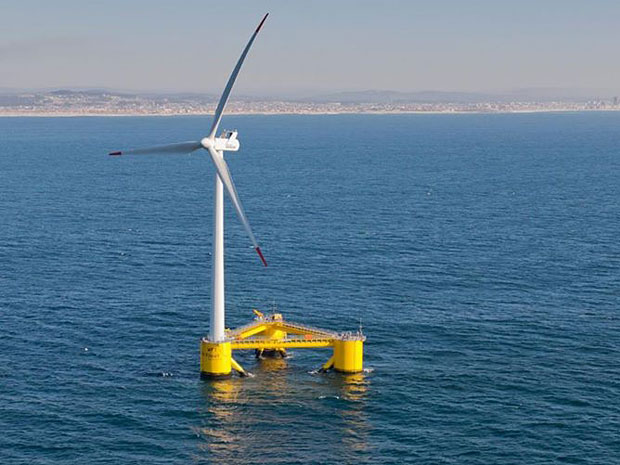
Floating wind power is no longer science fiction. Promising results from five test platforms operating worldwide—including three in Japan—are turning into project plans for a first generation of floating wind farms. Industry analyst Annette Bossler, who runs Bremen, Maine-based Main(e) International Consulting, predicts that the number of test platforms will nearly double over the next two years and that commercialization is within site. “By 2018-2019 you will start to see the first really large-scale commercial use of floating platforms,” predicts Bossler.
Putting wind turbines on offshore platforms akin to those developed for the petroleum industry provides a means of exploiting high-quality offshore winds—which are stronger and more consistent than onshore winds—in waters too deep for today’s bottom-fixed foundations. Continue reading “Floating Wind Turbines Headed for Offshore Farms”
Last year, IEEE Spectrum profiled an ultrasonic alert for wind farm operators designed to let them know when bats are nearing their turbines. The potentially bat-saving technology can’t be ready soon enough according to this week’s issue of the journal Bioscience. University of Colorado ecologist Mark Hayes estimates that at least 600 000 and possibly more than 900 000 bats were killed by wind turbines last year in the U.S.
Hayes’ report is a statistical reassessment of data on bat carcasses found at wind turbine sites. His figure lends credence to a March 2013 mortality estimate of 880 000 deaths per year by Sacramento-based ornithologist and consultant Shawn Smallwood. That figure was well beyond previous estimates, which had ranged as low as 33 000. “My estimates, using different methods and data, bracket Smallwood’s 888 000 estimate,” writes Hayes in an e-mail to Spectrum. Continue reading “Broken Bats: Wind Power and the Damage Done”


 Peter Fairley