Why New Nuclear Depends on Loan Guarantees

Constellation Energy and Electricité de France boasted this week that they are closer to winning federal loan guarantees for a new reactor they want to build at Constellation’s Calvert Cliffs power station in Maryland. The $18.5 billion pool of funding they’re vying for will be critical to jump-starting the stalled U.S. nuclear industry. Construction problems in Finland and France with the reactor design slated for Calvert Cliffs — the EPR from Paris-based nuclear technology and services giant Areva — show why.

Bad news flows in constantly from Olkiluoto, the site on Finland’s coast where Areva is three years behind schedule on an EPR it is building for a Finnish utility — the first of the 1,600-megawatt reactors. Continue reading “Why New Nuclear Depends on Loan Guarantees”

China Close to Firing Up a Fast Reactor

Russian nuclear energy holding company Rosatom reported yesterday that a subsidiary had completed construction of an experimental nuclear reactor in Beijing. At 25 megawatts the reactor’s power output is small, but it sends a big message about where nuclear technology may be heading — especially after the Obama Administration’s effective cancellation last month of plans to store U.S. spent nuclear fuel at an underground repository below Nevada’s Yucca Mountain.

The Chinese Experimental Fast Reactor is so-named because the neutrons produced in its core are not ‘moderated’ with water like those that generate heat in nearly all commercial nuclear reactors. The faster neutrons can burn down nuclear waste and even generate new fuel, promising a solution to the thorny problem of waste storage as well as energy independence.

Continue reading “China Close to Firing Up a Fast Reactor”

Sarkozy Keeping Nuclear Atop France’s Energy Pile

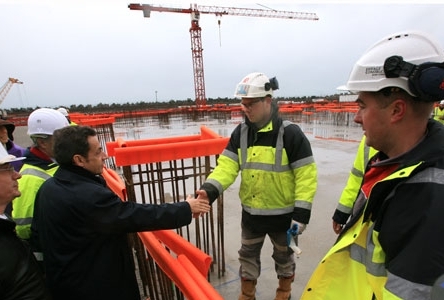
french-president-nicolas-sarkozy-at-flamanvilleFrench president Nicolas Sarkozy was in Normandy last week at the construction site of France’s first new nuclear reactor in two decades, highlighting plans to commence a second new reactor and,  according to Paris-based daily Le Monde (Google translation here), calling nuclear energy a key part of the country’s economic recovery plan. The move is evidence of further diversity in how countries are seeking to shape their energy futures via recovery plans, as President Barack Obama negotiates with Congress to keep renewable energy atop his plan and Canada’s latest budget pursues a heavy emphasis on carbon capture and storage.

A who’s-who list of French corporate heavyweights angling for a piece of Sarkozy’s action leaves no doubt that government dollars impact industrial strategy. French state-owned power giant Electricité de France (EDF) is building the reactor at Flammanville that Sarkozy visited last week, using the third-generation EPR reactor designed by French nuclear technology firm Areva. But Sarkozy says a second EPR to be built further up the Normandy coast at Penly will unite EDF and France’s number two player in electricity, GDF Suez; Reuters reported today that French oil and gas firm Total also wants a “double-digit” stake in the project.

Continue reading “Sarkozy Keeping Nuclear Atop France’s Energy Pile”

Canadian ‘Stimulus’ Targets Carbon Capture & Nuclear

canadian-prime-minister-stephen-harper

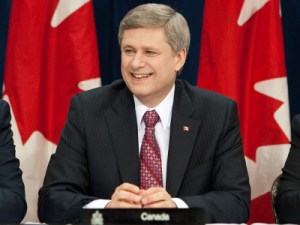
Canada’s Conservative government unveiled a budget yesterday with an energy balance distinctly different from that contemplated by President Obama in his economic stimulus package. “Green Causes Left Out of Budget” is how the Toronto-based National Post headlined its coverage of the Canadian budget proposed yesterday. Toronto Star columnist Chantal Hebert writes that environmentalists may be the only “constituency, friendly or hostile to the Conservatives, that will not get a piece of the multibillion-dollar stimulus package.”

Whereas Obama’s $819-billion stimulus package proposes to give renewables a big boost, Prime Minister Stephen Harper’s C$33-billion (US$27-billion) ‘Economic Action Plan’ would leave unchanged Canada’s EcoEnergy support program for renewable energy. Canadian Wind Energy Association president Robert Hornung predicts the program may run out of cash before the end of the coming fiscal year, blunting the industry’s ability to draw investment amidst a superhot U.S. market:

“Our ability to compete with the United States for investment in wind energy projects and manufacturing opportunities will decline as a result of this budget. At a time when the United States has made measures to support renewable energy deployment a key component of its plans to stimulate the US economy, Canada is moving in the opposite direction.”

Continue reading “Canadian ‘Stimulus’ Targets Carbon Capture & Nuclear”

Nukes, Gas, Oil and Coal All Losers in EU Energy Strategy

The European Commission issued its Strategic Energy Review yesterday, proposing energy efficiency investments, a shift to alternative fuel vehicles to end oil dependence in transport, and more aggressive deployment of renewable energy and carbon capture and storage to “decarbonise” the EU electricity supply. Figuring prominantly among its first six “priorities essential for the EU’s energy security” are the North Sea offshore electric power supergrid that Energywise covered in September and the Mediterranean Ring electric interconnection of Europe and North Africa that I’ve been harping on this week.

The EC energy strategy not only endorses the MedRing, but views it as a component of a future supergrid traversing Europe and stretching beyond the Mediterranean to Iraq, the Middle East and Sub-Saharan Africa.

How would this new vision (and $100/barrel oil) alter the complexion of European energy consumption? The energy review projects that by 2020 total energy demand drops from the equivalent of 1811 metric tons of oil in 2005 to 1672 MTOE in 2020. Demand met by renewables such as wind, solar and hydro more than doubles in real terms from 123 to 274 MTOE, while their share of total demand leaps from 6.8% to 16.4%. Imported renewables – with the MedRing delivering North African wind and solar power – jump 10-fold from 0.8% in 2005 to 8.8% in 2020.

Oil, gas, coal and nuclear, meanwhile, all see a diminished role, both in real terms and as a share of European energy demand. Interestingly the role of natural gas – the low-carbon fossil fuel – drops the most, from 25% to 21%, reflecting EU concern over dependence on gas imports from Russia. Nuclear’s share drops the least, from just slightly over to slightly under 14% of demand; this assumes that nuclear phaseout plans, particularly Germany’s, are followed through.

How to make it all come true? Accompanying the EC review is a ‘green paper‘ (the EU’s unbleached alternative terminology for what we’d call a ‘white paper’) outlining a variety of new regulatory and financial mechanisms. The EU is already a world leader in terms of incentives for lower carbon energy with strong price supports for solar and wind and a carbon cap and trade program up and running (though still lacking teeth as my Energywise colleague Bill Sweet notes). However, the energy review warns that the primarily national-level financing that drives energy projects today are inadequate to drive infrastructure that is pan-European or larger. A perfect example is the massive investment in high-voltage dc lines needed to turn the MedRing into a bulk power mover (see the second half of our feature on MedRing: “Closing the Circuit”).

Even less viable under existing financing mechanisms are those projects that entail considerable “non-commercial risks” such as threats of political instability or terrorism. Did someone say North Africa?

add to del.icio.us : Add to Blinkslist : add to furl : Digg it : add to ma.gnolia : Stumble It! : add to simpy : seed the vine : : : TailRank

This post was created for EnergywiseIEEE Spectrum’s blog on green power, cars and climate
Does Fusion Have a Future?

The 2004 report “Burning Plasma: Bringing a Star to Earth,” from the U.S. National Research Council, sold Washington on the International Thermonuclear Experimental Reactor (ITER), a massive R&D project that proponents predict will be the breakthrough project for fusion energy. In its fiscal 2008 budget, however, Congress drove the United States’ role in ITER right into the ground, slashing US $160 million promised for this year to $10.7 million. That has some wondering if fusion research, considered since the 1960s one of the great long shots for a sustainable and relatively clean energy supply, has run out of time.

What makes fusion a long shot? Like most fusion experiments to date, ITER proposes to use formidable electric currents and magnetic fields to induce fusion in isotopes of hydrogen (deuterium and tritium) and to contain the resulting burning plasma-akin to a tiny star and exceeding 100 million ˚C. Existing fusion reactors have produced heat equivalent to just a few megawatts of power–less than the energy required to induce the reaction–and for just fractions of a second. ITER should put out ten times as much power as it consumes, but still for just a matter of minutes.

And even that level of performance will require a 27-meter-high magnetic confinement chamber that will take a decade to build and cost an estimated $2.76 billion. Including design, administration, and 20 years of operation, the project’s total expenses will be nearly $15 billion.

For more on fusion’s troubled poster child, see my story at Spectrum Online.

add to del.icio.us : Add to Blinkslist : add to furl : Digg it : add to ma.gnolia : Stumble It! : add to simpy : seed the vine : : : TailRank

Earthzine: Widening the scope

Time to introduce to another web portal launched this month, this one called Earthzine. It’s a webzine created by dedicated volunteers involved in Earth observation offering fresh perspective on the state of the planet. Fostering Earth observation & global awareness

My contribution to the launch is an interview with Rob Adam, who emerged from political incarceration during Apartheid to help lead South Africa’s scientific and technological renaissance. I spoke to Adam primarily about his role in GEO, an international collaboration to foster global sharing of oceanic, terrestrial and satellite-based Earth observations. Among other things, GEO could be a critical step towards better modeling of climate change.

Adam made two noteworthy observations on the energy challenge. One was the fact that coal has lost some of its shine even in South Africa, which needs energy to meet its development goals. Some of the many new coal-fired power projects in the offing there are being converted to nuclear projects (which he oversees as CEO of the South African Nuclear Energy Corporation). Adam explains that South Africa wants to pull its weight in the fight against climate change, but also that its leadership recognized that at some point in the future even this developing nation would have to pay the full price of coal — including its environmental costs. The net result, says Adam, is “a profound effect on the thinking on energy production and energy generation in South Africa.”

More profound to me was another comment by Adam, this time on the value of better modeling of weather and climate for renewable energy. Why? Because most renewable energy, as he points out, depends on the weather. How do you project where to put a wind farm or how much energy a solar park will produce if historic patterns of wind flow and cloud cover no longer hold? “The biggest challenge for renewables,” says Adam, “is climate change.”

add to del.icio.us : Add to Blinkslist : add to furl : Digg it : add to ma.gnolia : Stumble It! : add to simpy : seed the vine : : : TailRank