EU Climate Summit Commits to 2030 Carbon Cuts

European leaders wrapped up a two-day climate summit in Brussels last week with a deal to cut the European Union’s total greenhouse gas emissions to 40 percent below 1990 levels. This would continue a downward trend – the EU is already on track to meet a 20 percent reduction from 1990 levels by 2020 – but the agreement is weak relative to Europe’s prior ambitions to confront climate change.

Investors in green tech pushed aggressively for the deal, seeking a longterm signal that the European market will continue to reward advances in energy efficiency and low-carbon energy production. The deal is also a shot in the arm for the Paris global climate talks, scheduled for December 2015, which will seek to achieve the decisive binding global targets for greenhouse gas reductions that failed to emerge from the 2009 Cophenhagen climate talks.

What the deal lacks is specificity and ambition regarding the mechanisms by which European countries are to achieve the carbon reduction. “Key aspects of the deal that will form a bargaining position for global climate talks in Paris next year were left vague or voluntary,” reported The Guardian. Continue reading “EU Climate Summit Commits to 2030 Carbon Cuts”
Internet-Exposed Energy Control Systems Abound

Two-and-a-half years ago researchers at Chicago-based cyber security firm Infracritical set out to measure how many industrial control systems are openly exposed to the Internet. Their disquieting findings are up for discussion today at the 2014 ICS Cyber Security Conference in Atlanta. Infracritical remotely identified over 2.2 million unique IP addresses linked to industrial control systems at energy-related sites including electrical substations, wind farms, and water purification plants. And they were still logging an average of 2,000-3,000 new addresses per day when they closed the count in January 2014. “We never reached bottom,” says Infracritical cofounder Bob Radvanovsky, an expert in securing supervisory control and data acquisition (SCADA) systems. Continue reading “Internet-Exposed Energy Control Systems Abound”

Nuclear Shutdowns Put Belgians and Britons on Blackout Alert

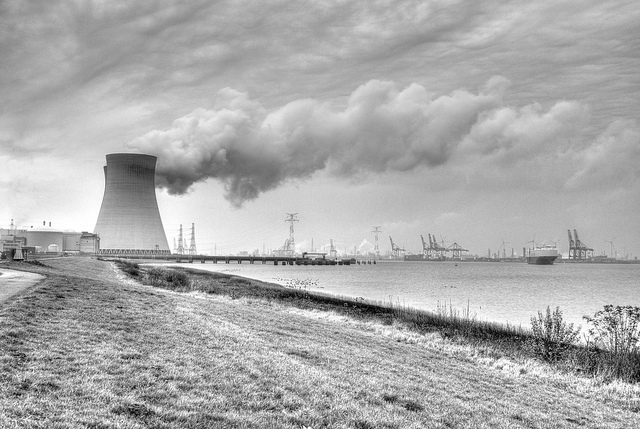
Doel nuclear power plant by Lennart Tange
Doel nuclear power plant. Credit: Lennart Tange

A bad year for nuclear power producers has Belgians and Britons shivering more vigorously as summer heat fades into fall. Multiple reactor shutdowns in both countries have heightened concern about the security of power supplies when demand spikes this winter.

In Belgium, rolling blackouts are already part of this winter’s forecast because three of the country’s largest reactors — reactors that normally provide one-quarter of Belgian electricity — are shut down. Continue reading “Nuclear Shutdowns Put Belgians and Britons on Blackout Alert”

Germany’s Grid: Renewables-Rich and Rock-Solid

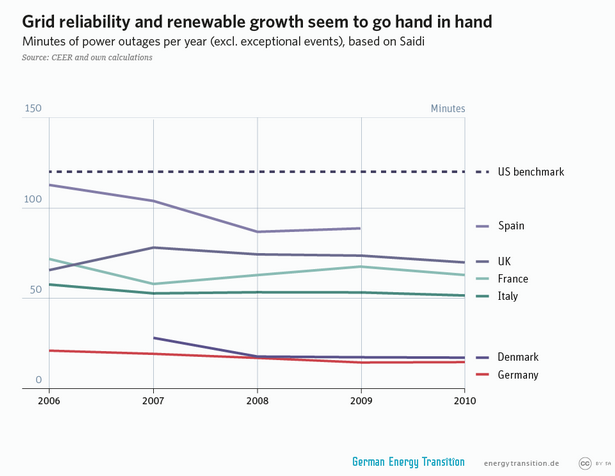
Grid graph German Energy TransitionLast Friday Germany’s grid regulator released the 2013 data for grid reliability, and the figures have renewable energy advocates crowing. The latest numbers (released in German) reveal no sign of growing instability despite record levels of renewable energy on the grid — 28.5 percent of the power supplied in the first half of 2014. In fact, Germany’s grid is one of the world’s most reliable. Continue reading “Germany’s Grid: Renewables-Rich and Rock-Solid”

NASA Launches its First Carbon-Tracking Satellite

It’s been a rough birthing process for NASA’s Orbiting Carbon Observatory (OCO) satellite program, which promises global tracking of carbon dioxide entering and leaving the atmosphere at ground level. Five years ago the first OCO fell into the Antarctic Ocean and sank, trapped inside the nose cone of a Taurus XL launch vehicle that failed to separate during launch. The angst deepened yesterday when NASA’s Jet Propulsion Laboratory (JPL) scrubbed a first attempt to launch a twin of the lost $280-million satellite, OCO-2, after sensors spotted trouble with the launch pad’s water-flood vibration-damping system less than a minute before ignition.

Continue reading “NASA Launches its First Carbon-Tracking Satellite”

Renewables to Dethrone Nuclear Under French Energy Plan

After months of negotiation, the French government has unveiled a long-awaited energy plan that is remarkably true to its election promises. The legislation’s cornerstone is the one-third reduction in the role of nuclear power that President François Hollande proposed on the campaign trail in 2012.

Under the plan, nuclear’s share of the nation’s power generation is to drop from 75 percent to 50 percent by 2025, as renewable energy’s role rises from 15 percent today to 40 percent to make up the difference. That is a dramatic statement for France, which is the world’s second largest generator of nuclear energy, after the United States. France has a globally-competitive nuclear industry led by state-owned utility Electricité de France (EDF) and nuclear technology and services giant Areva. Continue reading “Renewables to Dethrone Nuclear Under French Energy Plan”

Amid Blackouts, India’s New Leader Vows 24-7 Power for All

Blackouts this week in New Delhi and surrounding states are providing a dramatic backdrop for a bold promise by India’s new prime minister, Narendra Modi, whose Hindu nationalist party swept to power in a landslide election last month. As a scorching heatwave drove power consumption beyond the grid’s capacity, Modi’s government vowed to deliver “round-the-clock power for all by 2022,” reports the Wall Street Journal.

That will be an awesome task. Nearly one-quarter of India’s 1.26 billion citizens lack grid access. And India’s utilities have struggled to keep up with demand from those who are connected. Power cuts are frequent. Continue reading “Amid Blackouts, India’s New Leader Vows 24-7 Power for All”