Floating Wind Turbines Headed for Offshore Farms

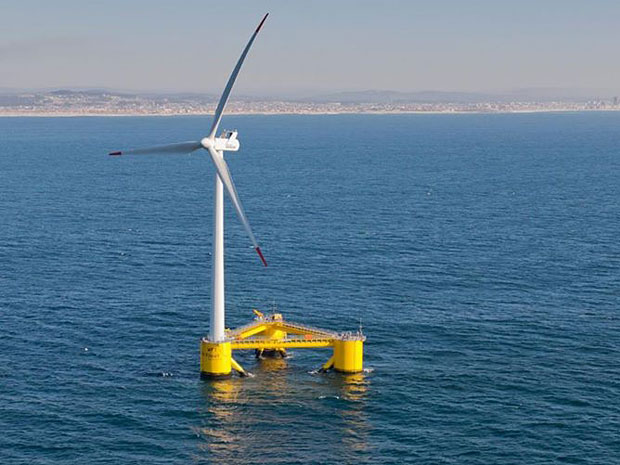
PrinciplePower.WindFloatFloating wind power is no longer science fiction. Promising results from five test platforms operating worldwide—including three in Japan—are turning into project plans for a first generation of floating wind farms. Industry analyst Annette Bossler, who runs Bremen, Maine-based Main(e) International Consulting, predicts that the number of test platforms will nearly double over the next two years and that commercialization is within site. “By 2018-2019 you will start to see the first really large-scale commercial use of floating platforms,” predicts Bossler.

Putting wind turbines on offshore platforms akin to those developed for the petroleum industry provides a means of exploiting high-quality offshore winds—which are stronger and more consistent than onshore winds—in waters too deep for today’s bottom-fixed foundations. Continue reading “Floating Wind Turbines Headed for Offshore Farms”

Capturing Carbon is One Thing. Keeping It Down is Another.

The IPCC recently stated that failure to deploy technology to capture carbon emissions from coal would double the cost of stopping climate change. Two coal-fired power plants nearing completion in Saskatchewan and Mississippi will be the first in the world to actually prove the technology, capturing their CO2 emissions and store that bolus of greenhouse gases underground. You can learn how they will do it in my latest for Technology Review. However, one point dropped from that story bears stressing. Part of what makes the extra cost of carbon capture feasible for these plants is that they have buyers for their CO2: oilfield operators who will use the stuff as a solvent to loosen up petroleum stuck in aging oil wells. That means the CO2 may not be permanently trapped underground warns Sarah Forbes, a carbon capture expert at the Washington-based World Resources Institute. In Canada ensuring CO2 stays underground is urgent, according to Robert Watson, CEO of SaskPower, the utility completing the coal-fired power plant in Saskatchewan. Watson told me that the oilfield operator taking his plant’s CO2 must ensure that any CO2 that comes back to the surface with produced oil is recycled back underground: “They’re going to have to assure the government that they can account for all of the CO2 they use all of the time.”

Seattle’s Bullitt Center Shines

The designers of Seattle’s Bullitt Center have overachieved. The designers set out to demonstrate that a six-story office building could generate all of the energy it needs, but after one year of operation, it is sending a sizable energy surplus to the local power grid, according to data released by its developer, the Bullitt Foundation. Consumption is simply far lower than what its architects and engineers projected for the 52,000-square-foot building. Instead of using 16kBtu per square foot—half the energy-use intensity (EUI) of Seattle’s best-performing office building—consumption during its first year was just 10kBtu/sf …read on at Architectural Record

Time to Rightsize the Grid?

Does Size Matter Source CarrerasLast week a team of systems scientists known for counter-intuitive insights on power grids delivered a fresh one that questions one of the tenets of grid design: bigger grids, they argue, may not make for better grids. University of Iowa electrical engineering professor Ian Dobson and physicists David Newman and Ben Carreras make the case for optimal sizing of power grids in last week’s issue of the nonlinear sciences journal Chaos.

In a nutshell, the systems scientists use grid modeling to show that grid benefits such as frequency stabilization and power trading can be outweighed by the debilitating impacts of big blackouts. As grids grow larger, they become enablers for ever larger cascading blackouts. The Northeast Blackout of 2003 was a classic case. From a tripped line in northern Ohio, the outage cascaded in all directions to unplug more than 50 million people from western Michigan and Toronto to New York City. Continue reading “Time to Rightsize the Grid?”

Sniffing Gas: White House Taps ARPA-E to Boost Methane Detection

This month’s issue of IEEE Spectrum spotlights methane emissions overlooked by the U.S. EPA’s official inventory, and the satellite-based detector launching next year to map this “missing methane.” Last week the White House acknowledged EPA’s missing methane problem, and laid out a strategy to combat it. While promising to improve EPA’s inventory, including more use of top-down methane measurement, the White House also promised federal investment in ground-based methane sensing to plug leaky natural gas systems thought to be the source of much of the missing methane. Action can’t come soon enough according to the Intergovernmental Panel on Climate Change (IPCC), which on Monday unveiled its latest climate assessment. The IPCC said “widespread and consequential” impacts are already visible and world leaders have only a few years to change course to avoid catastrophic warning. Methane is a major contributor according to the scientific body, which deems methane to be up to 44 percent more potent as a warming agent than previously recognized. Continue reading “Sniffing Gas: White House Taps ARPA-E to Boost Methane Detection”

Satellites and Simulations Track Missing Methane

In the April 2014 issue of IEEE Spectrum:

Methane emissions from oil and gas extraction, herding livestock, and other human activities in the United States are likely 25 to 75 percent higher than the U.S. Environmental Protection Agency currently recognizes, according to ameta-analysis of methane emissions research published recently in Science. While experts in remote sensing debate the merits of this and other recent challenges to the EPA’s numbers, definitive answers are already on order via a high-precision Earth observation satellite to be launched next year.

The intensifying methane emissions debate has profound implications for climate and energy policy. Natural gas consumption is rising, and methane’s global warming impact is more than 30 times as much as that of carbon dioxide, molecule for molecule, and second only to carbon dioxide’s in today’s net climate impact …

click to read on

Minnesota Finds Net Metering Undervalues Rooftop Solar

Utilities should be paying more for their customers’ surplus solar power generation according to a solar pricing scheme approved by Minnesota’s Public Utility Commission last month and expected to be finalized in early April. Minnesota’s move marks the first state-level application of the ‘value of solar’ approach, which sets a price by accounting for rooftop solar power’s net benefits, pioneered by the municipal utility in Austin, TX.

Minnesota is one of 43 U.S. states that requires utilities to pay retail rates for surplus solar power that their customers put on the grid. Utilities across the U.S. are fighting such net metering rules, arguing that they fail to compensate the utility for services that their grid provides to the distributed generator. So last year pro-solar activists and politicians in Minnesota called the utilities’ bluff, passing legislation tasking the state’s Department of Commerce with calculating the true value of rooftop solar power. Continue reading “Minnesota Finds Net Metering Undervalues Rooftop Solar”