Listening to Building Occupants

The stats on occupant comfort are disappointing, and green buildings are no exception. Consider, for example, heating and cooling performance. Thermal-comfort standard standards stipulate that such systems should satisfy at least four out of five occupants. “Very few buildings actually perform that well,” according to John Goins with the Center for the Built Environment (CBE) at UC Berkeley. Out of the 609 buildings in CBE’s database, only 13 percent meet ASHRAE’s performance threshold; among those that are LEED-certified, 20 percent make the grade. There is increasing recognition that all that discomfort may be translating into a lot of wasted energy. Goins estimates that the average office building wastes 4 percent of its energy just by cooling and heating more than occupants want. The indirect impact could be even bigger when one considers how disgruntled occupants—who in most buildings lack an effective channel for requesting change—fight back against the machine. They may block air vents or plug in space heaters to combat excessive air-conditioning…

Excerpted from the May/June edition of GreenSource Magazine. Read the story at GreenSource.

Germany Jumpstarts the Supergrid

05OLGermanGridMap
Power Core: Spectrum’s infographic take on Germany’s HVDC transmission plans

New developments in high-voltage DC electronics could herald an epic shift in energy delivery

By Peter Fairley

Stuttgart is one of the last places you’d expect to find in a power pinch. This south German city’s massive automotive plants run 24-7 without a hiccup, efficiency measures have held industrial power consumption flat, and solar panels flash from atop its major buildings. But now all that is at risk. The country’s accelerated shift from nuclear power and fossil fuels to renewable resources, such as wind and solar, has exposed a huge gap in its transmission capacity. If they are to survive, Stuttgart’s factories—and power consumers across southern Germany—will need to import a lot more power from the north, and Germany’s grid is already at capacity.

To fill the gap, Germany is considering an aggressive plan that would push high-voltage direct current, or HVDC, from its conventional position on the periphery of AC grids to a central role. The primary reason is simple: For the first time, HVDC seems cheaper than patching up the AC grid. But Germany’s transmission planners also have another motivation: They want to provide as much performance and reliability as they can to an AC grid that’s already strained by excess wind power. For that, they’re considering implementing power electronics that are capable of doing something that’s never before been done on a commercial line: stop DC current in milliseconds flat.

Germany’s plan could mark the beginning of something much bigger: a “supergrid” of inter connected DC lines capable of transporting electricity on a continental scale, ferrying energy from North Sea turbines, dams in Scandinavia, or Mediterranean solar farms to wherever demand is greatest at that moment…

Published in the May issue of IEEE Spectrum. Read the story at Spectrum.com.

Building-in a Force of Nature

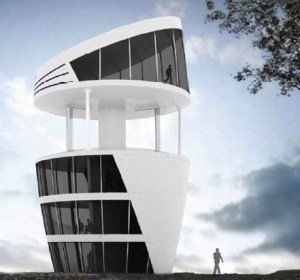
Turbine House: Design by Michael Pelken & Thong Dang
Turbine House: Michael Pelken & Thong Dang’s residence with horizontal-axis wind turbine

As design teams work toward harnessing air flows around buildings, they are producing some intriguing structures. But just how viable is wind power as a source of on-site renewable energy?
By Peter Fairley

Wind power is the fastest-growing source of megawatts thanks to the jumbo-jet-sized turbines sprouting en masse worldwide. But it also has a significant presence in the city, where gusts regularly send umbrellas to landfills. Rather than considering it a nuisance, architects increasingly view urban wind as a renewable resource for on-building power generation.

Building-integrated wind power (BIWP)—wind turbines mounted on or incorporated within an occupied structure—may lack wind farms’ economies of scale. But like the leading source of on-building renewables—photovoltaics (PVs)—wind turbines offer some advantages in architectural applications. No roads get cut through wilderness to erect towers, and they deliver electricity without power lines and transmission losses. Wind turbines are also attractive to designers and clients looking to express a commitment to sustainability.

Such benefits provide potential for dramatic growth, says mechanical engineer Roger Frechette, principal in the Washington, D.C., office of Interface Engineering. “If there’s data showing that BIWP works and testimony that it’s a good thing to do, there will be an explosion,” he predicts…

Published in the April 2013 issue of Architectural Record Magazine. Read the whole story.

Supergrid Technology Beats Expectations

HVDC breaker Source AlstomAn industrial research consortium that is a who’s-who of the European power industry says development of technologies to produce high-voltage DC (HVDC) supergrids accelerated in 2012 — “surpassing expectations.” The assessment comes in the supergrids technology roadmap updated earlier this month by Friends of the Supergrid, whose members include power equipment suppliers such as Siemens, ABB and Alstom, as well as transmission system operators and renewable energy developers.

Summarizing the conclusions of an expert group within the International Council on Large Electric Systems — better known as CIGRE, its French acroynm — the Friends of the Supergrid says there is now no doubt as to the feasibility of HVDC networks ferrying renewable energy resources from wherever they are in surplus to wherever they are needed: “CIGRE Working Group B4–52 considered this question, specifically whether it was technically and economically feasible to build a DC Grid, and the answer was yes.” Continue reading “Supergrid Technology Beats Expectations”

Ohio State Gets a Bead on Cleaner Coal

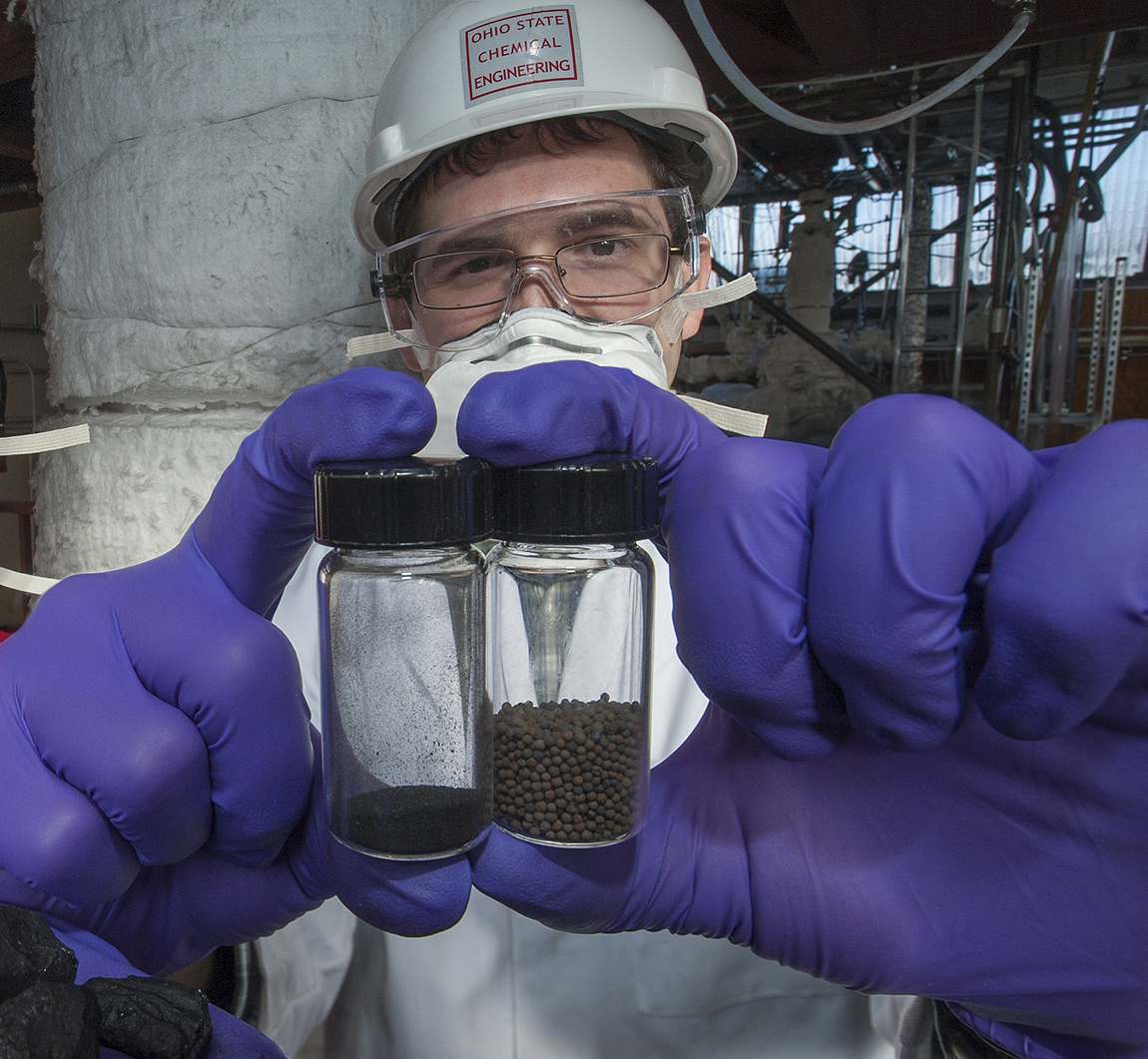
OSU cleaner coalOhio State University claims to have reached a milestone towards proving a radical new take on oxyfuel power generation that could push down the cost of zeroing out coal’s large and growing carbon footprint. Project director Liang-Shih Fan, director of OSU’s Clean Coal Research Laboratory, revealed recently that their reactor had operated for 203 continuous hours last fall and captured 99 percent of the resulting CO2.

Their run is the longest to date for a “chemical looping” reactor consuming coal, according to the U.S. Department of Energy, and in Fan’s view it means the technology is ready for testing at pilot scale.

OSU’s chemical looping reactor (the centerpiece for a $7.1 million ARPA-E project that began in 2010) is so named because it circulates its components in a continuous loop in a manner that controls the interaction of pulverized coal and oxygen to prevent ignition of the coal. “We carefully control the chemical reaction so that the coal never burns—it is consumed chemically, and the carbon dioxide is entirely contained inside the reactor,” says Fan. Continue reading “Ohio State Gets a Bead on Cleaner Coal”

AC/DC 101

Much of your editor’s reporting in 2012 focused on the re-emergence of direct current or DC power — through pieces in IEEE Spectrum, Technology Review, and Power & Energy Magazine — and there is more in the works. Some of you, however, may still be wondering what DC power is and how it differs from the alternating current or AC power flowing from most electrical sockets. So here are some answers.

The questions were posed by Andrew Huang, a 9th grader at High Technology High School in Lincroft, NJ, who recently interviewed me for a history project on Nikola Tesla and Thomas Edison’s late-19th Century War of Currents. (Check out The Oatmeal’s Why Nikola Tesla was the greatest geek who ever lived for a rather tilted yet entertaining take on a key combattant in this epic tech tussle.)

What are some differences between the physics of AC and DC? Continue reading “AC/DC 101”

The Debate: Fracking and the Future of Energy

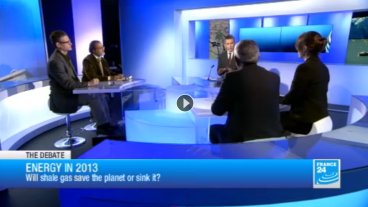
France 24 Energy in 2013 DebateThe Arctic is melting faster than predicted. Is now the time to shut down the low-carbon nuclear power plants in France — the 20th Century’s staunchest proponent of nuclear energy? Is natural gas produced via hydraulic fracturing or ‘fracking’ a gift that is buying time for a transition to renewable energy or a curse that reinforces fossil fuel dependence? Will carbon belching heavyweights such as the U.S. and China ever get serious about cleaning up their energy systems?

Such questions are top order in France, whose President kicked off a Grand Débat on energy this month Continue reading “The Debate: Fracking and the Future of Energy”