EC Sees Heavy Pricetag to UK Nukes Plan

UK prime minister David Cameron at Hinkley Point

Government incentives for a pair of proposed nuclear reactors could cost U.K. taxpayers as much as £17.62 billion, thus exceeding the reactors’ projected cost. The EC figure is a preliminary estimate included in an initial report to London published on Friday by European Commission competition czars. The letter notifies the British government that—as we predicted in December—Brussels is launching a formal investigation to assess whether the subsidies violate European state aid rules.

The preliminary findings suggest that the U.K. and E.C. are on a collision source. As the Financial Times summed it up this weekend: “The severity of [the EC’s] initial concerns will cast a shadow over government hopes to win approval for the deal.”

Continue reading “EC Sees Heavy Pricetag to UK Nukes Plan”

Broken Bats: Wind Power and the Damage Done

Last year, IEEE Spectrum profiled an ultrasonic alert for wind farm operators designed to let them know when bats are nearing their turbines. The potentially bat-saving technology can’t be ready soon enough according to this week’s issue of the journal Bioscience. University of Colorado ecologist Mark Hayes estimates that at least 600 000 and possibly more than 900 000 bats were killed by wind turbines last year in the U.S.

Hayes’ report is a statistical reassessment of data on bat carcasses found at wind turbine sites. His figure lends credence to a March 2013 mortality estimate of 880 000 deaths per year by Sacramento-based ornithologist and consultant Shawn Smallwood. That figure was well beyond previous estimates, which had ranged as low as 33 000. “My estimates, using different methods and data, bracket Smallwood’s 888 000 estimate,” writes Hayes in an e-mail to Spectrum. Continue reading “Broken Bats: Wind Power and the Damage Done”

Counting the Sins of Chinese SynGas

Heavy water use, threats of tainted groundwater, and artificial earthquakes are but a sampling of the environmental side effects that have tarnished North America’s recent boom in natural gas production via hydraulic fracturing or fracking. No surprise then that in European countries such as the U.K. that are looking to frack for cheap domestic gas, the environmental protesters often arrive ahead of the drill rigs.

But countries seeking fresh gas supplies could do far worse than fracking. So say Duke University researchers who, in today’s issue of the research journal Nature Climate Change, shine a jaundiced spotlight on China’s plans to synthesize natural gas from coal. Nine synthetic gas plants recently approved by Beijing would increase the annual demand for water in the country’s arid northern regions by over 180 million metric tons, the Duke team concluded, while emissions of carbon dioxide would entirely wipe out the climate-cooling impact of China’s massive wind and solar power installations. Continue reading “Counting the Sins of Chinese SynGas”

Blackouts Ahead on Our Unruly Power Grids

ImageTen years after the Northeast Blackout that shut off power in seven U.S. states and Ontario cascading power grid failures remain a fact of life. And, as I argue today on Spectrum’s Energywise blog, engineers are little closer to predicting and preventing them.

The good news is that engineers are beginning to accept that they have a complex system problem on their hands — an insight that could help them find solutions.

Such understanding was in short supply one year after the Northeast blackout, as I discovered with the publication of my August 2004 cover story for IEEE Spectrum commemorating its one-year anniversary profiling the apparent mathematical inevitability of cascading power-system failures. That message raised a firestorm of protest from engineers who saw their can-do creed under attack.

Today, however, the black sheep who spotted the tell-tale signs of a chaotic self-organizing system in blackout databases have come in from the cold. The University of Wisconsin’s Ian Dobson, for example, says he is having success attracting grants — no mean feat for interdisciplinary research targeting the uber-unsexy field of power transmission. And the IEEE set up a task force on cascading failures (with Dobson at the table).

One obvious cause for rising consciousness is the fact that blackouts just keep happening Continue reading “Blackouts Ahead on Our Unruly Power Grids”

Vertical Farming Grows Up

Community-gardening advocates have sold urban farming as a sustainable local alternative to industrial-scale farming and as an educational platform for healthier living. And municipalities are buying in, adopting urban ag to transform vacant lots into productive civic assets. In the last two or three years, however, entrepreneurial urban farmers have opened a new frontier with a different look and operating model than most community gardens. Their terrain is above the ground, not in it. Working with help from engineers, architects, and city halls, they have sown rooftops and the interiors of buildings worldwide. “There’s a lot of activity right now, and there is huge potential to do more of it,” says Gregory Kiss, principal at Brooklyn-based architecture firm Kiss + Cathcart. Continue reading “Vertical Farming Grows Up”

Tidal Power’s Surprising Comeback

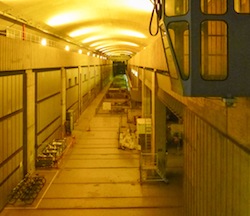
Below Sea Level: LaRance’s turbine hall

Can a U.K. firm’s novel plant design defuse environmental concerns?
By Peter Fairley

Fifty years ago this July, Électricité de France began sealing off Normandy’s La Rance estuary from the sea. After three years of work, the world’s first large-scale tidal power plant was born. The station operates still, generating up to 240 megawatts of renewable power as the twice-daily tides force water in and out of the estuary through the hydroturbines seated within its 750-meter-long seawall. But the three years of construction were tideless, which devastated La Rance’s ecosystem, killing off nearly all of its marine flora and fauna; it would take another decade for the estuary to bounce back. Due in part to that ecological hangover, La Rance would remain the only tidal station of its scale for nearly five decades …

Excerpted from the July 2013 edition of Spectrum Magazine. Get the full scoop via Spectrum.

German Parliament OKs Bold HVDC Grid Upgrade

Germany’s bold transmission plan is a go. The Bundesrat, Germany’s senate, has accepted the plan’s enabling legislation forwarded to it by the Bundestag (Germany’s parliament), according to the authoritative German Energy Blog. There is every reason to expect that the plan’s core element — four high-voltage direct current or HVDC transmission lines profiled by Spectrum last month — will get built.

That is good news for Germany’s grid and those of its neighbors. All are straining to manage powerful and variable flows from the wind turbines and solar panels that provided 12 percent of Germany’s power generation last year.

Elements of both the HVDC system design and the legislation should ease construction of the HVDC systems. On the design side, Germany’s transmission system operators have specified advanced converters whose ability to arrest and clear DC line faults will reduce the risk of running overhead lines. This means the HVDC lines can use existing rights-of-way used by AC lines. In fact, they can be hung from the same towers. Read the May 2013 story for extensive discussion of the advanced modular multilevel converters.

The enabling legislation, meanwhile, will simplify line permitting by making a federal court in Leipzig the only forum for legal disputes concerning the projects. Separate legislation passed by the Bundesrat and Bundestag makes  Germany’s federal networks regulator, the Bundesnetzagentur or BNetzA, the sole permitting authority for power lines that cross Germany’s state or national borders. These measures — for better or worse — cut out state-level officials that face greater pressure from local project opponents and may be more sympathetic to their concerns.

Add it all up and Germany is en route to become the first country with HVDC lines playing a critical role at the core of their power grid. It is arguably the first real challenge to AC’s century-plus reign as the top dog in power transmission since DC-advocate Thomas Edison lost the War of Currents. Tesla and Westinghouse may just be rolling over.

This post was created for Energywise, IEEE Spectrum’s blog on green power, cars and climate