 An advisory body for Japan’s powerful Ministry of Economy, Trade and Industry (METI) has endorsed a tripling of the capacity to pass power between Japan’s otherwise estranged AC power grids: the 50-hertz AC grid that serves Tokyo and northeastern Japan, and the 60-hertz grid that serves western Japan. This frequency divide hascomplicated efforts to keep Japan powered since the March 2011 earthquake and tsunami — a task that keeps getting harder with the inexorable decline in nuclear power generation (at present just one of Japan’s 54 reactors is operating). Continue reading “Electrical Upgrade Prescribed for Japan’s Crimped Grid”
How Canada Should Return Obama’s Oil Pipeline Punt
 Late last week President Barack Obama deferred consideration of the Keystone XL oil pipeline, designed to ship Alberta petroleum to the Gulf Coast, until after next year’s U.S. elections. Obama’s move immediately sparked vows in Canada to redirect crude exports to Asian markets less angst-ridden by the environmental impacts associated with tapping Alberta’s tough, tarry petroleum. A smarter strategy would be to reduce those impacts, starting with the black mark that brought Keystone XL to national attention: oil sands crude’s bloated carbon footprint. Continue reading “How Canada Should Return Obama’s Oil Pipeline Punt”
Is Gas Fracking Inducing Earthquakes?

Fracking for natural gas, whereby gas-trapping rock formations are blasted open with high-pressure water and chemicals, has prompted serious concerns over the safety of groundwater supplies. But another risk is gaining profile: the potential for inducing nerve-rattling microseismicity or, potentially, unleashing a quake of truly destructive magnitude. Like the magnitude-5.6 quake that rocked Oklahoma last weekend.
As I documented for Spectrum magazine this spring, human activity can and does induce earthquakes. Continue reading “Is Gas Fracking Inducing Earthquakes?”
Beacon Power Hits a Speed-bump, but it’s No Solyndra
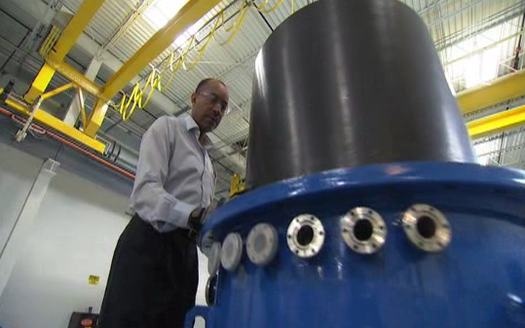 Flywheel energy storage developer Beacon Power filed for bankruptcy last weekend, prompting immediate comparisons to infamously failed solar manufacturer Solyndra. But while both firms used millions of dollars in federal loan guarantees to expand their businesses, Beacon Power — which Spectrum profiled this summer — has working assets and a good shot at restructuring and carrying on. Continue reading “Beacon Power Hits a Speed-bump, but it’s No Solyndra”
Digging into Miami’s Turkey Point Nuclear Power Station
The Society of Environmental Journalists’ Miami conference energy tour forged forward today, pursuing better understanding of South Florida’s energy options in spite of a disinvitation by local nuclear reactor operator Florida Power & Light. Continue reading “Digging into Miami’s Turkey Point Nuclear Power Station”
Chinese Bullet Trains’ Worrisome “Black-box” Controls
In August we brought you disquieting news that Hollysys Automation — the supplier of a control system implicated in China’s deadly bullet-train collision this summer — also provides controls for China’s nuclear reactors (which are multiplying just as fast as its high speed rail lines). The Hollysys story now looks darker after informed speculation reported in the Wall Street Journal that the company may not fully comprehend how the control systems work. Continue reading “Chinese Bullet Trains’ Worrisome “Black-box” Controls”
Notorious Grid Bottleneck Spawns Western Blackout
 The blackout that squelched power flows to nearly 5 million residents of Arizona, California and northern Mexico last night and shut down California’s San Onofre nuclear power plant may be the latest sign of strain in an outdated U.S. power grid. The incident began during maintenance at a substation in Yuma, Arizona that lies at the center of a sclerotic section of the grid between Phoenix and Tucson—one long recognized as critically congested and thus at heightened risk of failure. Continue reading “Notorious Grid Bottleneck Spawns Western Blackout”
 Peter Fairley