
Paris Puts the Bicyclette First

Paris threw open nearly one thousand one-way streets to two-way traffic this week — that is, for travelers willing to pedal. Whereas other cities such as Boulder and London have created a handful of designated counterflow bike lanes, the new rules taking effect in Paris this week allow bicyclists to cycle upstream against automobile traffic within all of the city’s 30 kilometer-per-hour zones.

Generally speaking these 30-kph zones comprise knots of narrow streets serving primarily neighborhood traffic. But Paris city hall expects a big impact for cyclists. According to Paris planners the move will expand route options for cyclists and may also (seemingly against all odds) improve safety. The mayor’s office notes that on some streets cyclists heading upstream will be further from parked cars, minimizing their risk of ‘winning a door prize’ from innattentive automobile users stepping out onto the roadway. Continue reading “Paris Puts the Bicyclette First”
Europe and Turkey’s High-Power Embrace

Ethnic and economic tensions may have stalled Turkey’s longstanding bid to join the European Union, but electrical circuits can be color blind. As of September the alternating current on the Turkish power grid will flow in synchrony with Continental Europe’s, according to the European Network of Transmission System Operators for Electricity (ENTSO-E), which took control of Europe’s power grids last summer.

Yesterday’s announcement means that Turkey can trade electricity with Europe and benefit from the bigger grid’s stability, in turn helping to stabilize the lines in neighboring Bulgaria and Greece. The link will run for at least one year, with power exchanges ramping up in stages.

Turkey’s integration provides hope for would-be regional developers in the Mediterranean, who face rising protectionism, ethnic tensions, and seemingly endless diplomatic bombshells from Israel and the Palestinian territories. The Middle East troubles caused the Union for the Mediterranean organized by French President Nicolas Sarkozy to delay a second summit scheduled to convene in Barcelona yesterday until November, according to the AP. Continue reading “Europe and Turkey’s High-Power Embrace”

BP Under Pressure to Tighten Spill Cap

How is one to bridge the gap between BP’s latest oil collection stats and visual reality?
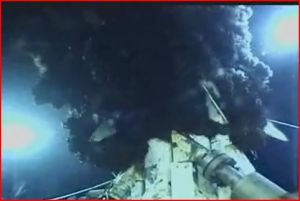
The oil and gas giant claims to be sucking crude straight off its stricken mile-deep wellhead and pouring it into the drillship Enterprise at a rate of 11,000 barrels per day, thanks to a cap and tube installed on Friday. And, yet, video feeds from ROVs present a plume of oil and gas that looks as angry as ever, gushing plenty more black goop destined for dispersal into the Gulf of Mexico’s already beleaguered  ecosystems.

“Clearly alot of people are looking at it and trying to understand what does this mean,” acknowledged BP senior vp/exploration Kent Wells of the top-rated video images during in a media briefing this afternoon. Continue reading “BP Under Pressure to Tighten Spill Cap”

BP Installs Crude Containment Scheme #4

BP is capturing oil at a rate of 1,000 barrels-per-day via its latest containment scheme — a cap and new riser installed on its gushing Gulf spill last night — according to Federal response coordinator and Coast Guard Admiral Thad Allen. But video feeds confirm that far more crude is still spilling into the sea from under the cap — at least 11,000 barrels per day if one subtracts 1,000 bpd from the minimum flow estimate of the Deepwater Horizon spill released by a federal task force last week.

BP Americas chief operating officer Doug Suttles told a media briefing this morning that the cap (BP containment scheme #4 by Carbon-Nation’s count) could ultimately capture over 90% of the leak. Suttles and his company have proved unreasonably optimistic before, and could be once again. Continue reading “BP Installs Crude Containment Scheme #4”

BP’s Name is Mud (which today counts as good news)

BP Americas chief operating officer Doug Suttles says the ‘top kill’ operation initiated this morning to stanch the Gulf oil spill is “performing as expected” and could be completed within 24 hours. But U.S. Coast Guard Rear Admiral Mary Landry, who spoke with Suttles at an early-evening media briefing, took a more reserved tone. “I do not want to express optimism until I know for sure that we’ve secured the well and that the leak has stopped,” says Landry.
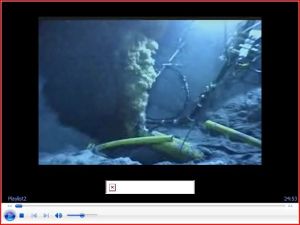
By 5pm Houston time on Wednesday BP had already pumped over 7,000 barrels of heavy drilling mud into the damaged blowout preventer on the wellhead created by the Deepwater Horizon rig whose destruction last month unleashed the spill. Much of that mud appears to be flowing up into the Gulf. Continue reading “BP’s Name is Mud (which today counts as good news)”

Facing Our Flow with BP’s Live Spill-Cam

Click image, then hit play (persistently) for live stream

For a look in the mirror that could inspire a car-free weekend, BP has made available a livestream feed of its uncontrolled oil spill over 5000-feet below the Gulf of Mexico’s increasingly oily surface. [You’ll need to hit play several times to get a peek at this very popular feed.] Government agencies and industry engineers have been viewing this feed for two weeks. BP made it accessible today to gasoline consumers and shareholders of the Gulf of Mexico ecosystem at the urging of Ed Markey, chair of the House Select Committee on Energy Independence and Global Warming and an advocate of fossil fuel-free energy and transportation. Continue reading “Facing Our Flow with BP’s Live Spill-Cam”

Life’s a ‘Paternoster’ (and then you fly)

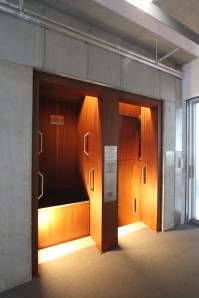
Solon SE’s new paternoster lift. Credit Kevin Matthews / ArchitectureWeek.

“Don’t leave the planet to the stupid.” The corporate tag line from German solar module manufacturer Solon SE screams: ‘We reject complacency’ (not to mention gentility). It’s a slap-in-the-face warning to expect the unexpected, so I was looking for something completely different when I visited Solon’s one-year old Berlin headquarters on an architectural tour of Germany last week. I was not to be disappointed. What I found is probably the first cyclic elevator system installed anywhere in decades.

No pressing a button and waiting for a lift with this modern incarnation of a late-19th-C elevator design! In a cyclic elevator a string of passenger cars run by in a continuous loop. One simply steps into one of the open cars scrolling up or down through its adjacent elevator shafts and takes off. To your weary Canadian correspondent, presently immobilized in Berlin by an angry planet, the hassle-free transport offered by Solon’s cyclic lift was a source of almost drunken pleasure.

Unfortunately, it may also be quite stupid (so to speak). Continue reading “Life’s a ‘Paternoster’ (and then you fly)”