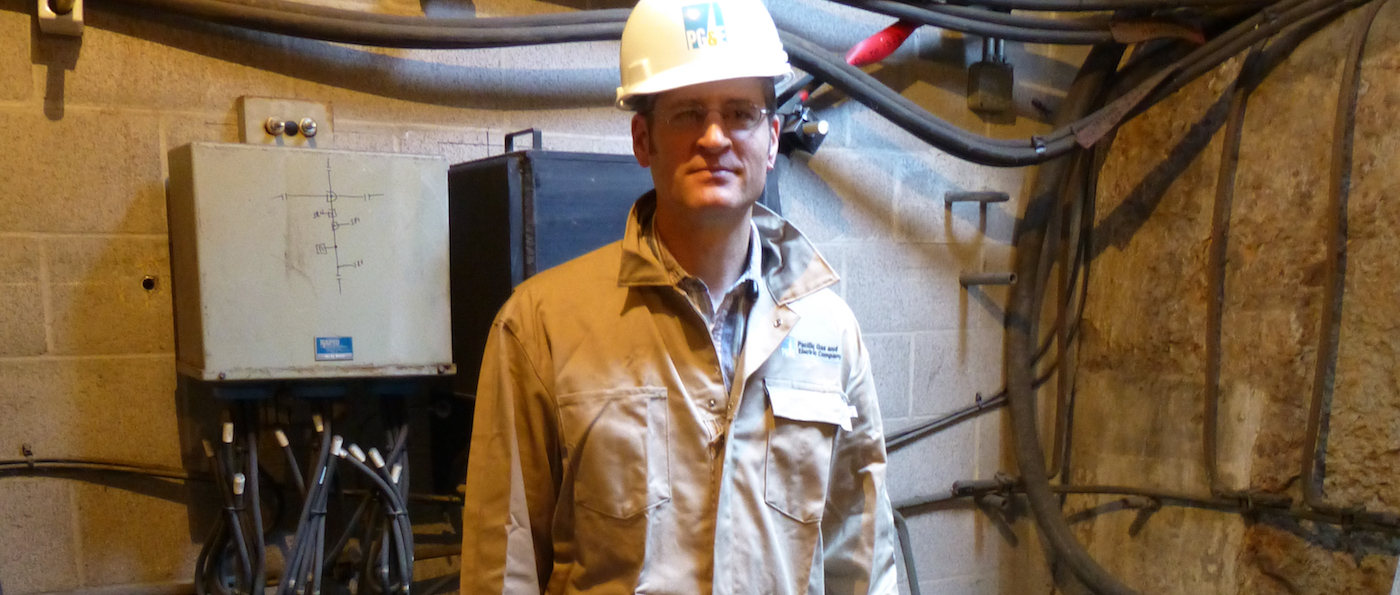
 A notorious economics joke has optimistic implications for solar energy and its decades-long dreams of matching the cost of the electricity now flowing on power grids — the vaunted grid parity that is most renewable energy advocates’ image of the singularity that will free us from climate change and the anti-democratic effects of centralized power. In the joke an economist, physicist and chemist are stranded, starving, on a remote island when a can of soup washes ashore. Continue reading “No Joke: Solar’s Energetic Lease on Life”
Fuel Cell Hype and Hopes
 Fuel cells deserved to hit the headlines this week, but not the way that it played out. The big splash came thanks to CBS News’ 60 MINUTES and heavy hyping of a stationary fuel cell developer emerging from stealth-mode development. More surprising, and of real significance, was a projection yesterday by Pike Research that fuel cell-equipped vehicles will go commercial in just 4 years.
The problem with Bloom Energy’s Bloom Box stationary fuel cell is that, despite 60 MINUTES’ assertion that it might be the holy grail to free Americans shackled to a coal-fired grid, the company has yet to deliver a product. Moreover, the technology is hardly new. Continue reading “Fuel Cell Hype and Hopes”
Buying a Car Without the Engine (or the fuel)
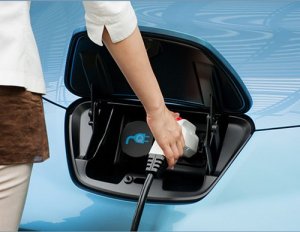
Carmakers have been toying with a novel marketing strategy to take the sting off the electric vehicle’s punishing price premium: selling EVs batteries-not-included. The idea is to lease the lithium batteries separately, shaving a third or more of an EV’s $30,000-plus package cost. Nissan poured some cold water on the idea last week but EV observers think the idea is just getting started, even for Nissan.
Nissan thinks car buyers are ready for its LEAF EV (see teaser ad above) but not for battery leasing. It closed out a pre-sale national tour of the LEAF with news that the compact will be sold or leased as a complete package. As I blogged for Energywise last month, the package includes installation of a home battery charger. Now we know buyers will own the battery too. “Based on the data we have, consumers prefer to buy the full car with batteries,” Nissan Americas chairman Carlos Tavares told the New York Times.
Greentech Media’s Michael Kanellos calls leasing a “conceptual leap” too far: “Imagine if you went to a car dealer today and they offered to sell you the car and lease the engine.” But his analogy may be missing a cog, if one considers the comparative cost of charging an EV versus fueling that internal combustion engine. Per mile, charging the EV will cost roughly a third the cost of gasing up. Imagine if you went to a car dealer and they proposed selling you five years’ worth of fuel up front! Continue reading “Buying a Car Without the Engine (or the fuel)”
WSJ Calls China’s Electric Bicycle Craze a Killer

“Because they are so silent, fast and heavy they’ve become a traffic menace,” says WSJ China correspondent Shai Oster in the video that accompanies his piece on e-bikes, unwisely shot while riding one through Beijing. Oster says this is why there is a “new backlash” against e-bikes, with various levels of Chinese governments trying to squelch the e-bike. What I see is ongoing harassment that China’s e-bike community has endured for the past 6-7 years.
Early on the official complaint was that rapid replacement of the lead acid batteries most Chinese e-bikes carry fueled pollution (According to the Times a typical Chinese e-bike uses five lead batteries in its lifetime, each containing 20 to 30 pounds of lead). Today the complaint is that deaths have “soared” from 34 in 2001 to over 2000 in 2007 (not too surprising given that e-bike use was exploding exponentially over that period). My take — reinforced by alternative-transport and urban design activists in China — is that these complaints are a smokescreen for car-oriented industrial and urban planners. Continue reading “WSJ Calls China’s Electric Bicycle Craze a Killer”
GM’s Feisty and Embarrassing Vice Chairman
 “Once again, Bob won’t get the job.” That was the definitive prediction this weekend by Automotive News, the industry’s journal of record, on GM vice chairman Robert Lutz’s chances of being named CEO [link may require subscription]. Yesterday they were proven right when GM’s acting CEO, GM chairman Ed Whitacre, announced that he would continue permanently in the position. What they got wrong, however, was why Lutz was unfit for the top job.
Automotive News let Lutz speak for himself, arguing that at 78 years old he was too “geriatric” for an ailing automaker in need of rejuvenation. That logic flies in the face of Whitacre’s logic that what GM needs most, after ousting two CEOs in 2009, is stability. After all, Lutz has served in top product development and marketing roles for GM since 2001, and previously held top jobs at Chrysler and Ford.
What makes Lutz the wrong man at the wrong time is that he rejects the intensifying concerns for sustainability that now drive automotive markets and innovation worldwide. At the Detroit Auto Show last week Lutz held forth on climate science with the Sydney Morning Herald, explaining that Earth is being cooled by a dearth of solar flares rather than warmed by greenhouse gases from cars and other fossil fuel-burners:
“All I ever say is look at the data, look at the empirical evidence…Katrina was six years ago and we have yet to have the next hurricane.” Continue reading “GM’s Feisty and Embarrassing Vice Chairman”
Nissan Joins the EV Charging Market
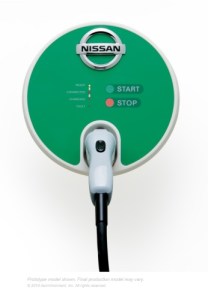 Nissan doesn’t plan to leave buyers of its battery-powered LEAF sedan, which goes on sale in December, to their own devices when it comes to vehicle charging. Nissan will offer a home-charging program to LEAF buyers which will start with an electrician visiting the buyer’s home to, among other things, check the quality of their electrical service, according to an announcement this week at the Detroit Auto Show.
Electric vehicle enthusiasts may poo-poo the practical and technical challenges posed by home-vehicle charging — witness the hostile comments to my coverage of concerns voiced by California such as PG&E and Southern California Edison that clusters of EVs could burn out block-level power circuits (see “Speed Bumps Ahead for Electric Vehicle Charging”). But Nissan, like the utilities, is leaving nothing to chance.
The idea is to make sure that infrastructure-induced challenges don’t detract from the on-street excitement of driving an EV, according to a Nissan spokesperson quoted in a BNET post from the Detroit show today by New York Times clean-car blogger Jim Motavalli:
“We didn’t want to say, ‘Here’s your car, now you’re on your own.”
— Mark Perry, a Nissan spokesman handling the Leaf introduction
Tata and Berkeley Frigid to MDI’s Air Cars
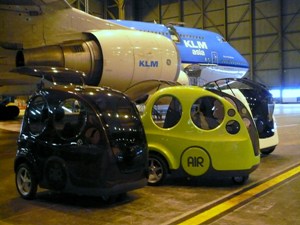
Indian carmaker Tata Motors is voicing concerns about the range and durability of the compressed-air powered minicar technology that I critically analyzed for IEEE Spectrum this month (see “Deflating the Air Car”). Tata Motors invested in French air car developer Motor Development International (MDI) in early 2007, but yesterday Mumbai-based news source DNA reported that Tata sees ongoing issues with MDI’s technology.
Tata already sells vehicles that run on gasoline, compressed natural gas, and liquid petroleum gas and is launching a battery-powered sedan in Europe. However, Tata Motors’ vice-president for engineering systems S Ravishankar apparently told DNA Money that the company’s efforts to add air-powered cars to its fleet are hung up by range limitations:
“Air is not a fuel, it is just an energy carrier. So a tank full of air does not have the same energy as a tank full of CNG. Any vehicle using only compressed air to run would face problems of range.”
When asked whether this means that “the ‘Air Car’ project [is] off?,” Ravishankar declined to comment. Instead, Ravishankar added that excessive cooling of the air car’s pneumatic engine is also presenting a challenge. Continue reading “Tata and Berkeley Frigid to MDI’s Air Cars”

