Low-Carbon Fuel Rules

California is about to add to its record of leadership on clean energy policy with its innovative Low-Carbon Fuel Standard that goes into effect January 1. We highlight the program and its likely impact on alternative energy sources for transportation today at MIT TechReview.com in “Low-Carbon Fuel Rules”. As the tagline states, “California is about to implement a standard to boost cleaner fuels and punish the rest.”

One point is that California’s LCFS may not deliver the knock-out blow to Canada’s carbon-intensive tarsands that many climate change activists continue to hope for. Gasoline and diesel fuel refined from the tarsands’ asphaltine bitumen may escape being banned if its producers emphasize energy efficiency according to UC Davis’ Daniel Sperling.

Another observation I’ll be following up is the cohesiveness of the biotech industry. In the face of regulatory innovations such as the LCFS that would disadvantage corn ethanol production and advantage cash-hungry innovators developing more carbon-smart advanced biofuels, the latter seem to be quietly defending the status quo.

Then there’s the California standard’s nuanced approach to diesel, which is not addressed in the TechReview piece but which Carbon-Nation spotlighted last summer. The short take is that the LCFS mandates separate and equal reductions in the carbon footprint of the gasoline and diesel fuels sold in California. That approach eliminates the possibility that diesel use will be incentivized as an alternative to gasoline. The reason? California regulators believe that even today’s ‘clean diesels’ release more than their share of soot, which is a major cause of premature mortality and also a potential contributor to climate change in its own right.

We explore the climate challenge and opportunity posed by soot in the September issue of Discover magazine. See “The Easiest Way to Fight Global Warming?”

add to del.icio.us : Add to Blinkslist : add to furl : Digg it : add to ma.gnolia : Stumble It! : add to simpy : seed the vine : : : TailRank

Could Mechanics Best Power Electronics in EVs?

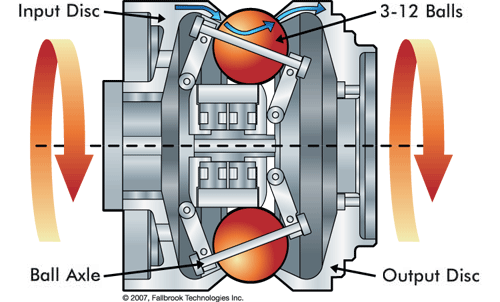
NuVinci CVT cutaway Credit Fallbrook TechnologiesCould smarter mechanical transmissions knock power electronics out of wind turbines, providing a cheaper and more efficient means of coupling the variable energy from ever-shifting winds to the regular waveform of AC power on the grid? They could according to my reporting in MIT’s TechReview today on Viryd Technologies’ bid to exploit continuously variable transmissions (CVTs). If mechanics reclaiming territory ceded to electronics sounds like a technological step backwards, here’s an even more heretical corollary: the same CVTs could also squeeze the power electronics out of electric vehicles (EVs).

That’s the argument put forward by Rob Smithson, CTO for Viryd parent company Fallbrook Technologies and one of the inventors of its clever CVT (dubbed NuVinci in a tip-of-the-hat to the Italian polymath who first dreamed up the CVT concept). “If you look at cost in large car-replacement type EVs today, the cost gets dominated by the battery pack and the motor controls. There’s an opportunity to knock out one of those two with an infinitely variable transmission,” insists Smithson.

Most EV elaborations today, says Smithson, rely on the electric motor to meet the entire dynamic performance envelope of the vehicle, from vehicle speed to torque demand — a feat made possible by hefty power electronics. Swap in a CVT to handle the vehicle speed, however, and the electric motor can operate as a fixed speed variable torque device. “When that happens there’s a tremendous opportunity there to simplify your power electronics and a lot of the attendant cost that goes with that,” he says. For more details, see Fallbrook’s white paper on increased power, speed and range observed in a NuVinci-equipped electric scooter. Continue reading “Could Mechanics Best Power Electronics in EVs?”

German Election A Likely Reprieve for Nuclear

Germany’s election this weekend could save nuclear energy’s neck, at least in Europe, thanks to the decisive re-election of Chancellor Angela Merkel and her center-right Christian Democratic Union. It may not be enough to secure the nuclear industry’s troubled renaissance, as poster-child projects bog down in delays and cost overruns. But Merkel could keep Germany’s reactors operating for another 15 years or so beyond the 2022 deadline set under her predecessor and erstwhile coalition partners, the Social Democrats.

“German poll gives mandate to delay nuclear phaseout” is the clarity with which Reuters presented the election’s energy implications in an article yesterday. That is surprising, given the extensive coverage given by German media to a supposed upwelling of antinuclear sentiment in the weeks leading up to the election. Continue reading “German Election A Likely Reprieve for Nuclear”

Cap and Trade Hopefulness @ Kiplinger Energy Confab

Pragmatism has been a nearly unanimous message at the McCormick Energy Conference, a gathering for working reporters this week organized by Ohio State University’s Kiplinger Program in Public Affairs Journalism (and largely funded by the McCormick Foundation). We need a price on carbon to drive the rethinking of energy in the U.S., and the cap-and-trade system built into energy legislation under consideration in Congress is the best hope to get that price in place.

At least that’s what the speakers argued. I remain concerned by the threat of enduring low carbon prices. Continue reading “Cap and Trade Hopefulness @ Kiplinger Energy Confab”

China’s Grid-Limited Wind Energy Potential

China’s wind power industry barely noticed the international financing crisis, doubling installations in 2008  for the fifth year in a row. Readers of Carbon-Nation shouldn’t be surprised, as we have already documented the state and market share-driven industry’s insensitivity to quaint financial targets such as profitability. What may ultimately check China’s seemingly unstoppable wind power surge is the capacity of its power grids to absorb the resulting energy.

China wind capacity-factor projection. Credit Michael McElroyThat conclusion emerges when one examines a report in Science last week by researchers at Harvard’s Kennedy School of Government and Beijing’s Tsinghua University, which combines meteorological and engineering models to predict that wind farms could meet all new electricity demand in China through 2030 at reasonably low cost. My coverage of the report, published yesterday by MIT’s Technology Review.com, concludes that China’s grid is the key hurdle to realizing this bold prediction, noting hopefully that China is already leading the world in the development of high voltage direct current (HVDC) transmission technology — the sort needed to share variable renewable energy sources such as wind power on a trans-continental scale, thereby minimizing the power supply’s vulnerability to regional weather patterns.

Analysts, however, doubt that China can build such renewables-ready supergrids fast enough to replace anticipated additions of coal and nuclear power, as projected by the Harvard-Tsinghua report. Caitlin Pollock, who prepares Asia wind market forecasts for Cambridge, MA-based consutancy Emerging Energy Research, says grid challenges make the growth level proposed “unfeasible and unlikely.” She notes that grid integration already lags wind-farm installation: “While China’s wind market has indeed doubled for the past two years, approximately 30% of this new capacity remained unconnected to the grid at the end of each year.” Continue reading “China’s Grid-Limited Wind Energy Potential”

Local Qualms Kill Ohio CCS Effort

Columbus-based sci-tech research group Battelle is pulling out of a $92.8 million project to test carbon capture and storage (CCS) in Ohio — one of seven regional sequestration tests underpinning the U.S. Department of Energy’s program to kick the wheels on CCS. A Battelle spokeswoman cited “business considerations” in a terse statement on Friday announcing the decision, but Ohio newspapers highlighted local fears that injecting CO2 underground would spark seismic tremors, disrupt underground water supplies, and depress property values.

The setback offers further evidence of the strong Not Under My Back Yard backlash elicited by CCS proposals. Earlier this month Energywise reported that similar concerns are blocking European power giant Vattenfall’s plan to sequester CO2 from its innovative oxyfuel coal-fired power plant in Schwarze Pumpe, Germany. Burial of the CO2 is on hold until at least next spring. Continue reading “Local Qualms Kill Ohio CCS Effort”

Schwarze Pumpe Hits a Bump

Vattenfall's oxyfuel pilot plantLocal concerns about the safety of carbon sequestration are blocking European power giant Vattenfall’s plan to close the loop on greenhouse gas emissions from its coal-fired carbon capture and storage (CCS) pilot plant in Schwarze Pumpe, Germany. The ‘oxyfuel’ plant has been burning coal in pure oxygen since starting up last fall, making its CO2 exhaust easy to capture. But burial of the CO2, set to begin this spring, is now on hold according to the U.K.’s Guardian newspaper. Staffan Gortz, Vattenfall’s CCS spokesperson, told the paper that, “people are very, very skeptical.” Continue reading “Schwarze Pumpe Hits a Bump”