Repowering Wind Farms via Electronic Paper

Journalism is in the grips of a financial crisis, and that should worry us all. Cutbacks in reporting staff, such as CNN’s elimination of its science/environment/technology unit, will deplete the capacity for learning and intelligent decision making that our society so badly needs at this critical energy juncture. Online distribution of news could help by reducing printing costs, but this potential new direction for journalism is currently undermined by several faults: online news tends to fracture readership because readers go only to those stories they know in advance will interest them, and free access to articles combined with slim advertising revenue makes it a poor mechanism for financing quality news gathering.

What if there was a means of reading magazines and newspapers online, in a semblance of their current form, providing the information richness of dozens of pages of varied content (plus the advertising to pay for it)? There are several experiments of this sort underway by major newspapers. I just signed up for a free trial of the New York Times Electronic Edition, which is a digital replica of the printed paper.

There are tech tools available to turn digital newspapers into the portable reading experience we’re accustomed to, and they keep getting better. The NYTimes got excited this fall about a largescreen reader to be released in trial volumes later this year by the U.K.’s Plastic Logic:

The device, which is unnamed, uses the same technology as the Sony eReader and Amazon.com‘s Kindle, a highly legible black-and-white display developed by the E Ink Corporation. While both of those devices are intended primarily as book readers, Plastic Logic’s device… has a screen more than twice as large. The size of a piece of copier paper, it can be continually updated via a wireless link, and can store and display hundreds of pages of newspapers, books and documents.

Richard Archuleta, the chief executive of Plastic Logic, said the display was big enough to provide a newspaperlike layout. “Even though we have positioned this for business documents, newspapers is what everyone asks for,” Mr. Archuleta said.

Software is also improving the online reading experience, such as the Scribd iPaper document reader, which the NYTimes and other news sources use to present primary sources in web stories (thanks to Jim Bruggers for the tip). The January edition of one of the magazines I write for, IEEE Spectrum, is available in Scribd’s iPaper format, complete with full-text indexing (see embedded reader below).

As a preliminary test why not flip to an article in January’s Spectrum that should interest Carbon-Nation readers: my story on the repowering of Europe’s first-generation wind farms — an energy upgrade that could dominate the next decade’s worth of wind installations in pioneering wind-energy states such as Denmark and Germany.

Search for “Europe Replaces Old Wind Farms” and the iPaper reader will take you to the story on page 15 before you’re done typing. Then click this post’s comments link to reply and let us know what you think of the virtual reading experience. Could electronic tools like this save journalism and, in turn, democracy?

add to del.icio.us : Add to Blinkslist : add to furl : Digg it : add to ma.gnolia : Stumble It! : add to simpy : seed the vine : : : TailRank

Clim’ City Animates the Climate Challenge

clim_city2French science center Cap Sciences takes flash-based learning to new heights in a free online game launched this week: Clim’ City (click Le Jeu to play). At present this climate change adventure is for those of you who read French or set learning to do so as a New Year’s goal. But here’s to hoping that Bordeaux-based Cap Sciences gets an English version out quick because this educational game is a beautifully crafted and ingeniously programmed device for learning the contingencies and costs that lie ahead on the road to a low-carbon energy future.

The action in Clim’ City takes place on a small map of an imaginary town animated by commuters driving here and there and all manner of agricultural, industrial and even entertainment operations (including a ski hill) energetically going about their business. The goal is to reduce the “Clim’s” carbon footprint and thus avert the town’s demise by tweaking the way its actors produce and consume energy.

Playing such games turns information into knowledge. According to the international Association of Science-Technology Centers’s program International Action on Global Warming, the gamers at Cap Sciences hope players will do some informed pondering of such questions as:

Why is global climate change accelerating? What kind of climate can we expect by the year 2100? What human activities contribute most to the emission of greenhouse gases? And how is it possible to reduce these emissions?

In my first stab at Clim’ City I have converted the town’s carbon-belching coal-fired power plant to biomass. To do so I was forced to first launch a forest management program, which really brought home the fact that collecting biomass to generate a meaningful amount of energy is, in itself, a substantial and complex task.

My powerplant conversion also came with an opportunity cost, drawing down my limited supply of government, corporate, and individual action points. In the words of International Action on Climate Change, this was a powerful reminder of the “sociopolitical constraints” facing decision makers today.

I’m not deep enough in to Clim’ City to know whether mine is going to make it. If accounts in the French press and blogosphere are to be believed there’s a good chance it won’t. This is a tough game and failure appears likely — at least early on — which imparts a healthy dose of realism.

But even if the Clim’s get cooked under my leadership, I can’t help learning.

add to del.icio.us : Add to Blinkslist : add to furl : Digg it : add to ma.gnolia : Stumble It! : add to simpy : seed the vine : : : TailRank

This post was created for the Technology Review guest blog: Insights, opinions and analysis of the latest in emerging technologies

CNN’s Climate Change Denial Darkens a Dimming Media Picture

CNN axed their entire science, environment and technology unit in December, as documented by the Columbia Journalism Review. The Society of Environmental Journalists (disclaimer: I serve on the board of directors) joined three other journalism groups on a letter to CNN’s leadership protesting this “short-sighted” move “at a time when science coverage could not be more important in our national and international discourse.” Unfortunately, further developments suggest that we can expect further occular dysfunction from the media majors in general and CNN in particular.

This week CNN anchor Lou Dobbs gets the silliness award for devoting prescious broadcast minutes to a poorly documented rehash of climate change skepticism, putting sunspots and natural cycles in the climate change driver’s seat rather than anthropogenic greenhouse gas emissions. See the video clip below, immortalized by progressive media watchdog group Media Matters’ County Fair blog:

Vodpod videos no longer available.

The deterioration of science reporting threatens to spread as other major media outlets follow suit with budget-slashing bloodletting. Joel Makower, a pioneer in reporting on sustainable business, made that point last month in a discouraging post entitled Are Environmental Journalists an Endangered Species?. Makower sees the cuts at CNN as just one example of a “devestating” trend, noting the recent loss of senior journalists at Fortune magazine, The Weather Channel, and the Los Angeles Times.

The likely result is that fewer reports on the environment (ie energy according to the IPCC, which Dobbs ignores) will run. As Makower points out, those that do run will be delivered by generalist reporters scrambling to get up to speed on complex topics:

I hear from such reporters every week: general-assignment reporters from newspapers and broadcast stations around the U.S., niche trade magazines, and others seeking comment or context on a story they’re covering. I can tell you unequivocally that the nature of their questions reveals a high degree of ignorance. I’m happy to bring them up to speed, but it’s a slog.

One of the few bright spots is the New York Times, where the environment team is still growing. However, given that the paper recently announced plans to re-mortgage its headquarters building to make up for slumping ad revenues, one wonders how long the leadership will last.

add to del.icio.us : Add to Blinkslist : add to furl : Digg it : add to ma.gnolia : Stumble It! : add to simpy : seed the vine : : : TailRank

This post was created for Energywise, IEEE Spectrum’s blog on green power, cars and climate

Dispelling Carbon Capture’s Scaling Myth

Critics of carbon capture and storage (CCS) often deride the scale of infrastructure required for CSS to make a meaningful dent in global carbon emissions — not just in equipment to capture emissions at power plants (and other ‘point’ sources of CO2) but also in pipelines to move the captured CO2 to storage sites. But an overlooked recent study by the Richland, WA-based Pacific Northwest National Laboratory (PNNL) makes a convincing case that, at least where pipelines are concerned, the scale of CO2 infrastructure required is well within the realm of current industrial activities.

First to the critics, who like to compare (unfavorably) CCS infrastructure to the heft of the oil industry. Take Joseph Romm, who writes in his Climate Progress blog that, “We need to put in place a dozen or so clean energy “stabilization wedges” by mid-century to avoid catastrophic climate outcomes … For CCS to be even one of those would require a flow of CO2 into the ground equal to the current flow of oil out of the ground. That would require, by itself, re-creating the equivalent of the planet’s entire oil delivery infrastructure, no mean feat.” [Emphasis by Romm]

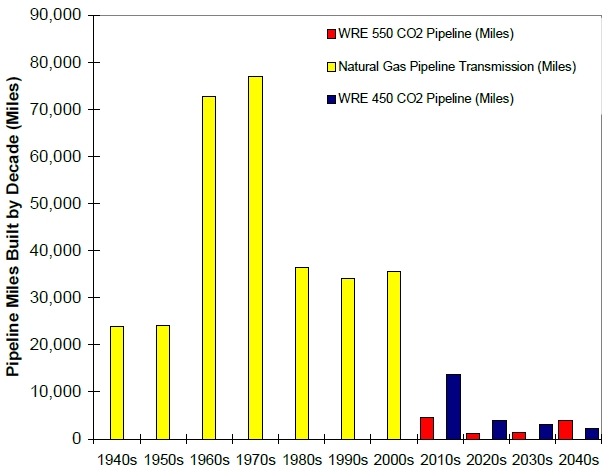
The PNNL study determines the feat is feasible not by taking issue with  estimates such as Romm’s, but rather by projecting a realistic implementation path for CCS technology. The research, presented by PNNL senior scientist Jim Dooley at November’s 9th International Conference on Greenhouse Gas Technologies, first projects how rapidly CCS could grow in the U.S. under agressive climate policies. Then it compares the pace of pipeline construction implied with the historic evolution of natural gas pipelines.

PNNL’s conclusion: “The sheer scale of the required infrastructure should not be seen as representing a significant impediment to US deployment of CCS technologies.”

PNNL Comparison of CCS and natural gas infrastructure growthBetween 11,000 and 23,000 miles of dedicated CO2 pipeline would need to be layed in the U.S. before 2050, according to PNNL’s estimates, in addition to the 3,900 miles already in place (which carry mostly naturally-occuring CO2 used to stimulate production from aging oil wells). The attached graph from Dooley’s presentation breaks the projected CO2 pipeline mileage down by decade of installation (see red and blue bars), and shows just how puny it is relative to the U.S. natural gas network (yellow bars).

Note that MIT’s 2007 Future of Coal report also compared CCS infrastructure favorably to natural gas pipelines. The MIT report estimated that capturing all of the roughly 1.5 billion tons per year of CO2 generated by coal- burning power plants in the U.S. would generate a CO2 flow with just one-third the volume of the natural gas flowing in the U.S. gas pipeline system.

That scale is certainly immense. But so is the challenge posed by climate change.

add to del.icio.us : Add to Blinkslist : add to furl : Digg it : add to ma.gnolia : Stumble It! : add to simpy : seed the vine : : : TailRank

This post was created for the Technology Review guest blog: Insights, opinions and analysis of the latest in emerging technologies

Tidal Power Flowing Stronger

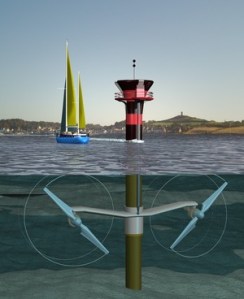
mct-seagen-system-with-yacht1Tidal power developments by British firms show this renewable power technology achieving impressive scale and continued design innovation. Bristol-based Marine Current Turbines (MCT) revealed last month that its SeaGen dual-turbine system achieved full power operation of 1.2 megawatts. MCT’s power peak is four times the global record for a tidal stream system set by the company in 2004, according to U.K.-based renewables journal REFocus, and 30-times more than the output from the tidal turbines pumping electricity in New York’s East River.

Meanwhile the U.K. Guardian reported yesterday that more largescale demonstrations are on the way as Cardiff-based Tidal Energy Ltd prepares to test a 1-MW version of its triple-rotor design by next year off the coast of Wales.

Achieving full power operation clears a major hurdle for MCT. As TechReview reported last July, the company suffered a setback early on when the powerful tidal streams of Northern Ireland’s Strangford Lough damaged one of its blades shortly after installation. In an odd way it’s an affirmation of MCT’s design, which enables the dual rotors to be lifted clear up out of the water for easy maintenance and repair.

While at a considerably earlier phase of development, MCT rival Tidal Energy’s triple-rotor concept provides an equally innovative means of ready repair. Tidal Energy’s rotors sit at the corners of a three-legged platform that can be deposited on the seabed and held in place by the systems 250-ton heft. That should not only ease recovery of the system for maintenance, but also simplify installation by eliminating the need for a fixed foundation in the seabed.

To see these concepts in action see MCT and Tidal Energy’s dueling animations.

add to del.icio.us : Add to Blinkslist : add to furl : Digg it : add to ma.gnolia : Stumble It! : add to simpy : seed the vine : : : TailRank

This post was created for the Technology Review guest blog: Insights, opinions and analysis of the latest in emerging technologies

Saying Adieu to the Mighty UCTE

By summer the Union for the Co-ordination of Transmission of Electricity (UCTE), whose 240,000 kilometers of high-voltage lines connect 26 European countries, may cease to exist. Europe is not giving up electricity. Electrons will still flow on the world’s largest interconnection of power grids. Rather, the 57-year-old UCTE will be subsumed within a new and broader organization designed to, among other improvements, make Europe’s grids renewables-ready: the European Network of Transmission System Operators for Electricity (ENTSO-E).

CEOs from 42 transmission system operator companies in 34 European countries unanimously decided to create the new association last month. Whereas UCTE was limited to ensuring the interoperability of largely self-sufficient national grids, ENTSO-E is to play a proactive role in coordinating grid development to create a truly European grid that can operate on a larger scale. This is exactly what’s needed as Europe increasingly seeks to widely distribute electricity generated from concentrated renewable resources such as wind power in the North Sea and Baltic Sea and Mediterranean solar power.

Moving power across regions implies a European-scale supergrid, while the European Commission (EC) has struggled simply to add small interconnections between the states. Last month for Spectrum Online I profiled the EC’s latest desperate attempt to overcoming inertia in transmission expansion: recruiting high-profile volunteers to sell the interconnections.

One of those volunteers, Władysław Mielczarski, the Polish electric power engineering expert whom the EC recruited to unstick projects connecting Poland to Lithuania and Germany, minced no words in describing his best efforts to get things as no substitute for European institutions dedicated to grid planning. “If we’re going to do a professional job on interconnection,” said Mielczarski, “we must have professional people working full time, and we must have more support from the commission.”

add to del.icio.us : Add to Blinkslist : add to furl : Digg it : add to ma.gnolia : Stumble It! : add to simpy : seed the vine : : : TailRank

This post was created for Energywise, IEEE Spectrum’s blog on green power, cars and climate

The Sahara Reveals its Carbon Capture Success

The market’s blasé reaction to the oil production cut ordered by OPEC ministers meeting in Algeria this week–bad news for greentech investors–topped the Wall Street Journal’s green business blog this week. The more lasting news from the meeting, however, may be the conference sideshow that took journalists to one of the world’s largest carbon capture and storage operations: Algeria’s In Salah natural gas operation, which stores about 800,000 tons of carbon dioxide per year, 1.2 miles below ground.

In Salah, hidden deep in the Sahara desert some 700 miles south of Algiers, is operated by oil and gas giant BP, Norway’s Statoil, and Algerian state oil and gas firm Sonatrach. The field’s gas is about 7% CO2, which must be cut to 2% or less before it can be shipped on to European markets. In Salah cuts the CO2 to 0.3% and, instead of simply venting the removed CO2 as many gas operations do, pumps it into an aquifer below the gas reservoir. Given the scale of the gas flow, it’s the environmental equivalent of taking 200,000 cars off the road.

The reporters visiting In Salah this week reported that the CO2 seems to be staying put, as is the case with the other two large-scale CCS operations in operation — the natural gas-stripping operation at Statoil’s Sleipner field in the North Sea, and the Dakota Gasification coal-to-synthetic natural gas operation. The Associated Press quoted Mohamed Keddan, the station manager, expressing confidence that the layer of thick shale sealing the In Salah reservoir would hold the CO2 for good: “If it contained gas for millions of years without leakage, why would it start leaking now?” said Keddan, according to the AP.

Better still, the cost of storing the CO2 is relatively low. Business Week reported that the $100 million CCS operation was just 2.5% of the overall $4 billion cost of the In Salah gas production complex. That puts the cost of sequestering the CO2 at about $14/ton.

At that price BP, Statoil and Sonatrach could eventually make money on the stored CO2 by selling carbon credits earned at In Salah to other polluters, such as coal-fired utilities, facing steeper CCS costs. That is, if future treaties governing greenhouse gas emissions enable CCS operations in developing countries such as Algeria to earn carbon credits — a concept rejected for the time being by international climate negotiators meeting in Poland last week — which could be revived by the time a follow-on to the Kyoto protocol is to be hammered out in Copenhagen twelve months from now.

So, given its success and low cost, why do we hear so little about In Salah, whereas the Dakota Gasification and Sleipner CCS operations enjoy pinup status? Business Week’s correspondent may have hit on the answer, noting that about 2,000 people work at In Salah if one includes the “military units intended to deter attacks by Islamic militants, who are still a serious threat in Algeria.”

Sometimes, and some places, it pays to keep your head down.

add to del.icio.us : Add to Blinkslist : add to furl : Digg it : add to ma.gnolia : Stumble It! : add to simpy : seed the vine : : : TailRank

This post was created for the Technology Review guest blog: Insights, opinions and analysis of the latest in emerging technologies