Black Liquor as Biofuel’s White Knight

Biofuels have really taken a beating this year in the court of public opinion, as concerns mounted over the impact of biofuel production on everything from biodiversity to food prices to water supplies. IEEE Spectrum reader Luc Rolland of Preston, England captured the sense of disillusionment in his letter to the editors this summer: “Valuing biofuel is very controversial—it impoverishes developing countries, and the true energy cost of biofuel is not worth it.”

But there are low-hanging fruit that respond to all of Rolland’s concerns. Today, at MIT’s TechReview.com, I take a look at the biofuel that appears to hang the lowest: dimethyl ether produced via gasification of black liquor. That’s quite a mouthful, so let’s define our terms:

  • black liquor: the blend of caustic inorganic chemicals and dissolved wood generated in pulp and paper mills
  • gasification: subjected to high heat and pressure, organic matter breaks down into a stream of principally hydrogen and carbon monoxide called syngas that can be catalytically reassembled into chemicals and fuels
  • dimethyl ether or DME: a clean-burning substitute for diesel fuel and liquid petroleum gas (LPG) that’s easily synthesized from syngas

Note that this is very similar in principle to the synthesis of methanol via coal gasification. In fact methanol is an intermediate in the synthesis of DME. Production of both methanol and DME from coal is exploding in China, and provides substantial local air quality benefits.

Gasifying black liquor to generate DME, or bio-DME for short, adds ecological and climate benefits, which is why the European Renew study released in July called it one of “the most advanced concepts for fuel production.” Net conversion efficiency on a lifecycle basis of 69%, the highest for any biofuel, means that for every hectare of agricultural production this fuel delivers the biggest energy bang. Greenhouse gas emissions, meanwhile, are on the order of 1/20th that of conventional diesel.

Bio-DME alone will not render personal transportation sustainable. Gasification of all of the black liquor generated in US mills would supply enough DME to displace just 3% of total fuel demand in the U.S., according to Jonas Rudberg, CEO of Swedish biomass gasification developer Chemrec. (For Canada, which has a higher pulp to car ratio, bio-DME could satisfy 7%).

But bio-DME’s potential looks much larger if one views it as a forerunner to broader application of gasification to solid biomass feedstocks such as switchgrass. Solid biomass tends to gum up gasification plants, as Germany’s Choren Industries may be learning as it seeks to start up the 18 million liter/year biomass-to-diesel plant it finished building in April. Mass application of black liquor gasification would invariably accelerate the diffusion of the technology.

If it does,  biomass gasification could deliver more than a fifth of Europe’s transport fuel by 2030 according to Volvo Group, which is coordinating a European bio-DME R&D consortium. Of course, how low all that fruit will hang remains to be seen.

For more on bio-DME, see the TechReview article: “Taking Pulp to the Pump”.

add to del.icio.us : Add to Blinkslist : add to furl : Digg it : add to ma.gnolia : Stumble It! : add to simpy : seed the vine : : : TailRank

This post was created for Energywise, IEEE Spectrum’s blog on green power, cars and climate

Should Carbon Capture Capture Carbon Credits?

Click image to see IEA's Nobuo Tanaka zeroing in on CCS at Poznan
Click image to see IEA's Tanaka on CCS at Poznan

International climate change negotiators gathered in Poznan, Poland to draft a follow-on to the Kyoto protocol appear to have rejected the talks’ most controversial proposal: giving a big boost to carbon capture and storage (CCS), whereby carbon dioxide produced by coal-fired power plants is trapped deep underground. The proposal was to award carbon credits to developing countries that installed CCS equipment — credits that they could then sell to industrialized nations or companies — but this morning opponents successfully tabled the proposal until next June, according to climate policy blog Climatico.

Countries pushing the credits-for-CCS proposal included Japan, Norway, Australia and Canada. All are major coal consumers eyeing CCS to meet their own greenhouse gas reduction targets and/or oil and gas producers that could dual-purpose captured CO2 for enhanced oil recovery. Japan and Canada also figure among the nations furthest behind in meeting emissions cuts mandated by the Kyoto protocol, and could be big buyers of CCS-generated carbon credits.

International Energy Agency executive director Nobuo Tanaka had also added his support (see video). Tanaka calls credits a means of accelerating development of capture and sequestration technologies, which the IEA sees as crucial to control emissions in countries such as China that will remain heavily dependent on coal for decades to come. “These technologies need all the financial help they can get,” says Tanaka.

But the idea remained red-hot among the climate activists swarming Poznan this week as it unites a controversial technology with an already controversial program. They see carbon sequestration as a potentially risky technology that could delay the transition from coal to solar, wind and other forms of renewable energy. Meanwhile the UN’s Clean Development Mechanism (CDM), which manages the awarding of carbon credits to developing nations, attracts scorn from those who see carbon trading as a numbers game by which countries will avoid making real emissions cuts.

Many question whether emissions cuts certified for millions of dollars worth of credits under the CDM wouldn’t have occurred anyway — whether they offer ‘additionality’ in the UN lingo flowing in Poland this week.

The UN acknowledged possible problems after spot-checking a leading CDM certification firm and identifying a series of “non-conformities” in its auditing practices. The firm, DNV Certification AS, was suspended but insists it is addressing the concerns identified to regain its accreditation.

Poznan’s ministerial-level talks start tomorrow and should wrap up Friday. Unless they pop CCS back onto the agenda the credits proposal will be stalled until next June’s followup meeting in Bonn. That meeting is a prelude to the big game that will define global energy policy: final negotiations and, if all goes as planned, the signing of a ‘Kyoto II’ treaty in Copenhagen next December.

add to del.icio.us : Add to Blinkslist : add to furl : Digg it : add to ma.gnolia : Stumble It! : add to simpy : seed the vine : : : TailRank

This post was created for the Technology Review Editors Blog: Insights, opinions and analysis of the latest in emerging technologies

Biodiversity Hangs in the Energy Balance

Jo Mulongoy CBDThe newly elected president of the Maldives wants to build a contingency fund to buy land elsewhere so that the island country can literally move to higher ground to escape rising sea levels. But what of the rest of the island’s biodiversity? According to Jo Mulongoy, chief scientist for the Convention on Biological Diversity’s secretariat in Montreal, the island ecosystems will never be reconstructed if they’re swamped – powerful motivation for capping greenhouse gas emissions and blunting climate change.

Overall, however, Mulongoy is more hopeful. Partly because governments are moving to act on biodiversity (says the scientific diplomat). But also because the power of information technology is informing smarter decision making and thus making it easier to do the right thing and preserve biodiversity (at least on higher ground).

The Congolese microbiologist needs to look no further than his homeland, where satellite imagery is helping the government protect its equatorial forests from over-harvesting by refugees displaced by years of civil war.

For more, in his own words, see my Q&A with Mulongoy that posted to Earthzine on Friday.

add to del.icio.us : Add to Blinkslist : add to furl : Digg it : add to ma.gnolia : Stumble It! : add to simpy : seed the vine : : :

Nanotech’s Outsized Energy Impact

I think Richard Smalley would have appreciated my article “Realizing Lithium Battery Potential” which headlines MIT TechReview.com today. The Rice University chemist – who shared the 1996 Nobel Prize in Chemistry for the discovery of soccer ball-shaped carbon cages called buckyballs – believed that nanotechnology could multiply the efficiency of the myriad energy devices upon which modern human society relies and, as such, had a central role to play in cleaning up our energy systems.

I relied on Smalley’s vision to wrap up a 2004 feature story for Tech Review – “Solar-Cell Rollout” – on plastic solar cells, which represent a radical, nanotech-enabled departure from the high-performance silicon crystal materials that still dominate the photovoltaics industry. Smalley’s belief in the rather anemic, flimsy plastic cells’ potential to someday be rooftop-ready lent crucial authority. (Doesn’t seem so crazy now. Just yesterday a German R&D agency decided the technology’s performance warranted a €2.5-million investment in improving its stability.)

In the same breath I passed along Smalley’s plea for bold investments in physical sciences research:

Nanotech could help solve the energy problem, Smalley contends, by providing new tools and materials that make widespread use of solar cells economically viable. But he believes it will take billions of dollars in funding and the focused efforts of the world’s top chemists and physicists to make that happen. So for the past two years, he has been crisscrossing the United States, evangelizing for nothing short of a modern-day Manhattan Project to use nanotech to deliver a sustainable energy system.

Smalley died from leukemia in 2005, but the vision he championed continues to spread and the advances he foresaw are being realized. My article on TechReview.com today presents nanotech-fueled advances that could multiply the energy storage capacity of lithium batteries. The immense potential of lithium batteries is the inspiration for today’s renaissance in electric vehicle development. But auto industry analysts say their cost will constrain EV expansion through 2020; see for example these uninspiring growth curves from PriceWaterhouseCoopers’ Calum MacRae. More potent batteries should help by extending EVs’ range and thus improving their value proposition.

Nanotech, by the way, is already improving the lithium battery. Boston-area technology developer A123, for example, coats its batteries’ positive electrodes with nanoparticles of iron-phosphate to boost safety and reduce cost relative to conventional laptop-style batteries. A123 is believed to have lost its bid to supply GM’s Chevy Volt plug-in hybrid vehicle, but as TechReview editor Kevin Bullis points out recently A123 has plenty of other EVs to bid on.

This post was created for Energywise, IEEE Spectrum’s blog on green power, cars and climate

add to del.icio.us : Add to Blinkslist : add to furl : Digg it : add to ma.gnolia : Stumble It! : add to simpy : seed the vine : : : TailRank

Probing for Fluff in Europe’s Supergrids Vision

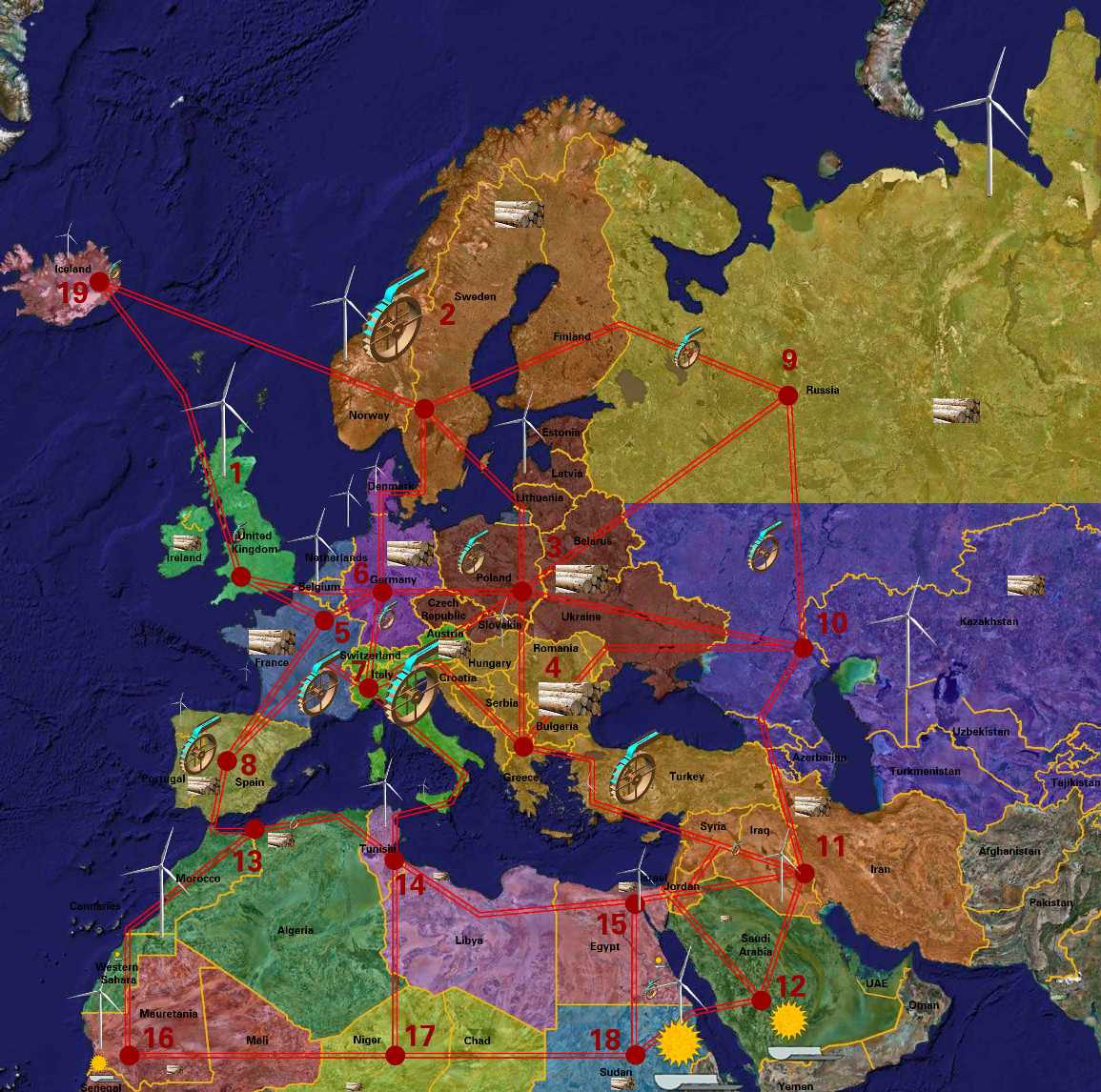
European renewable energy supergrid map Credit Wibke von FlemmingLast month the European Commission (EC) called for construction of regional power transmission grids that would ultimately merge into a supergrid distributing Mediterranean solar energy and offshore wind energy across Europe. Today, in MIT’s Technology Review, I test the political reality of sharing power across Europe (see “Europe Backs Supergrids”) and show that the EC just might pull it off.

Why be skeptical? Because for over a decade the EC has been pushing the liberalization of the European electricity market. Whereas, given the limited capacity for exchange of power between many European countries one could fairly question whether a ‘European market’ for electricity even exists.

Wind power developer Eddie O’Connor, for example, told me that his priority – building an offshore grid to connect tens of gigawatts of North Sea wind farms to be installed in the coming decade – would remain a dream so long as the European states and their politically powerful utilities control tranmission planning. “The utilities are the enemy,” says O’Connor, founder of wind developer Airtricity and CEO of Mainstream Renewable Power. “Even at this stage they’re still the enemy.”

What my report for TechReview shows, however, is that change is possible. The best example is a French-Spanish agreement this summer — under intense prodding from the EC — clearing the way for a much-needed second powerline across the Pyrenees. A special envoy appointed by the EC broke what had been a 15-year impasse complicated by local environmental concerns, Catalan fury, and diverging interests of the utilities involved. 

Even O’Connor is optimistic. He believes that new international institutions must be created to conjur up the supergrid Europe needs to carry renewable energy. But, says O’Connor, both are possible: “I believe the building of the supergrid is imminent.”  

Stay tuned for more on the EC’s energy envoys.

This post was created for Energywise, IEEE Spectrum’s blog on green power, cars and climate

add to del.icio.us : Add to Blinkslist : add to furl : Digg it : add to ma.gnolia : Stumble It! : add to simpy : seed the vine : : : TailRank

Nukes, Gas, Oil and Coal All Losers in EU Energy Strategy

The European Commission issued its Strategic Energy Review yesterday, proposing energy efficiency investments, a shift to alternative fuel vehicles to end oil dependence in transport, and more aggressive deployment of renewable energy and carbon capture and storage to “decarbonise” the EU electricity supply. Figuring prominantly among its first six “priorities essential for the EU’s energy security” are the North Sea offshore electric power supergrid that Energywise covered in September and the Mediterranean Ring electric interconnection of Europe and North Africa that I’ve been harping on this week.

The EC energy strategy not only endorses the MedRing, but views it as a component of a future supergrid traversing Europe and stretching beyond the Mediterranean to Iraq, the Middle East and Sub-Saharan Africa.

How would this new vision (and $100/barrel oil) alter the complexion of European energy consumption? The energy review projects that by 2020 total energy demand drops from the equivalent of 1811 metric tons of oil in 2005 to 1672 MTOE in 2020. Demand met by renewables such as wind, solar and hydro more than doubles in real terms from 123 to 274 MTOE, while their share of total demand leaps from 6.8% to 16.4%. Imported renewables – with the MedRing delivering North African wind and solar power – jump 10-fold from 0.8% in 2005 to 8.8% in 2020.

Oil, gas, coal and nuclear, meanwhile, all see a diminished role, both in real terms and as a share of European energy demand. Interestingly the role of natural gas – the low-carbon fossil fuel – drops the most, from 25% to 21%, reflecting EU concern over dependence on gas imports from Russia. Nuclear’s share drops the least, from just slightly over to slightly under 14% of demand; this assumes that nuclear phaseout plans, particularly Germany’s, are followed through.

How to make it all come true? Accompanying the EC review is a ‘green paper‘ (the EU’s unbleached alternative terminology for what we’d call a ‘white paper’) outlining a variety of new regulatory and financial mechanisms. The EU is already a world leader in terms of incentives for lower carbon energy with strong price supports for solar and wind and a carbon cap and trade program up and running (though still lacking teeth as my Energywise colleague Bill Sweet notes). However, the energy review warns that the primarily national-level financing that drives energy projects today are inadequate to drive infrastructure that is pan-European or larger. A perfect example is the massive investment in high-voltage dc lines needed to turn the MedRing into a bulk power mover (see the second half of our feature on MedRing: “Closing the Circuit”).

Even less viable under existing financing mechanisms are those projects that entail considerable “non-commercial risks” such as threats of political instability or terrorism. Did someone say North Africa?

add to del.icio.us : Add to Blinkslist : add to furl : Digg it : add to ma.gnolia : Stumble It! : add to simpy : seed the vine : : : TailRank

This post was created for Energywise, IEEE Spectrum’s blog on green power, cars and climate

Power Struggles and the Mediterranean Ring

‘The Mediterranean Ring’ would make a fitting title for a high-voltage action thriller where cut-throat crime gangs vie for control in the labyrinthine medieval medina’s of North Africa. Alas it is no such thing. And yet this project to connect the power grids of North Africa and Europe does boast a potentially destructive internal power struggle that could stymie its promise — clean power supplies for Europe, economic development for North Africa, and a much needed bond between neighbors.

MedRing’s power struggle spilled into the daylight on November 21, 2005 when power engineers activated a key electrical circuit linking Tunisia and Libya in a key test of the MedRing. For a moment nearly all of the AC power systems of North Africa operated synchronously with those of Europe. Power plants, transmission lines and controls from Syria to Morocco were in electrical conversation with those of the mighty UCTE, whose 240,000 kilometers of high-voltage lines connect 26 European countries. Add links to Turkey and the MedRing would have been complete.

Seven minutes later the grids had broken apart and the test had failed.

It was a tug of war between North African grid control systems that broke the synchronicity. Understanding why isn’t straightforward. Bear with me as I try because the failure of this early trial exemplifies the challenge inherent in connecting a robust power system like the UCTE’s — the world’s biggest — to much weaker grids such as those of North Africa.

Continue reading “Power Struggles and the Mediterranean Ring”