Solar PoweRING the Mediterranean

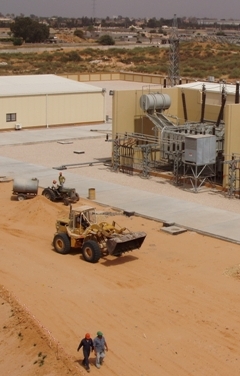
Areva's Bir Osta Milad substation in Libya copycreditpeterfairley2008Engineers working in the teeming cities and lonely deserts of North Africa are creating the last links in a power grid that will ring the Mediterranean Sea. Sharing electricity over this ‘Mediterranean Ring’ could secure Europe’s power supply with clean renewable energy, accelerating North Africa’s development and knitting together two worlds that seem to be racing apart — those of Muslim North Africa and an increasingly xenophobic Europe.

We make the case for all this unabashed optimism in Closing the Circuit – a feature story in this month’s issue of Spectrum. Closing the Circuit is the product of two years of on-again, off-again research that came to fruition with on-site reporting in Libya and Morocco this summer.

The timing is fortuitious: North African countries – in many ways among the most progressive in the Muslim world – face a rising threat of Islamic fundamentalism, including increasingly deadly attacks by Al Qaeda-aligned militants. Economic development and democratization are the best hope for a North African renaissance. At the same time Europe’s growing dependence on Russian oil and gas and desire to slash carbon emissions has intensified interest in North Africa’s energy resources.

The scale of the potential exchange is immense: Analyses by the German government estimate that solar power generated in scorching North Africa could meet Germany’s entire electricity demand. No wonder then that the Union for the Mediterranean launched by French president Nicolas Sarkozy this summer to spur cooperation between Europe and North Africa is fleshing out a “Mediterranean solar plan” as one of its first actions.

The geopolitical and social import could be bigger. Consider what Dominique Maillard, President of French grid operator Réseau de Transport de l’Electricité, said when asked last month what the Mediterranean Ring represents during an interview last month for the European Energy Review. Maillard began his response by noting that the electrical interconnections between the European countries got started in 1951 – well before the signing of the Treaty or Paris, which created a European coal and steel market, and before the Treaty of Rome in 1957. “At the dawn of Europe, energy – and even electrical energy – had therefore already preceded politics,” says Maillard.

The implication by extension is clear: Electrical interconnection can be the forerunner for peaceful codevelopment among the countries of the Mediterranean, even including Israel. Call it informed optimism.

add to del.icio.us : Add to Blinkslist : add to furl : Digg it : add to ma.gnolia : Stumble It! : add to simpy : seed the vine : : : TailRank

This post was created for Energywise, IEEE Spectrum’s blog on green power, cars and climate

Democracy and Climate Change

Here’s some elegant prose on the hopes that rest on the Obama Administration to come from R.K. Pachauri, director general of The Energy and Resources Institute (TERI) in New Dehli and Chairman of the Intergovernmental Panel on Climate Change (IPCC) – the UN body that seeks and sells scientific consensus on climate science and policy. In a statement released yesterday Pachauri elegantly explains why the election is a cause for optimism:

The presidential elections in the US have vindicated the power of democracy as the most responsive form of government of the people, by the people and for the people. In respect of policies related to climate change, there was obviously a major divergence between the position of the Federal Government and that of the people at large, state governments and the cities in the US.

President-elect Barack Obama has not only been very clear in emphasizing the need for the US to engage in global solutions to meet the challenge of climate change but also in respect of bringing about a major shift in US energy policy.

The US now has a unique opportunity to assume leadership in meeting the threat of climate change, and it would help greatly if the new President were to announce a coherent and forward looking policy soon after he takes office. There is every reason to believe that President Obama will actually do so. This should please people across the globe, because US leadership is critical for mounting global efforts to meet this threat effectively. For this reason itself, apart from several others, the election of Mr Obama is a development that should generate optimism all-round.

Pachauri’s statement was forwarded to members of the Society of Environmental Journalists by Arul Louis, a fellow at the International Center for Journalists in Washington, DC.

add to del.icio.us : Add to Blinkslist : add to furl : Digg it : add to ma.gnolia : Stumble It! : add to simpy : seed the vine : : : TailRank

This post was created for Energywise, IEEE Spectrum’s blog on green power, cars and climate

China’s Explosive and Inadequate Wind Power Boom

China’s dramatic jump into wind power installations and manufacturing provides a glimmer of hope amidst what is otherwise a terribly polluted picture of unsustainable environmental devestation driven largely by coal-fired power generation. But just a glimmer.

Cambridge, MA-based consulting firm Emerging Energy Research affirmed the wind sector growth last week, issuing an analysis that puts China on track to hit 135,000-megawatt of wind capacity in 2020; EER expects China to lead the world in annual wind installations by 2011. EER’s 135-gigawatt prediction for 2020 marks a big jump up from the already optimistic prediction by Chinese Wind Energy Association secretary general Haiyan Qin that closed our May 2008 reporting on China’s wind sector — namely that his members would have no trouble doubling the official 30 GW national goal for 2020.

And still the wind sector remains dwarfed by the heft and growth of China’s coal-fired power sector. In 2006 alone, China commissioned 102 GW of new coal-fired power stations, a power bloc that exceeds the United Kingdom’s entire electric power system. In other words it will likely take a decade of world-leading growth in wind power installations before China’s total installed base of wind turbines can put out more power than the coal plants it added in 2006.

Factor in the intermittent output from the wind turbines and the comparison looks that much more lopsided (averaged out over a year, wind turbines produce at their peak capacity only 30% of the time). The result is toxic air that probably kills upwards of a million people per year in China, and is a leading contributor to global greenhouse gas emissions.

Cleaning up the coal-fired plants provides a more likely handle for cutting the local air pollution. According to a survey of coal plant operators issued by MIT’s China Energy Project in August — Greener Plants, Grayer Skies? — China’s coal-fired power plants have the means to capture acid rain and smog forming pollutans, as well as particulates. The authors determined that most of the new plants being added in China employ decent technology, including pollution controls. The problem, they conclude, is that these controls aren’t turned on.

Why break the law and leave pollution-trapping scrubbers and baghouses lying dormant? They consume energy, which cuts into revenues, and China’s inadequate environmental enforcement is incapable of enforcing compliance.

Could Beijing’s extension of controls on auto traffic post-Olympics signal the new ethic of environmental protection needed to activate those scrubbers and start detoxifying China’s air? One that could even, some day, include carbon capture to start trimming China’s world-leading greenhouse gas emissions? Those may sound like terribly hopeful notes, but they’re at least as realistic as relying on wind power to do the job.

add to del.icio.us : Add to Blinkslist : add to furl : Digg it : add to ma.gnolia : Stumble It! : add to simpy : seed the vine : : : TailRank

This post was created for Energywise, IEEE Spectrum’s blog on green power, cars and climate

Clean Coal’s Mountainous Upstream Blindspot

Gasification-based IGCC power plant technology offers a powerful means of cleaning up local air pollution from coal-fired power and, via carbon capture and storage, its carbon footprint. Carbon-Nation has argued in past that it should be legally mandated for new power plants burning coal because (1) air pollution laws require use of the best emissions controls available, (2) carbon capture and storage will be economically viable under emerging carbon caps and taxes, and (3) adding new carbon emissions from coal is unjustifiable given the critical need to stabilize atmospheric levels of CO2. 

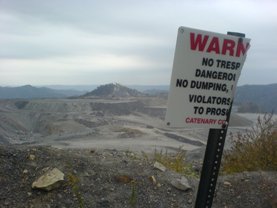
But let’s be clear on one thing: IGCC and carbon capture can substantially clean up the coal-fired power plant, but they can’t deliver “clean” coal. That’s because extracting coal to feed the power plants is, in itself, a dirty business — at least as it is currently practised. Last week I witnessed this firsthand at two West Virginia mines where mountains are literally dismantled to reveal their hidden coal seams, then piled back to a rough approximation of their original contours or left flat for development. I visited the mines as part of the Society of Environmental Journalists’ annual conference, held this year in the heart of coal country in Roanoke, Virginia. 

Mountaintop removal mining, as this practice is called, accounts for about a third of Appalachian coal production but contributes a considerably larger share of Appalachian coal burned in power plants (conventional deep mines yield more metallurgical coal used in steel mills). They are, without question, environmentally and culturally destructive. Thousands of cubic meters of rock, sand, and soil dumped into valleys bury ephemeral stream beds; wildlife are displaced; sludge impoundments from coal-cleaning operations threaten groundwater and communities; and residents of the mountains suffer internal devestation as the lands that define their existence are blasted into oblivion. For a sense of scale check out this 5MB panorama of the mine pictured above by National Geographic executive editor Dennis Dimmick.  

Can the coal industry do better? Yes. For example, reclamation experts from Virginia Tech told the tour that mountaintop mines are adopting a new reforestation approach that could restore the mountains’ ecology within two generations. That’s huge improvement over current practices where grasses and shrubs take over, leaving the land in what Virginia Tech forestry professor James Berger called a state of “arrested succession.”

Will the industry ever make coal mining socially and environmentally sustainable? Appalachian activists who have fought ‘Big Coal’ for decades doubt it. For one thing, the coal companies enjoy undivided support from state legislators and governors in coal states. That’s why West Virginia author and political activist Denise Giardina told the SEJ conference attendees that she was “rooting for global warming” to stop coal. “I think it will force us to change,” said Giardina, who made it clear that IGCC power plants sequestering CO2 weren’t the kind of change she had in mind. Quite the opposite in fact: “If we ever have clean coal,” said Giardina, “you can kiss the mountains goodbye.”

I’m going to need more time to reflect on what I saw and heard last week. The scale of carbon reductions required and developing nations’ right to develop may yet justify the ongoing use of coal. But, at the very least, it is more clearer to me than ever that cleaning up our energy systems must start with energy efficiency and less extractive forms of renewable energy. We are all, as willing users of coal-supplied power grids, contributors to Appalachia’s plight everytime we turn on the juice. 

Storied author, poet and social critic Wendell Berry put that message to the SEJ conference in the bluntest of terms: “It’s awfully hard to remember when you push that button that you are authorizing mountaintop removal.” 

For more on mountaintop removal mining check out this week’s article by the Associated Press which I believe was inspired by the SEJ mountaintop mining tour.

add to del.icio.us : Add to Blinkslist : add to furl : Digg it : add to ma.gnolia : Stumble It! : add to simpy : seed the vine : : : TailRank

This post was created for Energywise, IEEE Spectrum’s blog on green power, cars and climate

Peak Lithium Counterpoint from Gas 2.0

My presentation of Le Monde’s Peak Lithium story prompted some sage commentary from critics of the notion that lithium could ever run dry (so to speak). Rather than leaving the counter-argument buried in the comments, here’s a thoughtful elaboration argued from first principles by EV software developer Karen Pease.

The post appears on Gas 2.0, a blog dedicated to alternative fueling options that looks worthy of much deeper exploration.

One quick followup on the “drive less” front: Beijing has enacted agressive car restrictions. In essence the city is extending restrictions brought into play this summer in a desperate bid to clear the air for the Olympic games.

CN’s editor is feeling thoroughly vindicated for the optimism imparted in that coverage. Change is Always possible.

add to del.icio.us : Add to Blinkslist : add to furl : Digg it : add to ma.gnolia : Stumble It! : add to simpy : seed the vine : : :

Peak Lithium: EVs’ Dirty Little Secret?

Electric vehicles web-journal EV World has done the English-speaking world a favor by translating an excellent Peak Lithium story written last week by Le Monde journalist Hervé Kempf. What is Peak Lithium you ask? The notion that a wholesale shift to EVs powered by lithium batteries in response to peaking petroleum production could just as quickly exhaust the global supply of lithium metal.

Kempf credits a May 2008 study by consultancy Meridian International Research — The Trouble with Lithium 2 — as the source of growing concern over peak lithium; the study concluded that reasonable increases in lithium production over the next decade will generate enough of the light, energetic metal to produce batteries for only 8 million batteries of the sort that GM plans to use in its Chevy Volt plug-in hybrid.

But he does his own homework, providing an accessible introduction to the geological distribution of lithium and its likely magnitude. I say ‘likely’ because Kempf shows that industrial secrecy makes it difficult to assess the probability of a peak lithium scenario prematurely squelching the electrification of the automobile.

As George Pichon, CEO of French metals trader Marsmétal puts it in Kempf’s piece, the world of a lithium metal is “un monde fermé.”

Alas, it’s just a little less closed today thanks to Le Monde and EV World.

add to del.icio.us : Add to Blinkslist : add to furl : Digg it : add to ma.gnolia : Stumble It! : add to simpy : seed the vine : : : TailRank

This post was created for Tech Talk – Insights into tomorrow’s technology from the editors of IEEE Spectrum.

The EuroParliament’s Schwarzenegger Clause and CCS

Carbon sequestration — the notion that carbon dioxide from coal-fired power stations and other major greenhouse gas emitters can be captured and stored underground — is taking a lot of hits from environmental activists bent on banning coal outright. For a taste, check out this recent post on the Gristmill green blog by Joseph Romm, a most articulate carbon capture critic. Political leaders, in contrast, appear far more supportive, and it’s not just American presidential candidates wooing coal-country voters. Last week European parliamentarians voted to finance largescale sequestration demo projects with a generous €10-billion fund and, better still, approved what they called a ‘Schwarzenegger Clause’ to mandate carbon capture for new generating stations from 2015. Like an existing requirement approved by California’s governor the clause sets a 500 gram CO2 per kilowatt-hour emissions limit that coal-fired plants can beat only with carbon capture.

The U.K.’s Environment Agency had already recommended a ban new coal-fired power plants that don’t use carbon capture and storage (CCS) the week before.

Part of the European motivation, as French and British leaders have made clear, is that CCS is more than a key to meeting agressive climate change action goals. They are also a critical means of keeping coal in the mix and thus limiting Europe’s dependence on imported oil and gas from Russia and the Middle East.

In the U.S., meanwhile, Al Gore is calling for civil disobediance to force adoption of the same CCS mandate. In fact, there are already steps in this direction even in North America beyond Schwarzenegger’s innovations:A panel appointed by Arkansas’ governor recommended last month the state approve no new coal plants until CCS is ready; the Canadian government floated a plan this spring to require CCS at new bitumen-to-oil plants in Alberta’s tarsands from 2012; and last fall British Columbia decreed a no-new CO2 from coal policy that stalled two proposed coal-fired plants (one may go forward as a biomass plant to burn trees killed by a warming-enabled infestation of beetles).

A wildcard to watch: weakening political resolve in the face of the global finance crisis. According to this report from Agence France Press yesterday, a few European leaders are wavering on greenhouse gas emissions as energy-intensive industries face tough times ahead.

add to del.icio.us : Add to Blinkslist : add to furl : Digg it : add to ma.gnolia : Stumble It! : add to simpy : seed the vine : : :