
Feathered Farmland Friends of the Fens

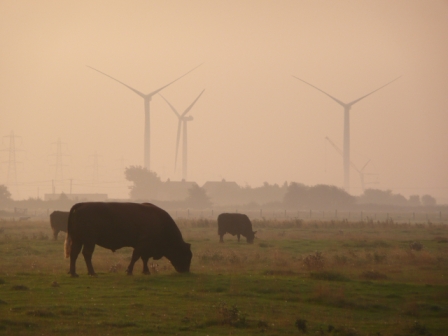
The wind power industry has had close to zero success designing bird and bat-safe turbines, but nascent research by ecologists nevertheless shows that wind power is compatible with local ecology. Case in point: today’s report in Britain’s Journal of Applied Ecology on wind farms and birds in the East Anglian fens.

Mark Whittingham and fellow ecologists from Newcastle University surveyed birds on farmland around two wind farms in the fens and recorded almost 3,000 birds from 23 different species. Among them are five endangered species: the yellowhammer, the Eurasian tree sparrow, the corn bunting, the Eurasian skylark and the common reed bunting.

Whittingham and company found the wind turbines had no effect on the birds’ distribution with the exception of common pheasants. “This is the first evidence suggesting that the present and future location of large numbers of wind turbines on European farmland is unlikely to have detrimental effects on farmland birds,” says Whittingham.

Plenty of questions remain. For example, a comprehensive $15 million study of Denmark’s large offshore wind farms published last winter showed seabirds to be remarkably adept at avoiding offshore installations, but ecologists remain concerned that the 10,000 megawatts of offshore wind power that Germany hopes to install by 2020 could scare off populations of endangered loons along Germany’s North Sea coast.

Even the Newcastle study was conducted last winter and must be followed up to confirm there are no unexpected impacts during the breeding season.

The wind industry would do well to continue working on newer, safer technology.

add to del.icio.us : Add to Blinkslist : add to furl : Digg it : add to ma.gnolia : Stumble It! : add to simpy : seed the vine : : : TailRank

This post was created for Tech Talk – Insights into tomorrow’s technology from the editors of IEEE Spectrum.
Physicists Talk Tough on Efficiency and The War

I recall well a meeting of journalists at the Kennedy School of Government in 2003 where I was regarded as a wingnut + conspiracy theorist for seeing a linkage between U.S. intransigence on greenhouse gas controls and the War in Iraq. Never have I felt as alienated as an American intellectual. These days I reflect instead on how far the national conversation has come in the years since. I happened upon the latest sign of hope quite unexpectedly in a report on energy efficiency issued earlier this month by the American Physical Society: “Energy = Future. Think efficiency.” 

I’d been feeling guilty about letting the APS report pass by without a mention. Energy efficiency is a tough story for journalists — making do with less energy simply lacks the sex appeal of faster cars or new power generating technologies such as high-tech techniques for pollution-free coal power or the latest in photovoltaics. And yet, as the APS rightly points out, the U.S. is in a better position than most countries to meet its need for clean, domestic energy by squeezing a bigger bang out of every joule of energy consumed.

What will be useful about the APS report is its explicit connection between the technologies available to boost efficiency in the key sectors of transportation and buildings, and the shortcomings in science & technology policy that thwart their ready adoption or rapid adoption.

But what I really appreciated was the no-nonsense manner in which the analysis unfolds. The relatively frank prose of the executive summary (considering the genre) sets the stage for what follows:

“Nowhere is the standard of living more rooted in energy than in the United States, and, with its defense forces deployed in the most distant regions around the world, nowhere is the security of a nation more dependent on energy…Yet only in times of extreme turbulence — the OPEC (the Organization of Petroleum Exporting Countries) oil embargo in 1973, the overthrow of the shah of Iran in 1979 and the Persian Gulf War in 1991 — when public frustration became politically intolerable did American officials devote serious attention to energy policy. Although some of the policy initiatives yielded significant benefits, others were left on the drafting board as the nation reverted to a business-as-usual energy routine once the turbulence passed and public dissatisfaction dissipated.”

How refreshing. Now, let’s get to work.

add to del.icio.us : Add to Blinkslist : add to furl : Digg it : add to ma.gnolia : Stumble It! : add to simpy : seed the vine : : : TailRank

This post was created for Tech Talk – Insights into tomorrow’s technology from the editors of IEEE Spectrum.

Negative Prices for Clean Power

How do you know that congestion on high-voltage transmission grids is stranding valuable renewable energy? When the price of electricity goes negative. American Wind Energy Association electricity industry analyst Michael Goggin delivers a snapshot of the phenomenon in a recent column for Renewable Energy World.

Goggin points to data from the Electricity Reliability Council of Texas or ERCOT, the state’s grid operator, showing an increasing incidence of generators paying buyers to take their power. According to Goggin, such conditions track the explosive installation of wind farms in West Texas — and are very bad news for their operators.

Prices fell below US -$30/MWh (megawatt-hour) on 63% of days during the first half of 2008, compared to 10% for the same period in 2007 and 5% in 2006. If prices fall far enough below zero that the cost for a wind plant to continue operating is higher than the value of the US $20/MWh federal renewable electricity production tax credit plus the value of other state incentives, wind plant operators will typically curtail the output of their plants.

Worse still, consumers in adjacent areas are paying top dollar for power because the transmission lines between them and the excess wind power are overloaded.

Texas is running into trouble because it pushed wind power harder and faster than other states, but it is also leading the way to address what is really a nationwide problem. This summer the Public Utility Commission of Texas approved a scheme called the Competitive Renewable Energy Zone (CREZ) process to incentivize construction of new transmission lines to evacuate stranded wind power. Earlier this month a consortium of major utilities including MidAmerican and AEP announced their intention to do so.

For a detailed yet accessible look at Texas’ renewable energy transmission challenge and efforts to clear out the bottlenecks, see this overview from the State Energy Conservation Office.

add to del.icio.us : Add to Blinkslist : add to furl : Digg it : add to ma.gnolia : Stumble It! : add to simpy : seed the vine : : : TailRank

This post was created for Tech Talk – Insights into tomorrow’s technology from the editors of IEEE Spectrum.

CO2’s Bottom Line Just Keeps On Rising

Climate change skeptics obsess about the immense uncertainties that plague climate modeling. It’s not, however, all a matter of mysterious physics and chemistry. Human behavior — in this case our boundless capacity to ignore grave danger — poses the greatest challenge. No order of scientific progress nailing down the links that regulate Earth’s climate will enable certain projections of climate change over the next century because it is human behavior that controls the most powerful element: emissions of greenhouse gases such as CO2 and methane.

Today scientists with the international Global Carbon Project are releasing an updated accounting of CO2 emissions, and they far exceed the best guesses of human behavior by the Intergovernmental Panel on Climate Change (IPCC). “Emissions in 2007 were at the high end of’ those used for climate projections in the last [IPCC] report,” says Global Carbon Project participant Corinne Le Quéré, an environmental chemist at the University of East Anglia.

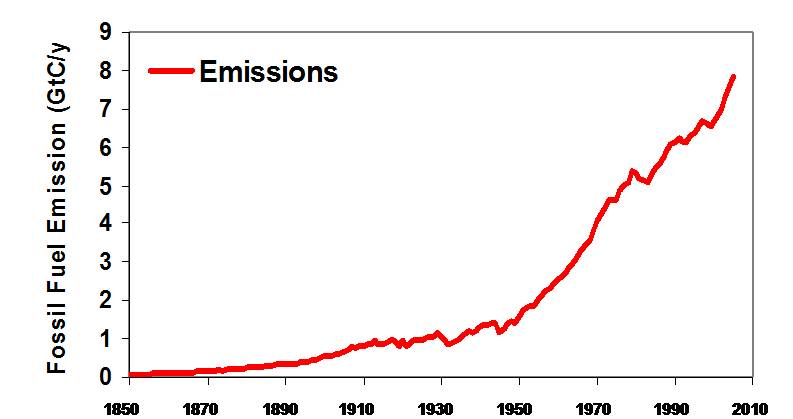
Emissions from burning fossil fuels and cement manufacturing — the largest sources of anthropogenic CO2 — continue to increase rapidly (see graph above); in 2007 they were now 38% higher than in 1990. In total, emissions drove up the atmospheric concentration of CO2 by 2.2 parts per million last year, compared with 1.8 ppm in 2006. At the end of 2007 CO2 was at 383 ppm — the highest concentration during the last 650,000 years and probably during the last 20 million years according to the Global Carbon Project. 

At the same time the oceans, which in past acted as a buffer to absorb excess CO2, are saturating. Le Quéré, who coauthored a report last year in Science that the Antarctic Ocean had already saturated, calls it a dangerous combination: “If this trend continues and the natural sinks weaken, we are on track towards the highest projections of climate change.”

add to del.icio.us : Add to Blinkslist : add to furl : Digg it : add to ma.gnolia : Stumble It! : add to simpy : seed the vine : : : TailRank

Hub Motors: When EVs Smash Open Auto Design

Chrysler leapt back into relevance this week announcing no less than four EVs in development — at least one of which it promises to sell in 2010. Most intriguing for this fan of EV technology is its claim to be experimenting with permanent magnet in-wheel motors for an plug-in hybrid version of the Jeep Wrangler. That step would be an exciting leap in auto design where the electric drivetrain frees the automobile from its heavy and design-constraining mechanical transmission and driveshafts.

For a sense of the hub motor’s potential design impact, consider the experimental Reconnaissance Surveillance Targeting Vehicle that General Dynamics built for the U.S. Marine Corps. The “Shadow” is “a four-ton armored truck that has the payload of a Humvee and yet is svelte enough to deploy from a tactical aircraft.” The Shadow used a series hybrid design in which the engine serves only to keep the lithium battery charged in extended range use–much like GM’s vaunted Chevy Volt.

Unlike the Volt it transmits power to the wheels via power cables, rather than using its stored electricity to drive a central motor and mechanically distributing it to the wheels. The result is unprecedented traction thanks to the direct control of each wheel by its hub motor and the wheels’ freedom to range up and down almost half a meter.

Then there’s the Shadow’s metamorphosis when it rolls out of a V-22 vertical take-off tactical plane. Sizing for the V-22’s cargo hold constrained the Shadow’s chassis to just 150 cm side to side — way narrower than the 215-cm-wide Humvee. How to ensure stability in operation at that width? Upon exiting from the V-22 the Shadow extends its wheels sideways 20 cm beyond the chassis, achieving a total wheelbase of 190 cm. The key is a folding pneumatic suspension, something that’s all but impossible with a mechanically-driven wheel.

The Shadow was General Dynamics’ 2004 bid for what has since become the joint U.S. Army – Marine Corps Joint Light Tactical Vehicle program. Development contracts for the vehicles are expected to be announced next month.

add to del.icio.us : Add to Blinkslist : add to furl : Digg it : add to ma.gnolia : Stumble It! : add to simpy : seed the vine : : : TailRank

This post was created for Tech Talk – Insights into tomorrow’s technology from the editors of IEEE Spectrum.

Flying the Rails at 360 kph

The AGV setting the world speed record for travel on railCall it a sign of the times: Air France-KLM, Europe’s leading air carrier, is going electric.

Forget about visions of battery-electric airplanes. EV technology has its work cut out just commercializing battery-electric cars, let alone trying to catapult hundreds of passengers into the air. Instead, Air France is recognizing the energy-efficiency and convenience of commuter trains and hitting the rails.

Last week the Paris-based airline launched a joint venture with European bus and train operator Veolia to offer high-speed rail service between London, Paris and Amsterdam beginning in 2010 — the year that EU laws will open international rail travel to competition. For technology they are eyeing a new generation of high-speed coaches that’s nearing completion: the Automotrice à Grande Vitesse or AGV under development by France’s Alstom.

The AGV is faster, more efficient and can haul more passengers than its predecessor, the TGV. In speed tests in 2007 the AGV hit 574.8 kilometers per hour — within spitting distance of the speed record set by Japan’s maglevs. Alstom expects the AGV to cruise at 360 kph in regular service — about 40 kph above the TGV’s limit.

Italy’s NTV is building rails for the first AGV’s, which are expected to begin rolling there in 2011.

add to del.icio.us : Add to Blinkslist : add to furl : Digg it : add to ma.gnolia : Stumble It! : add to simpy : seed the vine : : : TailRank

This post was created for Tech Talk – Insights into tomorrow’s technology from the editors of IEEE Spectrum.

Electric Supergrids Gaining Traction

Greenpeace%20Belgium%20North%20Sea%20Grid%20Map.jpgIncomplete and constrained transmission grids pose a serious impediment to the use of renewable energy sources such as wind power. Proposals launched over the past week show that support for more lines is going mainstream.

Last week none other than Greenpeace called for an underwater power grid criss-crossing the North Sea to accelerate the installation of dozens of new offshore wind farms. In “A North Sea Electricity Grid [R]Evolution”, Greenpeace Belgium and Brussels-based environmental consulting firm 3E map out an offshore network composed of 6,200 kilometers of undersea lines. According to their models, this grid extension could add 68 gigawatts of wind power capacity by 2020 — enough to meet 13% of net power demand of seven North Sea countries.

Yesterday the Washington, D.C.-based Council on Competitiveness, an alliance of corporate CEOs, university presidents and labor leaders, lent its support to grid expansion, urging the next U.S. president to create a “national transmission superhighway.” The proposal is part of a broader “100-Day Energy Action Plan”. The Council would empower the Federal Energy Regulatory Commission to determine when and where expanded transmission capacity is needed, overriding state authorities. “As with the interstate highway system and the information superhighway, our leaders must knit together the current patchwork of regulations and oversight into a seamlessly connected electrical power highway,” states the plan.

Proposals that need to be debated.

add to del.icio.us : Add to Blinkslist : add to furl : Digg it : add to ma.gnolia : Stumble It! : add to simpy : seed the vine : : : TailRank

This post was created for Tech Talk – Insights into tomorrow’s technology from the editors of IEEE Spectrum.