Carbon-Nation returns today from a month-long hiatus that took editor Peter Fairley on a fact-finding mission to North Africa. More to come on that. For instant gratification we refer you to the latest installment of Renewable Energy World’s Inside Renewable Energy podcast, released this morning. Topping this week’s podcast is an interview with C-N’s editor on the growing acrimony within organic photovoltaics research over the credibility of recent reports touting record power output from this promising next-generation approach to solar power.
Call it another friendly effort to pop the solar bubble before unrealized hype damages the entire industry. Akin to lancing a wound to stem a life-threatening infection.
Two months ago, on the evening of February 26, power grid controllers at the Electric Reliability Council of Texas (ERCOT) found themselves in an uncomfortable position: they were rapidly running out of power. As consumption outstripped supply the frequency of the alternating current — nominally 60 hertz — began to slide, threatening to damage utility and customer equipment. At 6:41 pm the grid controllers declared a grid emergency and began ‘shedding load’ to restore the grid frequency. Which is to say, they shut off the power to some customers.
These customers had agreed in advance to participate in such “demand-response” situations and would be compensated for their trouble. Nevertheless, saying no to a buyer is as much a measure of last-resort for the power industry as for any other.
Wind power got the blame early on, because wind turbines in West Texas were delivering less power than their operators had projected. But subsequent studies showed that other factors were more important. In the 40 minutes leading up to the emergency conventional power plants delivered 350 megawatts less than they had promised, while wind generation slipped just 80 megawatts relative to plan. At the same time consumption rose by a whopping 1,185 MW more than ERCOT had forecast. ERCOT’s report to the Public Utility Commission of Texas highlights that electric load growth as a key cause.
Still, smarter integration of Texas’ wind power could have prevented the trouble. As ERCOT’s report shows, an independent wind power forecast prepared for ERCOT on February 25 under an ongoing pilot project predicted the February 26 wind power drop with “good fidelity.” Unfortunately ERCOT’s grid operators never saw the forecast and hence could not take steps in advance to ensure that alternate power supplies were available.
My story on TechReview.com today, Scheduling Wind Power, shows that grid controllers increasingly get the message: Integrating wind forecasting into grid planning is not only key to reliably accomodating much greater levels of wind power. It will also maximize the pollution reductions achieved in the process.
Wind farms continue to inspire considerable opposition from neighbors and bird lovers. None more so than the proposal by Boston-based Cape Wind to erect 130 wind turbines in Nantucket Sound in what would be the first offshore wind farm in U.S. waters. Ted Kennedy, senior senator from Massachusetts, has led the charge against the proposal, claiming this industrial intrusion would mar the view from his family’s seaside compound and, by extension, harm Cape Cod’s leading industry: tourism.
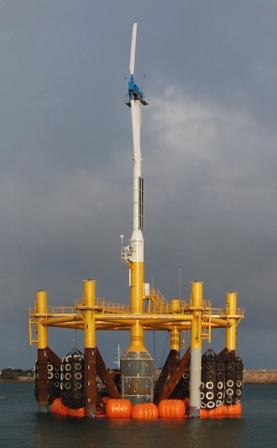
Now, into these contested seas sails a new developer with a proposal designed to please all: Blue H Technologies, which has staked out a parcel of seabed for a wind farm 23-miles off Nantucket, well beyond the sight of sling-sipping vacationers. And the technological solution enabling Blue H to site a wind farm in water 167 feet deep? Floating wind turbines.
Blue H’s proposal struck some partisans of the Cape Wind debate as a fraud. See this rant from Cape Cod Today, for example, suggesting the Blue H is an underhanded scheme by Ted Kennedy and other politicos to protect their waterfront viewscapes.
However, as my report headlining MIT TechReview.com today shows, Blue H is for real. The Dutch firm is well on the way to demonstrating a novel application for conventional oil and gas platform technology, and it has competitors just as intent on proving the economic and energy potential of deepwater wind.
A sudden zeal to go fossil-free is fueling plenty of hype in renewable energy circles. That hype hits its shrillest notes in the promise of the least cost-effective of the major renewable options: photovoltaics that convert sunlight directly into electricity.
Consider the holiday season gush around silicon-valley PV startup Nanosolar. The firm was founded to demonstrate a truly novel nanotech-inspired design, but is now commercializing comparatively conventional CIGS thin-film PV. Nevertheless, after Popular Science crowned the company’s “Powersheet” as its innovation of the year, articles on this “game-changing technology” multiplied to fill the slow late-December news season.
Never mind that Nanosolar declined to disclose the most important spec on its product: the efficiency with which it converts sunlight to electricity. Without the efficiency, it is impossible to analyze the product’s economic potential.
The solar rot, however, goes deeper than venture capital-fueled startups. My latest feature for IEEE Spectrum — “Solar-Cell Squabble” — shows that some scientists may also be overstating their advances. And they may be doing so in peer-reviewed reports in top journals such as Science and Nature.
Don’t get me wrong. I’m a big fan of solar energy, in all of its myriad forms. I’m ecstatic to see research dollars once again pouring into solar energy. But let’s make sure those dollars don’t pour back out via the sink, or walk out the rear exit.
The ZEV directive requires car manufacturers to market ultraclean and emissions-free vehicles (or buy credits earned by others making such vehicles). The California Air Resources Board decision yesterday reduces the quantity of emissions-free battery or fuel cell vehicles mandated for the 2012-2014 period from 25,000 to as few as 5,357, responding to automaker concern over the cost and reliability of EV batteries and fuel cells.
CARB says this reduction is offset by new rules recognizing the transitional value of plug-in hybrids. The agency claims that the ZEV rules will require automakers to produce 66,000 plug-in hybrids over the 2012-2014 period, thereby mainstreaming electric vehicle components and charging infrastructure that will hasten the day when the pure EVs go mainstream.
However, Plug In America claims the new rules will actually lead to 18,000 less plug-in hybrids over 2012-2014. It’s difficult to say who is right because the ZEV rules are devilishly complex, and automakers are not currently required to disclose how many credits they have banked (a transparency gap the new rules would fix).
Plug In America charges that California legislators should take back responsibility for driving electrification of the automobile, but ironically one of their proposals seems to affirm the very battery qualms underlying CARB’s revisions. Specifically, Plug In America proposes that legislators free manufacturers from providing the 15-year, 150,000-mile warranty CARB requires for hybrid batteries. That hardly seems like a recipe for driving mass confidence in the electric car.
Thispost was created for Tech Talk – Insights into tomorrow’s technology from the editors of IEEE Spectrum.
That’s the headline that an editor at MIT Technology Review popped onto my story (topping TechReview.com today) on a project to turn Boulder, Colorado’s power system into the world’s smartest grid. The punch phrase would be pronounced ‘schmahten up’ by my old boss at Ferranti-Dege, a professional photo shop in Harvard Square that finally gave way to the digital revolution and Boston’s soaring property values just a few years ago. And Bill’s sentiment would fit perfectly: You know how to do it right, so get to it.
Electrical engineers have the wherewithal to install smart meters and otherwise upgrade our power grids to deliver power more efficiently and accomodate intermittent but clean renewable energy. As utility IT chief Mike Carlson told me this week: “We’re not talking the Jetsons or Star Wars here.”
What is needed–and where Carlson’s project for Xcel Energy truly innovates–is a way of getting the required demonstrations paid for. To date conservative public utility commissions in state capitols around the country have been relucant to finance much-needed investments in grid modernization, without the kind of proof that Xcel hopes its Boulder project will provide.
That’s an emerging theme: Public utility commissions have immense control over investment in power infrastructure, but have a bottom-line mentality that tends to override environmental concerns. This is one factor delaying adotpion of coal gasification technology for power plants. The coal gasification or IGCC power plants are cleaner-burning but more expensive to build up front and, barring an EPA mandate to even consider the technology, public utility commissions have been relucant to approve the extra expense.
Two reports of ocean-crossing innovation breathe new life into the old addage that necessity spurs invention. The first is the completion last Thursday of the maiden 11,952-nautical mile voyage of a sail-assisted cargo ship. According to Hamburg-based Beluga Skysails, the tug of the 160-square meter kite saved about $1,000/day worth of bunker fuel.
The second proof of our capacity to think innovatively is Japanese adventurer Kenichi Horie’s departure from Hawaii on a wave-powered boat. Yes, that’s right: equipment Horie’s boat absorbs the vertical motion of waves hitting the bow into dolphin and converts this energy into dolphin kicks at the stern to propel the boat forward. He figures he’ll reach Japan, 4,400 miles away, by about June. A novelty, you might say? I guess many people said the same thing to Beluga Skysails.
I’ve often said that the accelerating exploitation of Alberta’s tarsands is living proof of peak oil. These innovations are living proof that human society can adapt to a carbon-constrained world.

 Carbon-Nation returns today from a month-long hiatus that took editor Peter Fairley on a fact-finding mission to North Africa. More to come on that. For instant gratification we refer you to the latest installment of Renewable Energy World’s Inside Renewable Energy podcast, released this morning. Topping this week’s podcast is an interview with C-N’s editor on the growing acrimony within organic photovoltaics research over the credibility of recent reports touting record power output from this promising next-generation approach to solar power.
 :
:  :
:  :
:  :
:  :
:  :
:  :
:  :
:  :
:  :
: