Rethinking Energy Deregulation’s Green Dividends

The European Commission proposed new rules today to break up Europe’s energy monopolies and I must say it makes me wonder whether they aren’t trying to fix something that isn’t broken–at least as far as the environment is concerned.

Commission President José Manuel Barroso told reporters today that: “We need a common European response to combat climate change, to achieve greater energy security and provide abundant energy at a fair price for citizens. This is only possible if we have a competitive gas and electricity market.” But that assumed connection between responding to climate change and competition is worth questioning.

Certainly, the EC’s proposal to take control of power transmission grids out of the big utilties’ hands seems a good bet, giving innovative new players such as wind farm developers a better chance of gaining access to the grid. In fact, the European Wind Energy Association says the EC should go farther and force utilities to sell their interest in power transmission. “Allowing power generation companies to own the transmission grid makes as much sense as allowing an airline company to own the sky,” comments EWEA CEO Christian Kjaer in a press statement issued today.  

However, one of my conclusions from reporting on China and the U.S. is that the increasing drive towards deregulation–in particular the conversion of utilities from state-owned entities into profit-focused firms–can make it more difficult to drive change in energy technology. As I reported in Part II of my feature for Technology Review, China’s Coal Future, China’s move to a more open economy hampered efforts to deploy that countries first gasification coal-fired power plant. 

In 1993, China’s leading power engineering firm, China Power Engineering Consulting in Beijing, began designing the country’s first gasification power plant for the monopoly utility of the era, the State Power Corporation. This demonstration plant was to be the beginning of a transition to cleaner coal technology. Instead, the plant went on a roller-coaster ride to nowhere. The project was delayed by cost concerns in the mid-1990s and then revived in the late 1990s, only to be cut adrift after 2002 by the breakup of the State Power Corporation.

Anyone who’s breathed the air in China recently knows that was an immense lost opportunity.

add to del.icio.us : Add to Blinkslist : add to furl : Digg it : add to ma.gnolia : Stumble It! : add to simpy : seed the vine : : : TailRank

Cleaner Coal is Cheap, But So Are Renewables

When the U.S. Energy Department under an adminstration like Bush/Cheney tells you cleaning up our energy system is cheap, you know the walls are coming down. This summer Carbon-Nation made the case that Cleaning Up Coal is Cheap thanks to affordable technology for capturing and sequestering carbon dioxide. Now the Energy Department’s Energy Information Administration (EIA) is projecting that the cleanest energy option available — renewable energy such as biofuels and wind power — should also fit nicely in our budgets. Ironically the EIA analysis responds to a request by Republican environment critic James Inhofe, a Senator from Oklahoma.

EIA’s analysis examines how mandating 25% renewable power and fuels by 2025 would change U.S. energy consumption and economic growth (see Energy and Economic Impacts of Implementing Both a 25-Percent Renewable Portfolio Standard and a 25-Percent Renewable Fuel Standard by 2025). They conclude that such a mandate would significantly cut U.S. greenhouse gas emissions: In 2030 carbon dioxide emissions would be 14% lower than 2005 levels, with emissions from electricity production specifically dropping 22%.  drop in emissions from the electricity sector and a 14-percent decrease in the transportation sector.

Yet the cost is negligible: a projected GDP hit of one-eighth of one percent and a rise in expense to consumers of one-tenth of a percent. Plus EIA’s analysis assumes that the mandate would spur fairly modest improvements in energy technology, a highly conservative assumption that one can hope Will prove false.

Cause for even greater optimism: the U.S. Senate’s version of the energy bill currently being negotiated in Congress establishes a 25% renewables mandate by 2025 as a national energy goal. Renewable energy is not perfect — as our recent discussion of Wind Energy’s Problem Child in the Bay Area shows — but it sure beats the status quo.

add to del.icio.us : Add to Blinkslist : add to furl : Digg it : add to ma.gnolia : Stumble It! : add to simpy : seed the vine : : : TailRank

SEJ 2007 at Altamont: Wind Energy’s Problem Child

I’m back from the ultimate professional recharge: the Society of Environmental Journalists’ annual conference, held south of San Francisco last week on the leafy Stanford University campus. This week I’ll be giving highlights from a packed agenda exploring environmental technology, politics, culture and science.

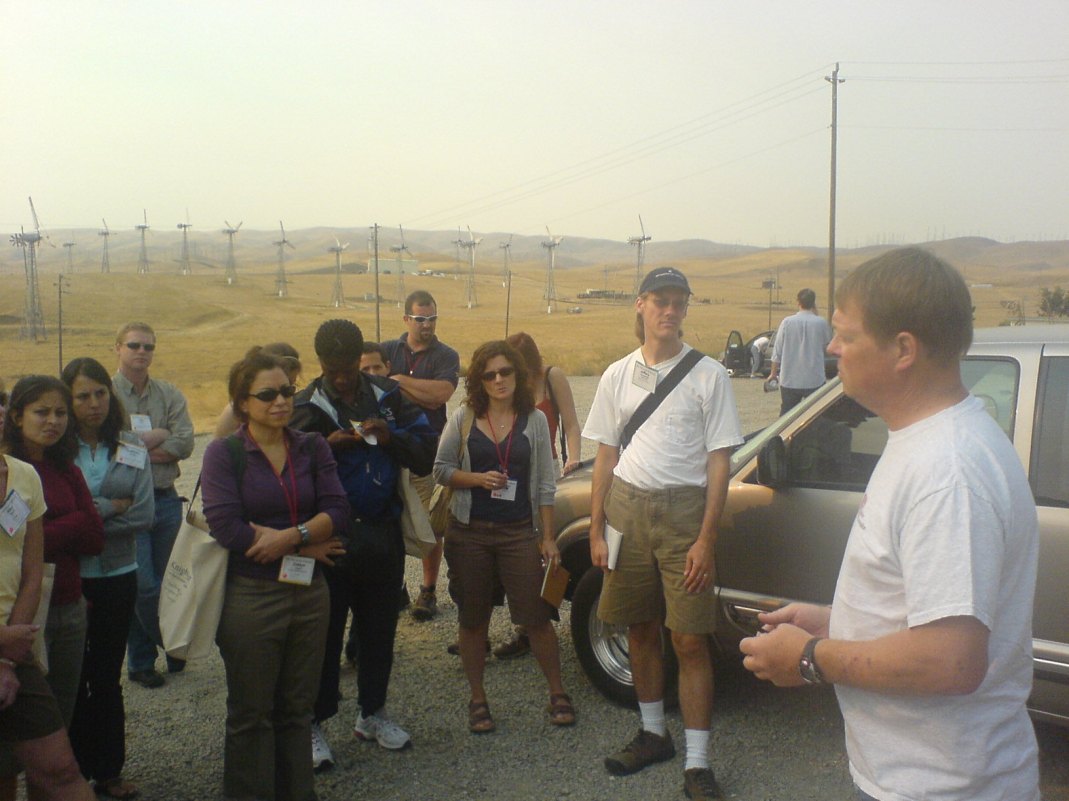
Highpoint #1: A trip across the Bay to Altamont Pass, where cool air sucked over coastal hills by the rising heat of California’s vast Central Valley spins some 5,200 wind turbines spanning a roughly 6×8-mile area. It was at Altamont that the U.S. wind power industry took flight in the early 1980s, as developers rushed to install largely untested technology to cash in on handsome federal and state tax credits. By 1985 California 80% of the world’s wind power capacity, and much of it was at Altamont. (The turbines in the photo are circa 1984). SEJ conference tour on California’s Altamont Pass

That early lead was handed to Europe as the U.S. fell back into reliance on imported oil and other fossil fuels. “Because of a whole raft of poor policy decisions both here and in Washington, we blew it,” says Tom Gray, a veteran of the 1980s wind boom and currently communications director for the American Wind Energy Association.

But the U.S. wind industry itself seems to be blowing another opportunity here at Altamont: the chance to clear its reputation as a bird killer. Altamont is almost certainly the world’s most deadly wind farm for birds. Collisions with wind turbine rotors and poles kill an estimated 70 golden eagles a year in an area big enough to support just one nesting pair, plus significant numbers of burrowing owls, red tailed hawks, and American kestrels. Buildings kill hundreds of times more birds than wind turbines, but the ongoing slaughter of endangered birds at Altamont remains a damaging black mark on an otherwise green industry. 

This winter a lawsuit by environmental organizations and scientists required Altamont’s wind turbine operators to cut the bird kill in half by 2009 by taking down a few hundred of the most dangerous wind turbines. Unfortunately, at least from what the SEJ journalists saw on the ground, the deal isn’t being implemented. (For a detailed if pointed telling of the settlement story, see “Tilting at Windmills” by the Ecology Center in Berkeley, CA.)

add to del.icio.us : Add to Blinkslist : add to furl : Digg it : add to ma.gnolia : Stumble It! : add to simpy : seed the vine : : : TailRank

Re-embracing the Grid

eagle-island-2007-145.jpgOne month ago (a thoroughly inexcusable gap for a webjournal) I began my annual migration to an island-bound off-grid retreat, promising to make up for my absence by bringing Carbon-Nation fresh insights on low-energy living.

First realization: Energy efficiency is a tough sell. People want energy. Fellow islanders, suddenly attuned to energy like the rest of North America, had trouble reconciling the fact that I write about energy and live in the most primitive house on the island. Yet energy conservation is the largest and cleanest opportunity we have to radically reduce our use of energy, far better than switching to new forms of power generation which inevitably bring their own risks and environmental impacts. The challenge is exciting people (including my editors).

Second insight: Our energy use on the island has expanded more than I had realized. Like our neighbors we have a propane stove and fridge, but we are the last holdouts without on-demand electricity (others use solar and gasoline generators while we rely on batteries and kerosene) and we still use an outhouse and a rain-fed cistern connected to a hand pump for plumbing (others have solar-pumped water systems and there are even a few toilets). Nevertheless, over the past decade we’ve added a chain saw and a small boat, bringing gasoline into our energy mix and thus plugging in a little tighter to a fossil fuel distribution ‘grid’ stretching from here to Iraq.

Mea culpa: I did plug in to a friend’s solar system once or twice to recharge a pocket PC and cell phone and, yes, to check my email. In 2003 I was ensconced in my island paradise in August, missing both the largest blackout in history and calls from CNN looking for on-air commentary on the state of the grid and the technological options for modernizing it. I didn’t want to miss the boat again. 

Three: Upon departing, I described the rain-fed cistern and hand pump as our cottage’s most advanced technological feature. I had overlooked the kerosene lamps, whiUncle Dave burning fuelch burn amazingly clean thanks to their glass chimneys. The contrast with what the off-grid villagers I visited in Bolivia’s Cordillera Real for “Lighting Up the Andes” is stark. Many used a kerosene-filled tin can with a wick stuck into the top producing a thick stream of soot.

A reminder: Huge efficiency and health gains await if we can banish such primitive lighting and open-burning stoves from the developing world.

Which brings me to Jerry’s comments during my absence: Jerry asked why North Americans surpass everyone else in energy consumed per capita, and what strategies we can employ to turn this around. Observing that Ford, Daimler-Chrysler and GM sell far more efficienct vehicles in Europe, the higher use of ductless AC in Asia (what is that?), and Europe’s tankless water heaters, Jerry says he is “beginning to believe that the technology required to significantly reduce our per-capita consumption is proven, established, even old.” How true. The glass-chimneyed kerosene lamp is but one more example.

Stay tuned for a proper response to the “what to do” portion of Jerry’s comment. Or start writing!

add to del.icio.us : Add to Blinkslist : add to furl : Digg it : add to ma.gnolia : Stumble It! : add to simpy : seed the vine : : : TailRank

Going Off-Grid

Eagle Island, METhis weekend I begin my annual migration to an off-grid cottage whose most advanced technological feature is a rain-fed cistern connected to a hand pump. I hope to resist the urge to use the Internet (technically feasible but not easy), thus returning to Carbon-Nation with fresh insights from both the alternative manner of existence and the uninterrupted stretches of deep-thinking it delivers. Go ahead and chime in with deep thoughts of your own about our use of energy and options for rethinking it.

Solar power records smashing like pumpkins

Wow. What a time for solar energy. On top of recent gains in plastic and thin-film photovoltaics the University of Delaware now reports the world’s most efficient solar cell at 42.8% — if the finding is confirmed it will boost high-end PV output an incredible 2.1% over the previous record set by Boeing-subsidiary SpectroLab last December (see my presentation of their approach at MIT Technology Review: “Ultra-efficient Photovoltaics”).

The University of Delaware advance is notable for (a) the incredible consortium assembled to bring together the multiple PV cells employed in the record-breaking cell, (b) the role of government funding — in this case its dollars from DARPA that were yanked out of the hands of another set of researchers developing plastic solar cells, and (c) the comeback it represents for Allen Barnett, the University of Delaware scientist leading the effort.

Barnett founded what was once the most successful solar U.S. solar producer, AstroPower, which made its mark producing photovoltaics from recycled silicon wafers. The firm took a blow when the tech bubble burst and semiconductor manufacturing slowed, causing a shortage of recycled wafers, and was then destroyed by an accounting scandal. GE picked up AstroPower’s assets in bankruptcy proceedings in 2004 — adding one more piece in the energy giant’s sweep into renewable energy (see “The Greening of GE” for more on that story).

add to del.icio.us : Add to Blinkslist : add to furl : Digg it : add to ma.gnolia : Stumble It! : add to simpy : seed the vine : : : TailRank

Solar Redux: Thin Film’s Time in the Sun

Power-plant scale installations of solar panels from photovoltaics developer First Solar provides a nice follow-up to a story I wrote for IEEE Spectrum five years ago, when BP’s solar subsidiary cast a pall over solar energy by terminating its investment in the same technology. The followup on First Solar’s perserverance and success ran this morning on the MIT Technology Review website (see “Thin Film’s Time in the Sun”).

Worth noting that this story affirms the observation we made last week that photovoltaics technology is advancing across the board thanks to sustained investment. In First Solar’s case the sustenance came in the form of a $250 million cash infusion from Walmart founder John Walton.

add to del.icio.us : Add to Blinkslist : add to furl : Digg it : add to ma.gnolia : Stumble It! : add to simpy : seed the vine : : : TailRank