WSJ Calls China’s Electric Bicycle Craze a Killer

Mainstream media have finally noticed the electric bicycle craze that’s swept China — where there are now 120 million e-bikes on the road — and is now making inroads in Europe and North America. This weekend the New York Times examined what it called China’s “accidental transportation upheaval”, and the Wall Street Journal devoted a coveted cover slot to China’s e-bikes in January. The latter, unfortunately, paints an unduly dark picture of this energy-efficient and relatively affordable urban transport option.

“Because they are so silent, fast and heavy they’ve become a traffic menace,” says WSJ China correspondent Shai Oster in the video that accompanies his piece on e-bikes, unwisely shot while riding one through Beijing. Oster says this is why there is a “new backlash” against e-bikes, with various levels of Chinese governments trying to squelch the e-bike. What I see is ongoing harassment that China’s e-bike community has endured for the past 6-7 years.

Early on the official complaint was that rapid replacement of the lead acid batteries most Chinese e-bikes carry  fueled pollution (According to the Times a typical Chinese e-bike uses five lead batteries in its lifetime, each containing 20 to 30 pounds of lead). Today the complaint is that deaths have “soared” from 34 in 2001 to over 2000 in 2007 (not too surprising given that e-bike use was exploding exponentially over that period). My take — reinforced by alternative-transport and urban design activists in China — is that these complaints are a smokescreen for car-oriented industrial and urban planners. Continue reading “WSJ Calls China’s Electric Bicycle Craze a Killer”

GM’s Feisty and Embarrassing Vice Chairman

“Once again, Bob won’t get the job.” That was the definitive prediction this weekend by Automotive News, the industry’s journal of record, on GM vice chairman Robert Lutz’s chances of being named CEO [link may require subscription]. Yesterday they were proven right when GM’s acting CEO, GM chairman Ed Whitacre, announced that he would continue permanently in the position. What they got wrong, however, was why Lutz was unfit for the top job.
Automotive News let Lutz speak for himself, arguing that at 78 years old he was too “geriatric” for an ailing automaker in need of rejuvenation. That logic flies in the face of Whitacre’s logic that what GM needs most, after ousting two CEOs in 2009, is stability. After all, Lutz has served in top product development and marketing roles for GM since 2001, and previously held top jobs at Chrysler and Ford.

What makes Lutz the wrong man at the wrong time is that he rejects the intensifying concerns for sustainability that now drive automotive markets and innovation worldwide. At the Detroit Auto Show last week Lutz held forth on climate science with the Sydney Morning Herald, explaining that Earth is being cooled by a dearth of solar flares rather than warmed by greenhouse gases from cars and other fossil fuel-burners:

“All I ever say is look at the data, look at the empirical evidence…Katrina was six years ago and we have yet to have the next hurricane.” Continue reading “GM’s Feisty and Embarrassing Vice Chairman”

Nissan Joins the EV Charging Market

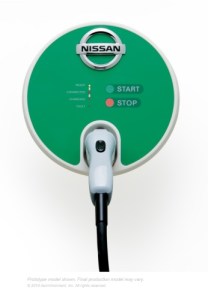
AeroVironment's Nissan-branded home EV chargerNissan doesn’t plan to leave buyers of its battery-powered LEAF sedan, which goes on sale in December, to their own devices when it comes to vehicle charging. Nissan will offer a home-charging program to LEAF buyers which will start with an electrician visiting the buyer’s home to, among other things, check the quality of their electrical service, according to an announcement this week at the Detroit Auto Show.
Electric vehicle enthusiasts may poo-poo the practical and technical challenges posed by home-vehicle charging — witness the hostile comments to my coverage of concerns voiced by California such as PG&E and Southern California Edison that clusters of EVs could burn out block-level power circuits (see “Speed Bumps Ahead for Electric Vehicle Charging”). But Nissan, like the utilities, is leaving nothing to chance.

The idea is to make sure that infrastructure-induced challenges don’t detract from the on-street excitement of driving an EV, according to a Nissan spokesperson quoted in a BNET post from the Detroit show today by New York Times clean-car blogger Jim Motavalli:

“We didn’t want to say, ‘Here’s your car, now you’re on your own.”
— Mark Perry, a Nissan spokesman handling the Leaf introduction

Continue reading “Nissan Joins the EV Charging Market”

Tata and Berkeley Frigid to MDI’s Air Cars

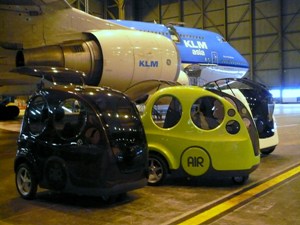
Air France and KLM agreed to test a dozen AirPods from spring 2009 but still await delivery from MDI

Indian carmaker Tata Motors is voicing concerns about the range and durability of the compressed-air powered minicar technology that I critically analyzed for IEEE Spectrum this month (see “Deflating the Air Car”). Tata Motors invested in French air car developer Motor Development International (MDI) in early 2007, but yesterday Mumbai-based news source DNA reported that Tata sees ongoing issues with MDI’s technology.

Tata already sells vehicles that run on gasoline, compressed natural gas, and liquid petroleum gas and is launching a battery-powered sedan in Europe. However, Tata Motors’ vice-president for engineering systems S Ravishankar apparently told DNA Money that the company’s efforts to add air-powered cars to its fleet are hung up by range limitations:

“Air is not a fuel, it is just an energy carrier. So a tank full of air does not have the same energy as a tank full of CNG. Any vehicle using only compressed air to run would face problems of range.”

When asked whether this means that “the ‘Air Car’ project [is] off?,” Ravishankar declined to comment. Instead, Ravishankar added that excessive cooling of the air car’s pneumatic engine is also presenting a challenge. Continue reading “Tata and Berkeley Frigid to MDI’s Air Cars”

Low-Carbon Fuel Rules

California is about to add to its record of leadership on clean energy policy with its innovative Low-Carbon Fuel Standard that goes into effect January 1. We highlight the program and its likely impact on alternative energy sources for transportation today at MIT TechReview.com in “Low-Carbon Fuel Rules”. As the tagline states, “California is about to implement a standard to boost cleaner fuels and punish the rest.”

One point is that California’s LCFS may not deliver the knock-out blow to Canada’s carbon-intensive tarsands that many climate change activists continue to hope for. Gasoline and diesel fuel refined from the tarsands’ asphaltine bitumen may escape being banned if its producers emphasize energy efficiency according to UC Davis’ Daniel Sperling.

Another observation I’ll be following up is the cohesiveness of the biotech industry. In the face of regulatory innovations such as the LCFS that would disadvantage corn ethanol production and advantage cash-hungry innovators developing more carbon-smart advanced biofuels, the latter seem to be quietly defending the status quo.

Then there’s the California standard’s nuanced approach to diesel, which is not addressed in the TechReview piece but which Carbon-Nation spotlighted last summer. The short take is that the LCFS mandates separate and equal reductions in the carbon footprint of the gasoline and diesel fuels sold in California. That approach eliminates the possibility that diesel use will be incentivized as an alternative to gasoline. The reason? California regulators believe that even today’s ‘clean diesels’ release more than their share of soot, which is a major cause of premature mortality and also a potential contributor to climate change in its own right.

We explore the climate challenge and opportunity posed by soot in the September issue of Discover magazine. See “The Easiest Way to Fight Global Warming?”

add to del.icio.us : Add to Blinkslist : add to furl : Digg it : add to ma.gnolia : Stumble It! : add to simpy : seed the vine : : : TailRank

Could Mechanics Best Power Electronics in EVs?

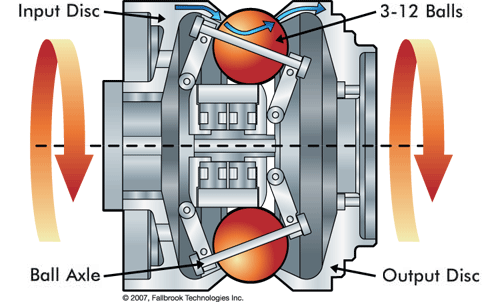
NuVinci CVT cutaway Credit Fallbrook TechnologiesCould smarter mechanical transmissions knock power electronics out of wind turbines, providing a cheaper and more efficient means of coupling the variable energy from ever-shifting winds to the regular waveform of AC power on the grid? They could according to my reporting in MIT’s TechReview today on Viryd Technologies’ bid to exploit continuously variable transmissions (CVTs). If mechanics reclaiming territory ceded to electronics sounds like a technological step backwards, here’s an even more heretical corollary: the same CVTs could also squeeze the power electronics out of electric vehicles (EVs).

That’s the argument put forward by Rob Smithson, CTO for Viryd parent company Fallbrook Technologies and one of the inventors of its clever CVT (dubbed NuVinci in a tip-of-the-hat to the Italian polymath who first dreamed up the CVT concept). “If you look at cost in large car-replacement type EVs today, the cost gets dominated by the battery pack and the motor controls. There’s an opportunity to knock out one of those two with an infinitely variable transmission,” insists Smithson.

Most EV elaborations today, says Smithson, rely on the electric motor to meet the entire dynamic performance envelope of the vehicle, from vehicle speed to torque demand — a feat made possible by hefty power electronics. Swap in a CVT to handle the vehicle speed, however, and the electric motor can operate as a fixed speed variable torque device. “When that happens there’s a tremendous opportunity there to simplify your power electronics and a lot of the attendant cost that goes with that,” he says. For more details, see Fallbrook’s white paper on increased power, speed and range observed in a NuVinci-equipped electric scooter. Continue reading “Could Mechanics Best Power Electronics in EVs?”

German Election A Likely Reprieve for Nuclear

Germany’s election this weekend could save nuclear energy’s neck, at least in Europe, thanks to the decisive re-election of Chancellor Angela Merkel and her center-right Christian Democratic Union. It may not be enough to secure the nuclear industry’s troubled renaissance, as poster-child projects bog down in delays and cost overruns. But Merkel could keep Germany’s reactors operating for another 15 years or so beyond the 2022 deadline set under her predecessor and erstwhile coalition partners, the Social Democrats.

“German poll gives mandate to delay nuclear phaseout” is the clarity with which Reuters presented the election’s energy implications in an article yesterday. That is surprising, given the extensive coverage given by German media to a supposed upwelling of antinuclear sentiment in the weeks leading up to the election. Continue reading “German Election A Likely Reprieve for Nuclear”